What AI-Native Looks Like
How I use AI with 20 years of engineering experience
以下正文同步自 Hacker News,版权归原站所有,已转换为易读排版。
Programming
Software Engineering
Reading
Technology
Here’s What AI-Native Looks Like
How I use AI with 20 years of engineering experience
Fayner Brack
9 min read·
3 days ago
--
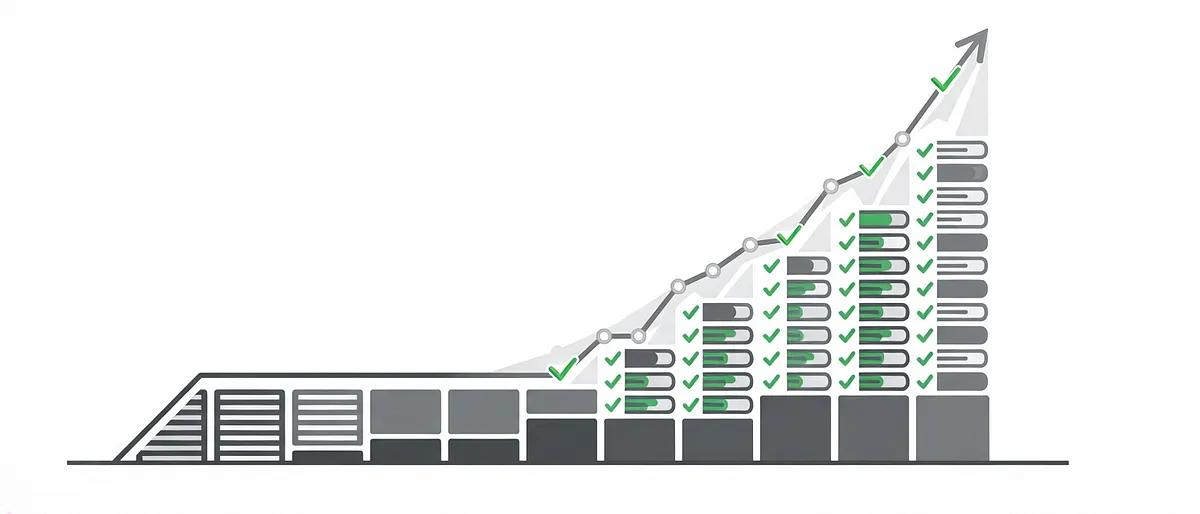
Upward trajectory built on stable deployment pipelines and testing
Want to come back later? Save this to readplace.com.
I remember the first software I developed in an actual company. It was circa 2006 when I implemented my website for my first client. It used iframes and crazy colors. When I showed the prototype to the client they unexpectedly said they had “given up” on building a website.
Almost half a million karma on Reddit and thousands of submissions on HackerNews later, I decided to create a SaaS for my hand-made 10 year-old read-later system so everyone could use it too. I called it readplace.com.
Here are the first commits: https://github.com/Readplace/readplace.com/commits/main/?since=2026-02-28&until=2026-02-28
I’ve been using assisted AI for coding since early 2023, but 2026 is when everything changed and I started using it full-time on Readplace. At the time of writing this, readplace.com has more than 3000 commits.
So yes I fully jumped on the AI bandwagon.
Creating a platform like this is not an easy feat, and I’m talking only about the engineering part. Most companies budget multiple feature teams at A$1M/year each just to achieve baseline parity. Alternatively, you can go the other way, use the Startup mindset and differentiate from competition, on a bet the big players will take longer to pivot to what you’re doing than your ability to convince a VC to give you a few millions for something you can’t do by yourself.
The core problem here is that any basic reading tool requires significant development effort just to achieve a baseline. It’s almost like a commodity nowadays. Until you can say “and this is what I use for filtering articles that’s different from everybody else” you need to build the whole read-it-later and reader infrastructure.
Good luck… that is, if you're still living in the past!
I still use my local system until I can fully migrate to Readplace, but my local system is dumb as f***. However, it was built from my real use cases and experience, not speculation from a founder that managed to convince some VC to give them money so they can shoot in all directions in the hope they can get enough hits before they meet their maker.
How my local system works? Oh glad you asked!
Well… quite simple honestly (and that’s why it took 10 years to be where it is):
It still uses “master” branch, so only guess how old this code is
Press enter or click to view image in full size
How the links-automator screen looks like
The first version of this system didn’t even use DynamoDB, it was a submissions.json file in Dropbox 🤣🤣🤣
So yeah in February I jumped on the bandwagon and got a number of Claude 20x subscriptions (now I got some Codex also). With my knowledge of AWS and coding infrastructure + testing and stability guard rails here’s what I managed to achieve in 7 months:
I made the project Open Source so you can see how I do it: https://github.com/Readplace/readplace.com
Join Medium for free to get updates from this writer.
There have been hundreds of production deployments in 7 months. The Actions history in the repo is public, count them yourself. Oh, and did I tell you? I’m the only employee of the company. Also, I spent less than A$5k (Not U$5k, AUD 5k, do the math).
No fancy agent system. No fancy SaaS that promises to simulate employees. Just me, a CLI, and my brain.
The best way to explain using the output of my /insights command:
Start from a plan file, a production log, an error-funnel PDF, or a categorized pile of prod errors — never from intuition. The brief is outcome-shaped and tightly scoped.
An explicit gate: implement this plan without committing. The work runs deep and multi-file (29-, 54-, 56-file changes) while you stay out of its way.
I audit the result and fix the one wrong detail precisely — a radio button that should be a dropdown, queues > 0 that should be > 1, identity coupled to a display label, the reserved word "tier".
Before I accept it: screenshots, emulator/simulator pixel diffs, mutation-verified tests, a green workspace gate — and proof that any red check is a pre-existing flake, not your regression.
The one order — commit and push it all — then watch CI to green, verify the deploy on staging and prod, and file follow-ups. The session ends at "verified live," not "code works."
Low messages per session against enormous autonomous Bash volume. I define the boundary and audit the result — you don’t micromanage the route. Often several sessions run at once.
I distrust unverified claims and push back hard: a “passing” check that was a misread piped exit code, a wrong “+19.9%” measurement, a greyscale-contrast claim — all retracted only after I pressed.
I tolerate long silent execution but not evasive conclusions. When an answer hedged with “both, in different places,” I demanded a straight yes/no before accepting it.
I ask for the business case, cost annotations, and RCA alongside the change — one whole session was an evidence-backed TypeScript adoption case, reframed until the data supported it.
Removal is first-class, fully-verified work: share-expiry stripped across 54 files, the feature=audio toggle across 12 — mapped, swept, and shipped green like any feature.
Heavy Skills + Workflows and multi-agent triage/deep-read pipelines — I encode a procedure once instead of re-explaining it, and treat implementation as cheap and reversible.
Now imagine a funded company, draining the money from an unfortunate VC, starting today, paying multiple feature teams A$1M a year each to have the capacity build a system that’s stable and predictable. A year of burn before they know if people like it or not.
I shipped it in 7 months. Alone. For less than A$5k.
Seems like years of progress, but I'm counting the clock in months… and this is certainly just the beginning 🤭
If you liked this, you might like Readplace, built for exactly this kind of reading.
Thanks for reading. If you have some feedback, reach out to me on LinkedIn, Reddit or by replying to this post.
正文由 探How 从来源站点 RSS 同步,内容未经改写;遇到排版缺失或需要图片、视频时请以原文为准。