Independent Assessment of AI R&D Acceleration at Anthropic in October 2026
A key concern is that acceleration from the use of AI could start to compound, as the development of more capable models leads to further acceleration. As we describe below, we did not identify any clear bottlenecks (li…
以下正文同步自 Hacker News 最新,版权归原站所有,已转换为易读排版。
A key concern is that acceleration from the use of AI could start to compound, as the development of more capable models leads to further acceleration. As we describe below, we did not identify any clear bottlenecks (limited inputs that would prevent further growth) or steep diminishing returns to further scaling that would get in the way of such compounding acceleration, though our understanding evolved several times over the course of this assessment, and we have significant uncertainty. Because of this, we believe there is a significant risk that further capabilities progress could lead to even faster acceleration over the coming year.
In this section, we summarize the key empirical findings from our Full Report that we can describe without revealing redacted information (see the process section for more details on what was redacted).
Terminology: We describe growth as annual multiples and acceleration as a ratio of growth rates.
We use “acceleration” to refer to an increase in the rate of growth, such that a 2x acceleration means that 2 years of historical progress is made in 1 year.
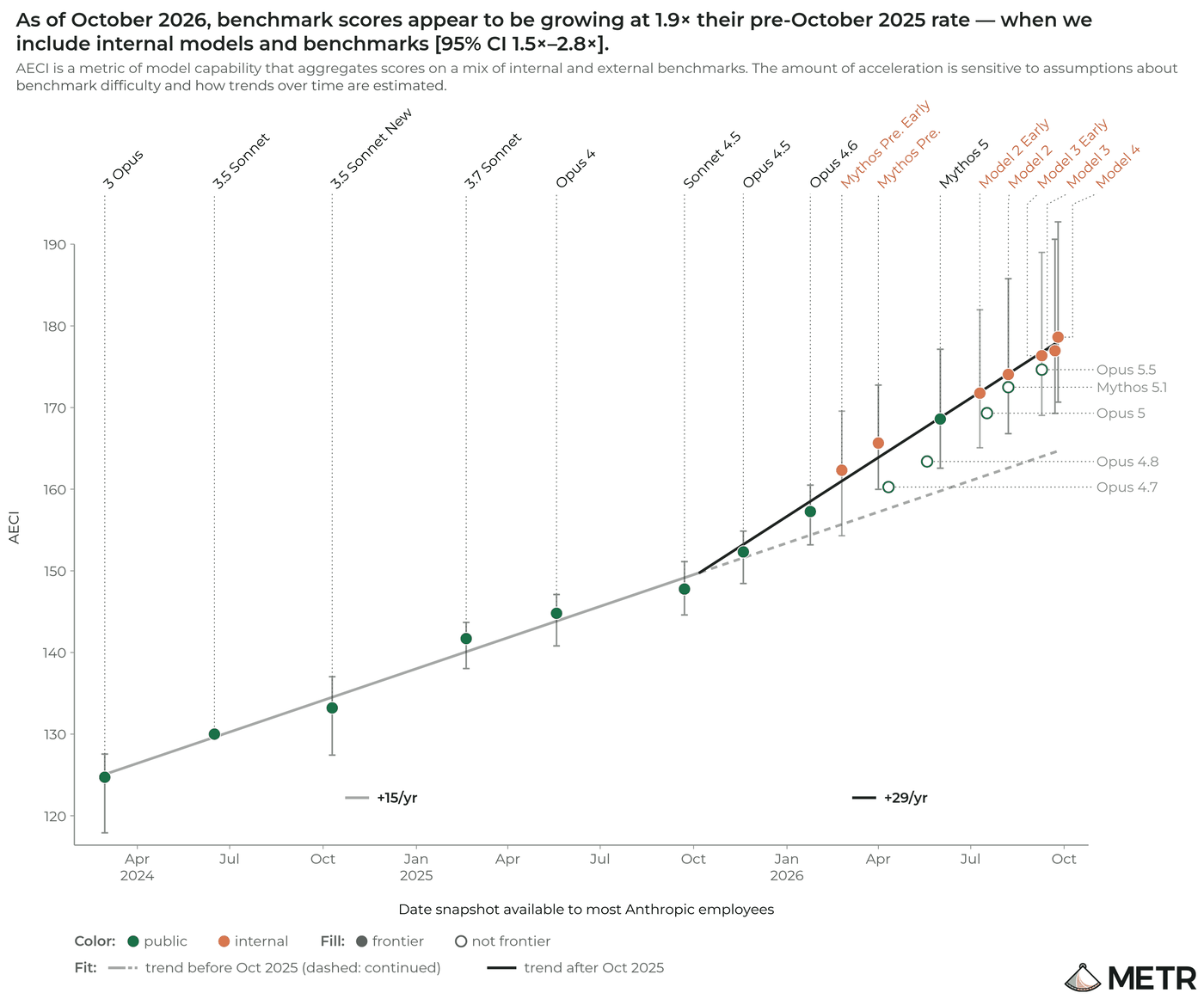
If AECI’s historical trend was 15 points/year, then increasing to 30 points/year implies an acceleration rate of 2 (it takes 1 year to achieve 2 years’ progress at the old rate). For an exponentially growing variable, the acceleration rate is the ratio of growth rates. If a variable is growing 3x/year, then to make 2 years of progress in 1 year the growth rate must be (32)x/yr = 9x/yr (and acceleration can be written as ln(9)/ln(3) = 2).
Since October 2025, benchmark scores for internal models have been growing at around twice their historical rate.
Benchmark scores of Anthropic’s models, as measured by AECI (Anthropic’s version of the Epoch Capabilities Index), have accelerated 1.9x [95% confidence interval: 1.5–2.8x] since October 2025. Put another way, Anthropic appears to have made as much progress on benchmarks in the past year as they did between October 2023 and October 2025 (roughly, Claude 2.1 to Sonnet 4.5):
Our estimated acceleration is greater than that reported in the Haiku 5.5 system card (1.7x) primarily because of the inclusion of data on newer unreleased models, explained further below.
We investigated the robustness of these results to different choices of benchmark inclusion, model dating, model inclusion, and benchmark saturation. Robustness analyses find acceleration rates between 1.1x and 2.9x. We would be surprised if the true evolution of benchmark scores (e.g. as measured by an improved version of AECI) showed no acceleration or acceleration above 3x. See our appendix section for details.
The acceleration is not driven by an acceleration in the scale of training compute.
We received convincing evidence that the acceleration was not due to an acceleration in the scale of training compute. Further details on this evidence were redacted.
Interviews and surveys are consistent with AI usage driving this doubling in the pace of capabilities progress.
We have many lines of evidence relevant to AI’s contribution to progress in different parts of the model training pipeline, including interviews, self-reported uplift, headcount, lines of code, experiment usage, and qualitative reflections from leadership. We highlight three important unredacted sources.
First, both METR and Anthropic interviewed many researchers in detail about the degree of overall acceleration in their area of work attributable to AI use (see details in the appendix below). Our overall impression was a quite wide range of estimates, but centered around a 2x acceleration. Some quotes, with sensitive details redacted, are in the appendix.
Second, Anthropic also shared data on self-reported uplift due to AI from a variety of sources. The most recent data is from a series of Slack polls, where staff use reactions to vote on their estimated speedup from the most recent model at the time. We consider this to be only very loose evidence, as the responses reflect low-effort consideration. Nevertheless, we observe consistent growth in these self-reports, and very high levels (reaching 12x in October 2026), as shown in the chart below.
Note that individual uplift/speedup estimates do not correspond to acceleration rates. Sustaining a particular growth rate in outputs like model capabilities generally requires a similarly sustained growth in inputs like labor and/or labor productivity to overcome diminishing returns. Achieving a significant acceleration in the overall rate of progress generally requires a significant acceleration of these inputs. We thus care most about whether we see a large change in the growth rate of individual uplift, not the absolute level. Our more detailed analysis of what rate of growth in individual uplift might be needed to explain our estimated acceleration rates in key areas was redacted.
Third, we understand that AI is not yet able to make highly significant and fully autonomous contributions to the most important parts of the model training process. However, researchers described significant “signs of life” implying such contributions could occur soon, although with substantial variation in maturity depending on the area.
We did not identify any convincing bottlenecks to continued rapid progress.
We did not see evidence for significant bottlenecks in algorithmic progress, training compute, experiment compute, or data that will take effect in the next 12 months. However, our understanding of the status of different bottlenecks changed several times as we got more detailed information, so we are not confident in our current assessment. Anthropic redacted our analysis of a number of specific bottlenecks.
Additional redacted evidence was sometimes hard to interpret, but supports sustained and potentially increasing acceleration.
We investigated a number of internal metrics and methodologies for measuring acceleration in key areas of the model training pipeline. This included evidence of progress on benchmarks and metrics of algorithmic efficiency and overall model strength in pretraining and RL, as well as improvements to compute utilization, inference efficiency and data efficiency. These investigations included attempts to understand:
This internal evidence provided support for there being significant acceleration in Anthropic’s model training pipeline. Some of this evidence indicated that acceleration could be above 2x and increasing over time, but there are significant uncertainties about how to interpret it.
METR staff assessed how much AI is speeding up AI R&D at Anthropic.
METR staff4 (2.5 full-time equivalents) piloted a high-access evaluation at Anthropic to assess the degree to which AI is accelerating AI R&D, and how quickly extreme and risky capabilities may emerge in the near future.
Anthropic lists AI R&D acceleration as a key risk indicator in its Responsible Scaling Policy (RSP). In this assessment, we do not pay special attention to the thresholds set in the RSP. Instead, we try to develop a holistic picture of AI-driven acceleration of AI R&D.
This engagement started in mid-August, and is distinct from the assessment announced on October 15 by Anthropic.
正文由 探How 从来源站点 RSS 同步,内容未经改写;遇到排版缺失或需要图片、视频时请以原文为准。