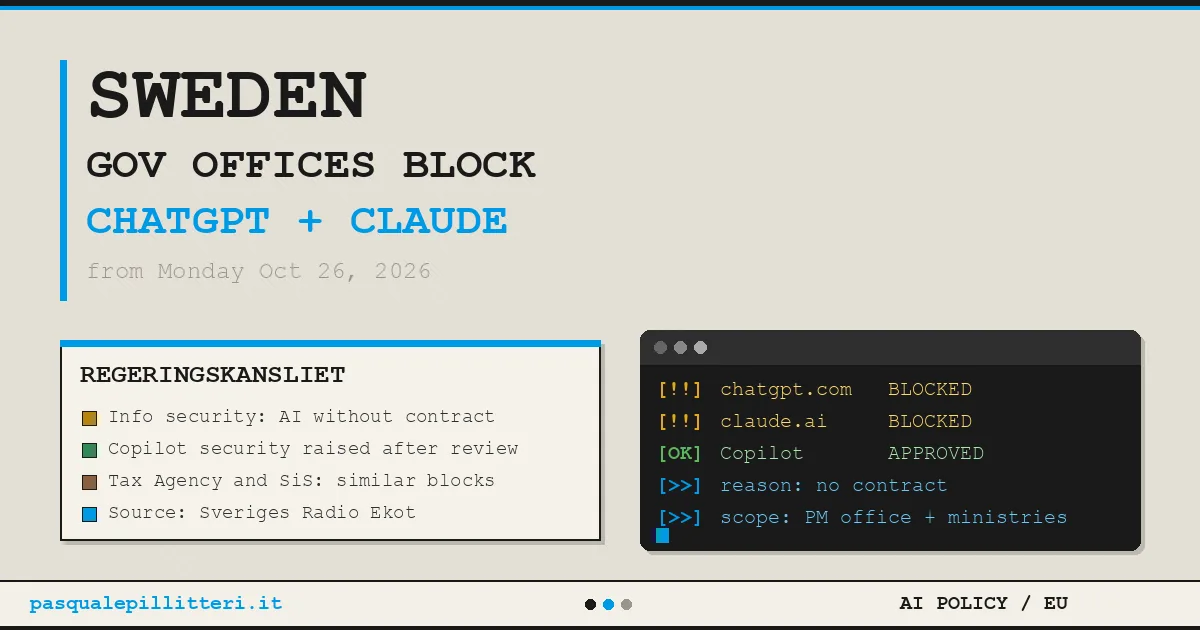
Sweden Blocks ChatGPT and Claude in Government Offices, Copilot Stays
The common thread is the same question. Who answers for the data an official enters into an outside service? Beyond Europe, the answer takes other routes. In the United States, for example, the Department of Homeland Se…
以下正文同步自 Hacker News 最新,版权归原站所有,已转换为易读排版。
The common thread is the same question. Who answers for the data an official enters into an outside service? Beyond Europe, the answer takes other routes. In the United States, for example, the Department of Homeland Security has just banned DeepSeek from civilian federal agencies, on logic tied more to the vendor's country of origin than to the contract.
SVT, Sweden's public television, asked the Regeringskansliet for comment and didn't get one. OpenAI and Anthropic have so far not commented publicly.
Microsoft 365 Copilot can use Anthropic's Claude models in Researcher, in Copilot Studio and in Copilot features inside Word, Excel and PowerPoint, with Anthropic acting as a Microsoft subprocessor. In the European Union, the EFTA countries and the United Kingdom, however, those models are off by default, and only an administrator can turn them on.
That comes from Microsoft Learn's official documentation, updated October 23. When Claude runs inside Copilot, the terms of the Microsoft contract apply (Product Terms and DPA), with one clear limit. Anthropic's models are excluded from the EU Data Boundary, Microsoft's pledge to process European customers' data inside the Union. Since April 3, 2026, European administrators have also had a setting to make Anthropic the default Copilot model in Microsoft 365 apps, as we covered in our piece on the new Microsoft 365 Copilot with Claude Opus 4.8.
The Regeringskansliet hasn't said whether Claude models are active in its Copilot. The paradox is served either way. The same Claude blocked on Anthropic's site could come back in through Microsoft's door, under a different contract. That confirms the Swedish problem is about the data agreement, far more than the model itself.
Microsoft applies a similar logic at home. In June the Redmond company pulled Claude Fable 5 from its own employees because that model requires Anthropic to retain data, outside the guarantees of the Microsoft contract. In the documentation, these “data retention” models stay off by default for every customer, in every region.
There is no common European Union ban on ChatGPT or Claude for public employees. There is, however, a rule that leads to the same conclusion the Swedes reached. Article 28 of the GDPR requires a written contract whenever a vendor processes personal data on behalf of an organization, and a chatbot opened with a private account has no such contract.
On top of that sits the European AI Act, which asks anyone using artificial intelligence systems in a professional setting to know which tools are in use and what risks they carry. That is hard to meet if every official picks their own chatbot to open in the browser.
Stockholm's logic, on reflection, holds for any administration, namely use the AI you bought under a contract and know how to govern. The difference lies in execution. The Swedish government went from principle to a network block with a firm date, while in most countries the choice of which chatbots can be opened from an office PC is left to the IT policies of each individual body. With AI agents starting to prepare case files and documents, that choice stops being a detail for the IT department.
The block Ekot describes covers the Regeringskansliet's work computers. The report says nothing about private phones. A network block normally acts on the office's devices and connection, so for everything else the internal rule of using only approved services for work is what counts.
No, as of October 24, 2026, neither OpenAI nor Anthropic has commented publicly on the decision. The Regeringskansliet hasn't added details beyond Wettercrantz's internal comment either, and its press office declined to explain how Copilot's security was strengthened.
No, the block covers only the work computers of the government offices and some state agencies. Swedish citizens and companies can keep using both services. The DeepSeek restriction already in force likewise concerns the Regeringskansliet and is not a national ban.
Yes, a company can block unapproved chatbots on its own network and on company computers. It only works, though, if a contract-backed alternative exists and the rule is written into a policy communicated to staff. Without an alternative, the work moves to personal phones and the risk stays identical, just less visible.
The press office confirms it exists and that some staff will be able to use it, without saying who. It is an AI assistant platform built by the Regeringskansliet. Its advantage over the public website is that the organization decides which models to connect and on what data terms.
Stockholm's move has little to do with ideology. The Swedish government chose which AI gets in through the front door, namely the one with a signed contract and written rules on data. The more chatbots become an everyday work tool, the more the signed paper behind the chat window matters. On Monday morning, in the Swedish ministries, chatgpt.com and claude.ai will stop responding. Copilot won't.
From October 26, Swedish government officials will use only contract-backed AI at work, such as Microsoft's Copilot. ChatGPT and Claude stay reachable only for some staff, through the Regeringskansliet's internal platform.
正文由 探How 从来源站点 RSS 同步,内容未经改写;遇到排版缺失或需要图片、视频时请以原文为准。