Notes on loneliness (Tommy Dixon)
I’ve been trying to write about loneliness for five or six months but it’s been frustrating and hard and I keep getting tangled up.
以下正文同步自 Hacker News 最新,版权归原站所有,已转换为易读排版。
Tommy Dixon
Oct 24, 2026
102
19
24
Share
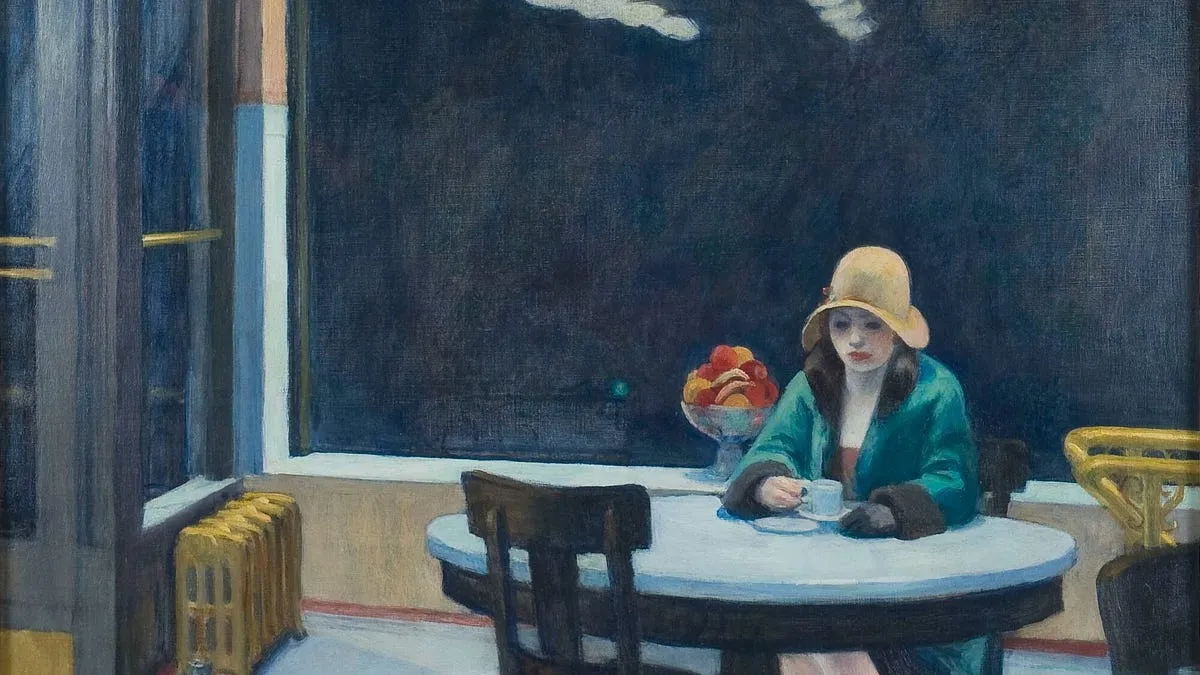
Automat (Edward Hopper, 1927)
I’ve been trying to write about loneliness for five or six months but it’s been frustrating and hard and I keep getting tangled up.
Partly, I don’t know if literary non-fiction can really address the root problem of loneliness. My existential rambling, however eloquent, simply becomes more abstract and disembodied thought, and a big part of loneliness is feeling abstracted and disembodied. Alienated. Apart from the world.
I suspect for writing to make people feel less lonely, in a visceral way, it has to be fiction.
Yet I also can’t seem to not write about it. It’s been the shadow looming over every unfinished draft, every half-haunted thought1.
So I wanted to sketch a few notes on loneliness:
I think the only real difference is the degree to which we’re aware of our loneliness.
I think if we stop a moment and look around, we can sense it: this feeling of being a stranger; this distance between the world and us; this film of separation; sometimes a great divide. Never fully able to touch reality, always an arm’s length away.
I think loneliness is always sort of there, latent beneath the surface. But sometimes it breaks in. Sometimes in a violent, flooding way.
I don’t think loneliness is a modern phenomenon. But I do think it is aggravated within a culture that centres on self, that tells you to care about yourself more than you care about anything else.
Yet no conclusion could be more horrible than dying without ever having loved anything more than myself.
Weight Watchers holds as a descriptive axiom the transparently true fact that for each of us the universe is deeply and sharply and completely divided into, for example in my case, me, on one side, and everything else, on the other. This for each of us exhaustively defines the whole universe.
When I think about loneliness I think about Dostoevsky’s White Nights. How it’s the archetypal example of the dreamer, the guy who is abstracted from reality, alienated, entirely in his own head, too lost in his books and ideas of things to interface with real life because real life would require him to kill his fantasy of living, what life could be, and that is a kind of death, while it is much safer and more pleasurable to dream. And how in the story he meets a girl, of course he meets a girl, who symbolizes the call to life for a man who’s lost somewhere in Neverland (Peter Pan not Michael Jackson), refusing to grow up. But in the end he loses her to some other, more “mature” guy because he can’t get out of his head or sacrifice his dreams or loosen his excruciating sentimentality.
I think being aware of this loneliness may free you from it in important ways (e.g. not drowning it in alcohol or committing adultery or engaging in other basic acts of denial and avoidance etc.) but may also make you more beholden to it in other ways. Although I think you probably can’t be fully alive and fully human until you face what is dreadful, what you’d rather deny or not think about. Confront it. Stare it down.
We all have our little solipsistic delusions, ghastly intuitions of utter singularity: that we are the only one in the house who ever fills the ice-cube tray, who unloads the clean dishwasher, who occasionally pees in the shower, whose eyelid twitches on first dates; that only we take casualness terribly seriously; that only we fashion supplication into courtesy; that only we hear the whiny pathos in a dog’s yawn, the timeless sigh in the opening of the hermetically-sealed jar, the splattered laugh in the frying egg, the minor-D lament in the vacuum’s scream; that only we feel the panic at sunset the rookie kindergartner feels at his mother’s retreat.
… Solipsism binds us together, J.D. knows. That we feel lonely in a crowd... That we are, always, faces in a crowd.
I think most vices are anesthetics against loneliness. (Weil: “All sins are attempts to fill voids.”)
I think the desire for pleasure is mostly the desire to escape, to chase away feeling lonely. It’s no coincidence that pleasure is synonymous with forgetfulness, unconsciousness. Drugs, alcohol, loud parties, TV, scrolling, having sex with someone you don’t care about, while different in appearance are near-identical in effect: they make us forget we’re alone. They’re easy ways to fill the emptiness, alleviate the angst. Pleasure is always amnesic.
But afterward we are hit with a hangover of loneliness, something like waking up outside of the Eden we thought we had climbed into, and this loneliness-hangover is more acute and painful than we can bear. And so we get stuck in a sort of vicious malignantly addictive feedback loop, where something makes us feel empty and hollow and aching, but the only way to feel better, it seems, is to do it again.
“Hangover” is perhaps misleading here, implying some period where the loneliness left.
We’re all lonely for something we don’t know we’re lonely for. How else to explain the curious feeling that goes around feeling like missing somebody we’ve never even met?
I think there is a macrocosm and microcosm to loneliness.
The microcosm has something to do with the fact that I have a loving family and great friends and a busy social calendar and tens of thousands of people read my writing and, despite all this, I am still pretty lonely most of the time.
Microcosmic loneliness is what most people mean when they say “loneliness”: feeling alone, left out, forgotten, alienated, homesick. The ache of isolation. A hurt that has no discrete edges.
An old journal entry: “I’ve realized the pain is not from being disliked by people, but rather my own inability to deal with their indifference. No one is out to get me. They just don’t care that much.”
The truth is you already know what it’s like. You already know the difference between the size and speed of everything that flashes through you and the tiny inadequate bit of it all you can ever let anyone know… What goes on inside is just too fast and huge and all interconnected for words to do more than barely sketch the outlines of at most one tiny little part of it at any given instant.
The macrocosm is trickier to talk about. It’s more to do with the dread of being trapped inside a self. Tethered to a single mind. Stranded in my skull. Encaged and claustrophobic. Another person is always a closed book, an interior world we can only penetrate a little, but never fully see or know. As in: I don’t know what you’re thinking. I don’t know what it’s like inside you and you don’t know what it’s like inside me. And I can never really know what the weather is like inside your head. And even on the outside, I don’t know all that much about you, just like I don’t know all that much about my sister or my Dad or my boss. I only see one side of you. A partial and managed and time-ravaged side at that.
I think this is very much a part of being human: never being seen and known in the way we want to be seen and known. Feeling that we are, in some fundamental and inescapable and terminal sense, alone.
“There’s something painful about being stuck in a body and a consciousness that can’t ever, except through sort of conversation, can’t ever be inside anybody else’s.”
It’s not like I think about this stuff when I’m falling asleep or anything. But sometimes I can’t stand it: how much of you I don’t know.
I think this macrocosmic loneliness has little to do with how much social time you do or don’t have, whether you have a family and screaming little kids and a demanding job or whatever. It isn’t about how much “me” time you get to write Substack essays in your basement and/or garage. This kind of loneliness has nothing to do with solitude. It is not a dramatic intense thing, but more a quiet conviction. A soft but persistent sensation of being sealed inside a self—a singular, isolated bundle of blood and bone that is almost insulting in its impermanence. It is the looming certainty that everyone I love will die and then I will die too and the world will hum along merrily without me, and it will be as if me and my family and my kitchen table never existed at all, and no matter what I do I am going to die and die very much alone and probably on some gray Wednesday at that. And, as much as I wish that certainty was just a bad dream, this is it. This is living. There is no waking up, no way out of this one.
All I mean is that I think loneliness is inseparable from the fear of death.
To add a corollary: I’m pretty sure microcosmic loneliness is a manifestation of macrocosmic loneliness. As in, I feel lonely at a church volunteer appreciation night or on a Wednesday evening walk after work to the extent it aggravates this subterranean awareness of being ultimately and imperially alone. Somehow being in big groups tends to do this for me.
I think this is what Kierkegaard was getting at when he wrote in his journal in 1836: “I have just returned from a party of which I was the life and soul; witty banter flowed from my lips, everyone laughed and admired me–but I came away, indeed that dash should be as long as the radii of the earth’s orbit––––––––––––––––––––––––wanting to shoot myself.”
At a wedding last summer at some chic mid-century modern barn venue out in the country, as we stood out in the twilight, fog floating over the field in white tendrils, some Pitbull modern-dance song thumping softly in the distance pierced by sporadic whoops and shrieks, a friend told me, slightly drunk, that of all the people in the Bible he relates most to Peter. He is told to walk on water, but most of the time he feels like he is sinking. His wife came over. He wiped the corners of his eyes and changed the subject.
I still have Mark 4:40 written on a sticky note above my stove. He said to them, “Why are you so afraid? Have you still no faith?”
I think being scared is caused mostly by thinking.
STREITFELD: “Scared” is a word that you often used to describe yourself.
WALLACE: Writers tend to be shy, bookish people. We’re always on the fringes of the party, resenting the attention paid to others. And then finally when attention is paid to you, it’s great and yet part of it sucks your liver out. Deep down it was the thing you always felt would make everything OK, and then you get it, and find everything isn’t OK, and you’re still scared.
I think loneliness is awkward and hard to talk about, almost socially repulsive. It’s a conversation killer. People tend to avert their eyes and furrow their brow, like they’re simultaneously trying to figure out if it resonates with something they’ve felt inside, and also if they should be concerned for me in a serious and non-trivial way.
Sometimes I wonder how much of my busy calendar is less an antidote to loneliness and more an anesthetic against it. As in, how much of my motivation to be social, to be around people, is simply a desire for distraction? If loneliness drifts back in, could it be anything else? What exactly am I so desperate to be distracted from? And if it is only distraction, is that a bad thing? What does “bad” even mean in this context?
I notice when I’m feeling lonely or avoidant or bored, I pick up my phone to check messages like a person possessed. Maybe it’s for the dopamine. But empirically, I think it’s for the flash of feeling unalone inside; that someone is thinking of me and likes me and wants to talk to me. Unbearably brief but enough to be addictive.
This sort of direct question is not for the squeamish. For one thing, it’s perilously close to ‘Do you like me? Please like me,’ which you know quite well that 99% of all the interhuman manipulation and bullshit gamesmanship that goes on goes on precisely because the idea of saying this sort of thing straight out is regarded as somehow obscene.
I think screens and social media probably make us more lonely, partly because they hold out the promise of eradicating loneliness but it doesn’t work, and we feel the fail
正文由 探How 从来源站点 RSS 同步,内容未经改写;遇到排版缺失或需要图片、视频时请以原文为准。