Why does a job board show more postings for Toronto than for Canada?
A few days ago, I was looking through job listings on Ashby’s career page.
以下正文同步自 Hacker News 最新,版权归原站所有,已转换为易读排版。
Ramona C. Truta
Nov 10, 2026
2
1
Share
A few days ago, I was looking through job listings on Ashby’s career page.
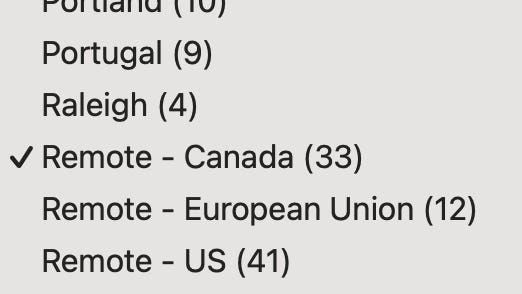
I live in Canada, so I looked for roles located here. When I scrolled down the location filter, Canada was not listed under C. I found a few Canadian cities, and I almost scrolled past Remote - Canada under R.
In the location list, some countries appear by name, while Canada, US and European Union are listed as Remote - name.
Browsing Cohere’s careers page, which also uses Ashby, I noticed something similar. The location filter showed:
If Toronto is in Canada, how could the city have nearly twice as many postings as the country itself?
When I select Canada on a job board, my expectation is seeing roles listed in Toronto, Ottawa, Montreal, Vancouver and other Canadian cities. Since that was not the case here, I wanted to understand what the board was counting.
I downloaded the public Ashby feed and saved a snapshot, then looked at the data directly.
curl -fsSL 'https://api.ashbyhq.com/posting-api/job-board/cohere'
-o cohere-ashby-feed.json
Note: I downloaded this snapshot on November 9, 2026. The counts below come from that snapshot. Running the same command now fetches the current feed, so your counts may differ.
The first thing I found was that Canada can appear in two places in the data. It can be the country in a location’s address, as in Toronto, Ontario, Canada. It can also be a separate location assigned to the posting, with Canada as its name.
In Cohere’s Senior Staff Data Engineer posting, Canada appears in two places:
it’s the addressCountry of the primary location, Toronto, and
it’s the name of a separate entry in secondaryLocations, with no city or province specified.
The first tells us which country Toronto is in. The second tells us that Canada was explicitly assigned to the posting as an additional location.
{ "title": "Senior Staff Data Engineer", "location": "Toronto", "address": { "postalAddress": { "addressRegion": "Ontario", "addressCountry": "Canada", "addressLocality": "Toronto" } }, "secondaryLocations": [ {...}, { "location": "Canada", "address": { "postalAddress": { "addressCountry": "Canada" } } ],
Cohere’s Financial Analyst, G&A posting also lists Toronto as a secondary location with addressCountry: "Canada", but it has no separate location named Canada. In my analysis, it matches a filter on address country, but not an exact match on location name.
{ "title": "Financial Analyst, G&A", "location": "United States", "address": { "postalAddress": { "addressRegion": "California", "addressCountry": "United States", "addressLocality": "San Francisco" } }, "secondaryLocations": [ {...}, { "location": "Toronto", "address": { "postalAddress": { "addressRegion": "Ontario", "addressCountry": "Canada", "addressLocality": "Toronto" } } } ],
Counting the overlap
I checked the primary and secondary location names for each of the 127 distinct listed postings in my snapshot.
The table shows 81 postings with a location named Toronto or Canada, and the 26 postings with both labels contribute to each location count:
69 postings explicitly naming Toronto (43 + 26),
38 explicitly naming Canada (12 + 26), and
26 postings explicitly naming both Toronto and Canada.
I also checked where the labels appeared. Was the overlap simply a case of Toronto being primary and Canada being added as a secondary location?
Among the 26 postings with both labels, 12 had Toronto as primary, 8 had Canada as primary, and 6 had both as secondary locations. I could reproduce the combined Toronto count from the feed.
I found 69 postings that listed Toronto in the API data. That matched the two Toronto counts (68 + 1) on the board added together, but I couldn’t tell from the API why the board showed two separate entries.
Then I asked a different question. How many postings have addressCountry: "Canada" on at least one primary or secondary location? I got 84. That’s the same 81, plus two postings with Ottawa as their primary location and one with Halifax. The feed already recorded Canada in their addresses, so I didn’t need a list of Canadian cities.
{ "title": "Customer Success Manager, Public Sector & Defence", "location": "Ottawa", "address": { "postalAddress": { "addressRegion": "Ontario", "addressCountry": "Canada", "addressLocality": "Ottawa" } }, "secondaryLocations": [], "workplaceType": null }
What should a Canada filter find?
This case study started with a question: Why did the board show 68 + 1 roles for Toronto, but only 38 for Canada?
In the same snapshot, 38 postings explicitly named Canada as a location and 84 listed at least one location whose address country was Canada. A filter labelled Canada could use either field and give a candidate different results.
That difference matters when you’re looking for a job.
If I select Canada, I expect to find postings that list a location in Canada, including cities like Toronto, Ottawa or Halifax. If I select Remote from Canada, I expect to find roles I can do remotely anywhere in Canada. The same posting can belong in both results, but the two filters answer different questions. The label should tell me which search I’m running.
I’m Ramona C. Truta, an independent researcher, solutions architect, and former university lecturer with more than 20 years of experience in database engineering. I write about how data systems behave in practice, from what a search filter counts to how a database query runs.
Stop Grouping by Everything explores how functional dependencies can help you write clearer and more efficient SQL.
Measuring Quack: DuckDB’s New Client-Server Protocol uses an independent benchmark to measure the cost of adding a network layer to DuckDB.
Structure is Not Security: The Architecture of Shadow Profiling explores how an app suggested people I knew before I finished signing up, and what that revealed about the data we share when we sync our contacts.
The Job That Wasn’t looks at what applicants are asked to share during hiring, before they know whether the opportunity is real.
正文由 探How 从来源站点 RSS 同步,内容未经改写;遇到排版缺失或需要图片、视频时请以原文为准。