What should we tell our students?
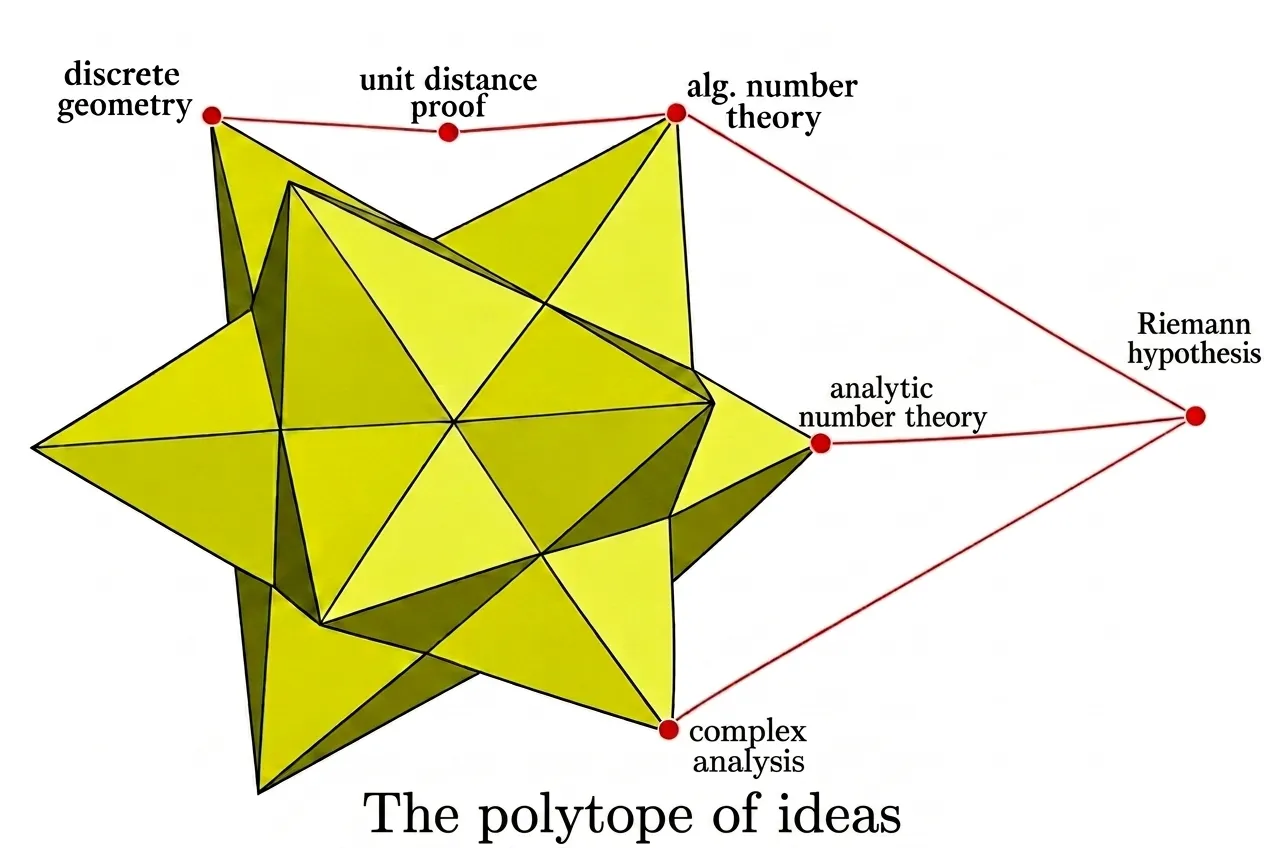
If this toy model holds up, then we would indeed expect the very fast advances in mathematics that we are currently seeing. As the LLMs take advantage of the stellated nature of the polytope of ideas, they will continue…
以下正文同步自 Hacker News,版权归原站所有,已转换为易读排版。
If this toy model holds up, then we would indeed expect the very fast advances in mathematics that we are currently seeing. As the LLMs take advantage of the stellated nature of the polytope of ideas, they will continue to fill in gaps between outer spikes. But as the LLMs fill in the convex hull with new results, we will see a deceleration in the number of results being shown solely by artificial intelligence. We will need human advances and intuition to generate new ideas that expand our knowledge polytope.
Even if the mathematical capacity of the LLMs (or future AI models) can at some point reach beyond the convex hull of the current set of human ideas, there is a different way that we may reach a limit to the LLM capacity: feasibility and ethical use of resources (this is similar what fellow optimist Kevin Buzzard called the “natural boundary” in a recent blog post). Is any cost (a dollar amount, human cost, ethical cost) acceptable in the pursuit of solving a given problem? Should we spend millions of dollars and an undisclosed amount of natural resources in order to find a solution for Navier-Stokes? As an analogy: we would like to know if there is life on Mars, but in order to do so as soon as possible, we would need an absurd amount of funding and risk the lives of a human crew in the process. Is it worth it? Similarly, we may reach a point where an LLM could solve an important problem for an exorbitant cost (in terms of funding and resources) but it may just not be an acceptable cost for the taxpayer or society to bear. Instead, we will need humans to devise an alternative route (the equivalent of a gravity-assisted robotic mission to Mars) to solve the problem at an acceptable cost, that produces a similar result in terms of mathematical advances and, more importantly, human understanding.
“Will research mathematicians become professional prompters’ and interpreters of LLM output?” There is no indication that this will be the case. Yes, LLMs have produced proofs of important results somewhat autonomously (according to the frontier model companies — see Disclaimer 2) that some mathematicians have been tasked with interpreting and digesting. But in my own experience, and other research mathematicians who are using LLMs in their research seem to agree, working with an LLM is akin to discussing a problem with a collaborator, and the results heavily depend on how much guidance and intuition the mathematician inputs into the conversation. In other words, the LLMs are more than tools: they can be research collaborators but, as in any collaboration, the experience and the results are greatly improved when all parties contribute to the discussion. Further, mathematicians have no desire to prompt “solve the Riemann hypothesis, make no mistakes” and then interpret the proof. We prefer to be active participants during all the steps in the process of the discovery of a proof, because we are motivated by the why the result is true,’ more than by the final answer that `the statement is true.’
Also, if we buy into the previous concept of the convex hull of ideas, then at some point in the near future it will be impossible to make progress in mathematics without a human adding a new idea, a new definition, a new concept that creates a new spike in the polytope, and then progress can occur.
“Will only the `brightest minds’ be able to meaningfully contribute to research mathematics?” At any given time in the history of mathematics, there have been mathematicians who are research active, and whose mental capacity for mathematics seems completely super human (e.g., the owner of this blog, among many others). It is natural to surmise that they could solve any problem we could solve, in a fraction of the time it would take us to complete a proof and write it up. However, this has never stopped those of us with a more modest capacity for mathematics from enormously enjoying doing research, and producing results that are far from insignificant. In fact, mathematics has always benefitted from the range of ideas and points of view, from the very concrete to the big bird’s eyeview, from the smaller contributions to the building of entire new theories.
Similarly, I am not threatened by the mathematical capacity of LLMs. For one thing their capacity is currently limited, as pointed above. And for another, even if their capacity becomes far superior, there will always be a need for mathematicians at all levels to guide research in paths that make sense for humans to walk (not run).
The mathematical universe is enormous (as Emily Riehl said), and computing time is finite. There will always be areas of mathematics that are under-explored and where even beginners can break new ground. The LLMs can help in the process, by quickly exploring avenues that may be dead ends, pointing out paths that have already been explored, and shining a light on paths that are likely to be fruitful.
As I mentioned above, I have never been this busy, because the access to LLMs has multiplied the number of areas that I have access to, and my curiosity has expanded well beyond my research area. I now have many more ideas that I can possibly explore on my own, so I am recruiting more student collaborators than ever before, to help me test whether these problems can lead to interesting results. Students can be involved in research earlier than ever before too because the LLMs can help them learn material faster (and deeper!), by virtue of being available 24/7 to answer their questions, instead of my meager one or two available hours per week to meet with them.
“Will mathematicians be needed? Will they be employable?” I find these questions natural but also perplexing. Even in the most dystopian of scenarios where AI becomes super human in all research tasks, what good would a proof (of a theorem in pure mathematics) be if there are no human mathematicians to digest it and understand it? Regardless of the advances in LLMs and AI, there will be mountains of research to be understood by humans, with or without the help of a computer.
In addition, we seem to forget that mathematics departments exist in universities to serve two primary goals: discovery and communication of mathematical knowledge. Virtually every mathematics department emphasizes, in equal parts, our research and educational missions (and many institutions place the educational mission of mathematics at a much higher level than their research mission). Mathematics courses are an integral part of a liberal arts curriculum because learning to think as a mathematician is a highly useful and applicable skill. The fact that we are researchers adds immense value to our educational goals, because students are best served learning from those scientists who are in the frontlines of research. The research opportunities that we provide for undergrads are a very valuable add-on to their curriculum, as it is a different type of training that helps them be employable in the future. And as long as the mathematical way of thinking continues to be a highly valuable skill to be learned by the undergraduate population, there will be a great need for mathematicians to be hired by universities.
The LLMs are making math research more accessible than ever to those who are not even in academia or even mathematicians. This means that undergrads will be able to join actual mathematician-led research projects much more easily, and it may be a new fertile ground for exploration. Not mindless exploration, though, but mathematical exploration where the goal is understanding and for the students to be initiated and trained into a highly technical field (in an ethical way). And, of course, we should prioritize training students in how to communicate the mathematics they learn, as that has always been (and probably will become even more of) a crucial skill.
All of this to say that I cannot conceive that the LLMs will displace mathematicians from their jobs. On the contrary, they might produce jobs since our research productivity may sky rocket. On the other hand, I am more worried about policies and funding issues that are political in nature and have nothing to do with the AI and LLM conversation.
Finally, the most important question of all, that I wanted to address here:
“Should I pursue a PhD in math at this time?” The answer to this question should be personal to each and every student. But, in my opinion, the answer should not have changed from a year ago to today. The most important reason (and perhaps the only reason) to do a PhD in math should be that the candidate is passionate about mathematics and wants to become an expert in a particular topic within our field. If that is the goal, then the presence of LLMs in mathematics is irrelevant, because the goal is achieved when the candidate has gained sufficient knowledge to be an expert on a particular problem. If anything, LLMs may be used as a tool to achieve that goal more efficiently. For one, I am using them every day to finally understand concepts and techniques that I always had questions about, and now I can query an LLM until I am fully satisfied. I am able to search for the explanations and examples that click with me, that click with my own particular way of thinking about mathematics.
To what degree a student wants to use LLMs in a math PhD should be a personal choice but I will say that, as my colleague Jeremy Teitelbaum put it in a recent interview (here is the bit I am referring to, and here is the full interview), students cannot afford not to learn about the current capabilities of LLMs, or any other technology for that matter. If your goal is to become an expert, then you have to be amenable to learning from all experts in the field, and from all sources that may allow you to go deeper into a subject than anyone else before you — and LLMs can be extremely efficient tools to explore literature, for instance.
But once again, the decision to do a PhD should not be based on the current state of the art of technology.
I wanted to do a PhD in mathematics because it seemed like a magnificent challenge. I wanted to do a PhD because I wanted to learn how Andrew Wiles proved Fermat’s Last Theorem. I wanted to continue studying mathematics because I simply did not want “a real job,” and the opportunity of contemplating advanced math on my own for a few years seemed like a dream to me, just too good not to give it my best shot. I know I would have deeply regretted it if I had not tried to complete a PhD when I had a chance (the best time to do it is when your undergrad knowledge is fresh!). I wanted to hear mathematicians talk about math, and rejoice in the small little details and miracles that make proofs work. I wanted to meet and hang out with other people who also thought number theory was the coolest thing on Earth. I wanted to publish a paper in a research journal, with my name on it, because I discovered a new theorem that no one had thought of before. I wanted to explain and share my passion for mathematics with others in a classroom and outside of the classroom.
Simply put, I just wanted to do math, and I would have been devastated if some undefined threat to the field of mathematics scared me away from the opportunity to pursue a PhD.
And if you are a student that is passionate about mathematics, and someone who wants all of that too, then a PhD is the right path for you, regardless of the technology available during your degree. You will learn to use the technology to a degree that you are comfortable with, and that fulfills your own dreams and expectations of what a PhD in Mathematics means to you.
Afterword: the BIG OpenAI release. After I finished writing this blog post, and had already sent it to Terry, OpenAI released a huge treasure trove of results in mathematics. This is, undoubtedly, a historic time in mathematics. The theorems in their papers prove some huge open problems in mathemati
正文由 探How 从来源站点 RSS 同步,内容未经改写;遇到排版缺失或需要图片、视频时请以原文为准。