Illustration Beyond Proof
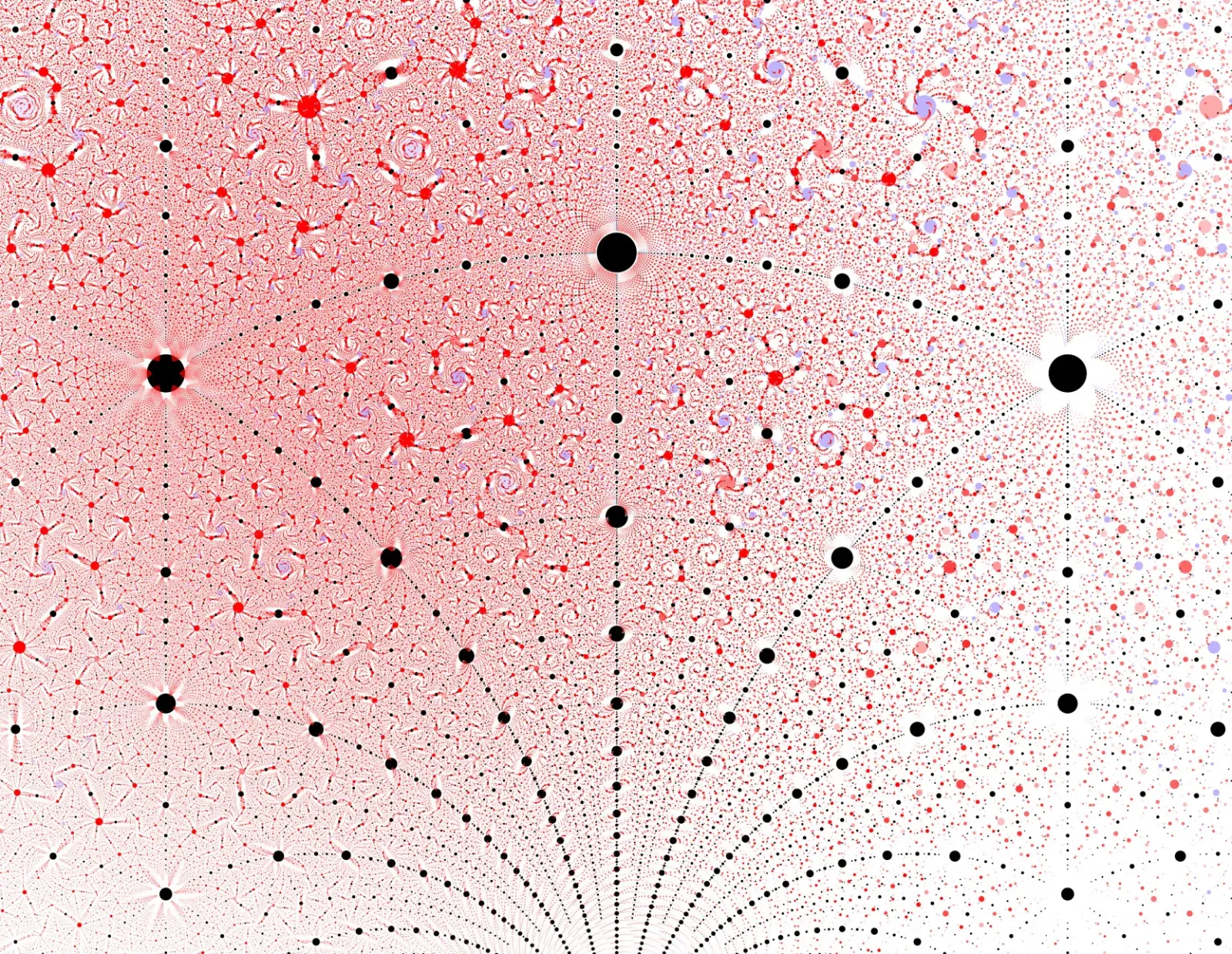
Algebraic number starscapes: the complex roots of rational cubic polynomials. The right-hand image is a shader by Steve Trettel; code at shadertoy.
以下正文同步自 Hacker News,版权归原站所有,已转换为易读排版。
Algebraic number starscapes: the complex roots of rational cubic polynomials. The right-hand image is a shader by Steve Trettel; code at shadertoy.
The Illustrating Mathematics community developed from this tradition of drawing and making mathematical objects. It took shape during a semester at ICERM in 2019 and went on to organise the IHP trimester this year [13]. It brings together mathematicians who actively develop images, models, software and experiences of mathematics. A particular focus has been the role illustration plays as a method of research: exploring, not just explaining, mathematics. In the same way that a good proof shows more than just its result, a good illustration does much more than demonstrate a form or pattern.
Our own work in algebraic starscapes [14], including the images above is a modest example (with Steve Trettel, and with Jayadev Athreya, Gabriel Dorfsman-Hopkins and Claudio Gonzalez joining in). The pictures show elaborate structure in the complex roots of rational cubic polynomials. When we moved to using shaders to draw the image (on the right), a naive first draft of the code turned circles into ellipses. But we realized that the unintended distortion revealed an extra dimension of meaningful structure. These pictures show mathematics that has not been explored, rather than explaining what is already known.
Of course, both proof and illustration can mislead, especially in research. The capabilities of LLMs come at a cost. In the case of illustration, their ability to produce code makes illustration more accessible than ever before. Yet by vibecoding, we are now two steps from knowledge: even the creation algorithm itself may not be understood.
In the case of proof, this problem of “digestion” is now centre-stage. This month [15], prompted by Ioannis Tsiokos, GPT-6 Astra found Chair44, the first three-dimensional aperiodic monotile. Tsiokos shared a 61-page paper [16]. He says he understood the intuitive geometric argument but not the mathematics. Chaim Goodman-Strauss then distilled the argument into eight pages [17] built around a diagram of matching arrows that makes the supertile structure visible, giving a classical hierarchical proof of aperiodicity. The illustration of the shape itself (in Tsiokos’ paper) was a critical clue in revealing the key idea.
So returning to our original question, in the face of these problems, how can an illustration be rigorous? In the paper we draw on Valeria Giardino’s account of representations as tools for thought (Endeavour 42, 2018) [18], which considers an illustration’s affordances: the readings, manipulations and inferences the figure invites. We might choose a stronger definition of affordances: the properties of the illustration that a proof certifies as accurate. Conversely, proofs can show that an apparent property is not an affordance. For example, early images of the Mandelbrot set seemed to show it was disconnected [19], but in a pixelated image a feature thinner than the step between pixels can be missed [20]. Properties such as the number of bulbs of a given size off the main cardioid, on the other hand, can be proved correct, provided the pixel size is small in comparison.
If this addresses the accuracy of an image, what about its engagement or ability to reveal? These are questions without clear answers, but they are not unimportant. They are also the questions that academic art asks of the work of its students, and art has a long-tested method: the “crit”. At the workshop, Jean Schmitt, a professor of art foundations, helped us set up a crit framework we used through the trimester. The crit is a discussion of a work, often presented with minimal introduction, to reveal how it is received by the audience. What are the similarities and differences between that reception and the creator’s intent? This gave a more formal structure to the sort of informal conversations we were already having, and placed the discussions in a communal space. The crit shares something with the style of Gelfand’s Moscow seminar.
Schmitt’s workshop talk [21] drew on Tim Ingold’s idea of thinking through making (Making, Routledge, 2013) [22], in which form and understanding emerge through the process and in collaboration with the tools and materials available. In the same way Monge’s students were expected to learn through the process of drawing, not by observing the drawings of others. Value and understanding often come as much from the effort of creation, be it illustration or proof, as from viewing that created by others.
These ideas from art make explicit and visible something that has always been implicit in the mathematics community. Being a mathematician is as much about being an excited audience for the work of others as it is about presenting or creating our own research. As a community, we value aesthetics, elegance, and insight, and we have developed these shared values through our interactions. The oversized importance of publication and previously unproven results merely overshadowed these broader values, but people have always been working to find ways to ensure we give credit for them.
Infrastructure to support these broader values has also been growing. The Geometry Labs United network [23] brings together groups in many universities where undergraduates and graduates work with postdocs and faculty, exploring math as research, experimentation and visualisation. This gives a natural space for learning through making proofs, experiments, exposition and illustrations. In many cases the proof can be more contextual, proving the affordances of a specific experiment or illustration. Learning through making also aligns with work in mathematics education. In the final talk of our workshop, Hortensia Soto showed how working with physical materials supports learners’ actions, perceptions and sensations on the way to understanding [24].
Answering Sanderson’s call to credit things beyond proof can consists of, as much as anything, recognising and growing the work that has already been done. This work is happening in the community of Illustrating Mathematics, but also in the Philosophy of Mathematical Practice, in Geometry Labs, and many other places. Insights are found by connecting to mathematics education, outreach and even art. The work is happening: what it needs, as Sanderson argues, is support. With that we can achieve what Bryna Kra describes: a mathematics that continues to
“enlarge our capacity to reason and open our minds to new ways of understanding.” [4]
正文由 探How 从来源站点 RSS 同步,内容未经改写;遇到排版缺失或需要图片、视频时请以原文为准。