2026: The State of Enterprise AI
Tim Tully, Joff Redfern, Deedy Das, Derek Xiao
以下正文同步自 Hacker News 最新,版权归原站所有,已转换为易读排版。
All Perspectives
ReportPerspectivePortfolio
2026: The State of Enterprise AI
November 03, 2026
Tim Tully, Joff Redfern, Deedy Das, Derek Xiao
Envelope
Copy link
Copied to clipboard!
Table of Contents
Key Findings
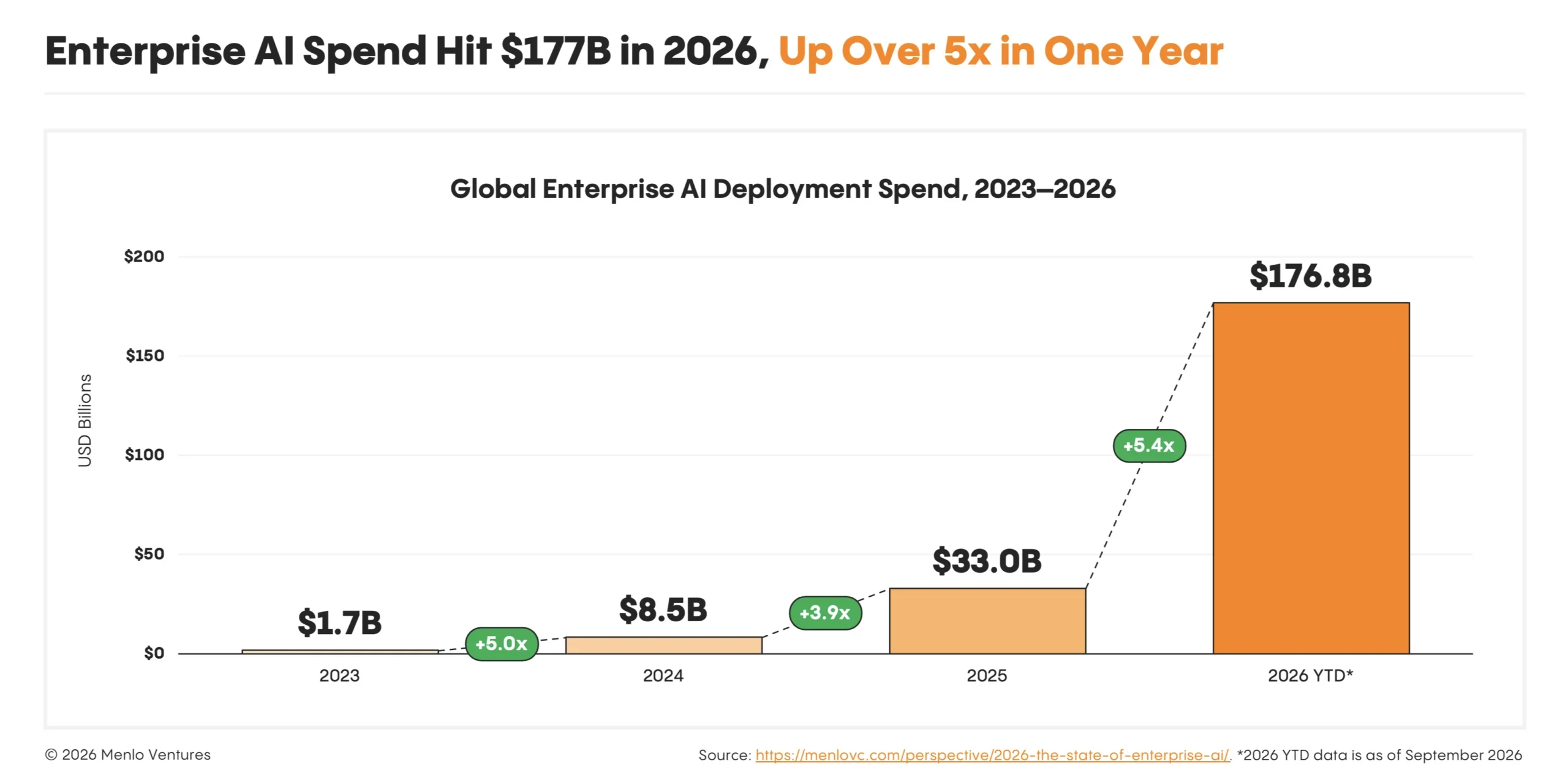
Enterprise AI deployment spend scaled to $177B by September 2026, up from $33B last year. Growth is accelerating: 5.4x vs. 3.9x a year ago. Every dollar that went into developing models this year is generating $1.70 of revenue.
Agents changed the math: OpenRouter agent traffic is up 37x since overtaking human traffic in February, tying spend to work performed rather than users.
For now, money follows capability: Frontier labs command 69% of deployment dollars (vs. 50% last year). Anthropic’s share of enterprise API spend increased from 40% to 55%, OpenAI’s from 27% to 31%, while Google’s fell from 21% to 9%. Open-source remains 4% of spend despite 19% of usage.
AI spend concentrates where agents work best: Coding ($34.0B) and chatbots ($25.0B) make up 76% of the $77.3B app market because they offer environments in which agents can act, workflows they can learn, and results they can verify.
AI-natives are winning new agent categories like coding, which is 96% AI-native. Compared to last year, incumbents are gaining share in IT (91%), data science (88%), and HR (68%).
AI is expanding the software economy: 55% of AI dollars is from net new spend, rather than existing software or labor budgets.
Enterprise AI Reaches Scale
In 2026, AI became an economy-scale force. Enterprise AI deployment spending surged from $33 billion to $177 billion in just one year. That’s over $140 billion in new annual spending, more than four times the size of the entire market a year ago.
The speed of AI’s rise set off alarms. Fears that AI would replace traditional software triggered a “SaaSpocalypse” selloff earlier this year, while others worried it would eat into labor budgets.
But our data tells a different story: Far from being a zero-sum game, AI is creating new value across the economy, expanding markets far more than it’s displacing existing revenue.
The biggest story of the past year has been the rise of AI agents, even among consumers. The launch of Anthropic’s* Opus 4.5 in November 2025 marked an inflection point as the model—for the first time—allowed AI to move beyond answering questions in conversational turns to executing complex, multi-step tasks with limited human oversight.
Since then, agents have now grown to become the biggest consumers of AI models. On OpenRouter*, a platform that gives developers access to hundreds of AI models, they now account for 80% of all tokens, roughly 7x human-driven usage.
Agent traffic tripled the week after Opus 4.5’s launch, then overtook human traffic in early February following the launches of Opus 4.6 and GPT-5.3-Codex. Since then, it has grown 37x, vs. 5x for human-driven usage. OpenRouter is just one channel, but it shows how quickly AI consumption is shifting from humans asking questions to machines doing work.
Leading AI apps rebuilt around this new autonomy: Harvey and Legora* each re-architected contract review from a fixed workflow into a multi-agent system, and Sierra launched Horizon, a platform for agents that pursue goals over days or weeks, like originating a loan. Factory*, whose Droids already worked autonomously, also took off with the new models—doubling revenue month over month for six straight months through April 2026.
As agents take on more work, buyers are paying a premium for the most capable models, even as much cheaper options have become available. We estimate Anthropic, OpenAI, and Google command $122.7B of enterprise spend—69% of all deployment dollars, up from 50% last year and 2.3x the rest of the market combined.
Concentration is not just at the API layer. The labs’ first-party apps also dominate the app layer and now total $40.0B: Claude Code and Codex account for $24.0B (70%) of coding spend, while enterprise Claude, ChatGPT, and Gemini make up $15.5B (62%) of the AI chatbot and productivity spend.
For now, the money follows model progress. Value accrues to the labs that introduce a new capability like long-horizon agents, and the initial apps they build around it. Over time though, we expect this concentration to ease as the capability matures and application companies bring it to new markets.
In the race to win AI builders, Anthropic and OpenAI now account for 86% of enterprise LLM API spend, up from 67% last year. As the market consolidates around the frontier leaders, model capability—not price—is proving to be the decisive competitive advantage.
The average enterprise planned to nearly double their AI spend in 2026. They ended up paying far more.
Reported spending averaged 4.7x last year’s level, against a planned 1.9x—roughly 2.5x plan. Median spending also exceeded expectations, though not nearly as dramatically: Spend reached 2.2x last year’s level against a 1.8x expectation. The difference between average and median reflects AI’s “fat head”: a small group of power users accounts for a disproportionate share of AI spend and grew far faster than most enterprises.
As for the difference between actual and planned spend, agents explain the gap. They work independently, run in parallel, and keep going even after people step away, so spending scales with work rather than headcount. This growth was the key driver of the AI market inflection this year: Spend per enterprise nearly quintupled while adoption among enterprises rose only from 55% to 65%.
Looking forward, we read this as an encouraging sign of sustained future demand: With so much AI spend coming from power users, both adoption and usage still have significant room to grow across the long tail of the rest of the economy.
At $176.8B, AI deployment spend now equals more than 30% of public cloud revenue, up from just 6% a year ago. Where is that money coming from?
Mostly new budgets, which funded 55% of incremental AI spend, compared with 22% from software budgets—though even with that, most (13%) stayed with incumbents converting SaaS licenses to AI, like Microsoft Office to Copilot, while only 9% ($12.6B) moved to AI-native vendors, about a 2-point growth headwind for the $600B+ application SaaS market (from +13% last year to +11% this year).
Our study also found limited evidence of enterprises replacing core systems such as Salesforce’s CRM, Workday’s HRIS, or Oracle’s NetSuite with AI. In other words, AI is significantly expanding the overall software market while modestly slowing growth for traditional SaaS. The question for these incumbents moving forward will be whether their new AI products can win enough incremental spend to avoid decelerating growth alongside the SaaS market.
For every $1 the industry spends building AI models, enterprises spend about $1.70 putting them to work. As of September 2026, we estimate $176.8B in enterprise spending on using AI (up 5.4x) versus $102.5B on building models (up 5.3x).
That demand underwrites the buildout. We estimate that Anthropic and OpenAI alone account for 25%+ of AWS, Azure, and Google Cloud revenue, with much of that spend going to training. That investment only pays off if enterprises keep putting models to work, which agents are now driving.
Open-source usage is rising and, in recent weeks, Anthropic and OpenAI have started discounting even their flagship models. The result is sharper competition at every intelligence tier, but our data show buyers continue to prioritize capability over cost in model selection.
Open-source now handles about one in five tokens but accounts for only about one in 25 dollars of model spending, driven by a significant delta in price between closed and open-source models.
Open weights give builders something closed models largely can’t: control over the model itself. Post-training lets them specialize models for their own tasks to lower costs and reduce dependence on frontier labs. Adoption rose from 6% of AI builders in 2025 to 10% this year, but it remains limited.
Two things hold it back: specialized models need constant updates to keep pace with a frontier that moves every few months, and most application companies lack the expertise to train them effectively. That creates an opportunity for infrastructure and services providers. Among builders that post-train, 91% use outside partners, including:
Cursor* built Composer 2 on Kimi K2.5, with Fireworks providing inference infrastructure for reinforcement-learning rollouts. Harvey developed Tenet with Fireworks and Mercor, and separately partnered with Applied Compute on its Review Table model.
The total AI application market is now $77.3B, up from $19B last year. But just two markets account for 76% of all app spend: coding ($34.0B, up 7.7x) and enterprise chatbots ($25.0B, up 3.0x). To put that in perspective, healthcare—one of the world’s largest industries—ranks a distant third at just $3.7B.
Agents have driven much of the growth in these two markets, as both provide key conditions that help agents succeed:
Where these conditions hold, spend follows. Customer success, where support playbooks document the steps and resolutions define success, grew 4.3x to $2.7B. Where they are harder to meet, growth is less robust. Human resources, where work often involves more subjective judgment, grew slower (2.5x), at smaller scale, to $0.9B. Marketing similarly grew just 1.8x to $1.2B.
As AI’s first killer use case, software development previews how agents can transform an entire category. The impact is now visible at ecosystem scale: Enterprise code activity is up 5x year over year, and that doesn’t include vibe coding, where Lovable* alone adds more repos in a month (+32M) than all of GitHub (+24M).
The labs capture most of the spend. Anthropic’s Claude Code and OpenAI’s Codex combine for $24.0B, 70% of the $34.0B coding market, up from about $1B last year.
But independent companies are growing, too. The rest of the market grew 2.9x to $10.1B, led by coding platforms like Cursor, Cognition, and Factory, as well as AI app builders like Lovable. More code is also creating demand for the tools that review, deploy, and maintain it: Pierre and East River Source Control in code storage, Greptile* in code review, Harness* and Blacksmith in build and deploy, and Resolve in SRE.
Horizontal apps serve a function or the whole workforce rather than a single industry. Outside coding and chatbots, they combine for $8.8B (up 3.0x). The fastest growth is in functions that look most like coding—with connected systems in which agents can act, complete context for how work gets done, and verifiable outcomes.
Most enterprise markets lack these conditions, so the opportunity for the app layer is to create them for new domains. That means connecting agents to all the fragmented systems and context they need, making tacit knowledge and procedures accessible, and designing evals to help agents to improve.
Some of the standouts doing this work include:
Vertical apps are built for a single industry. Vertical AI is a $10.1B market, up 2.9x from $3.5B last year.
Healthcare ($3.7B, up 2.5x) still leads every industry category with 37% of vertical spend, and on its own, it’s now bigger than all of vertical AI was last year. Clinical tools drove the growth, led by OpenEvidence* at the point of care and ambient scribes like Abridge. This year, biology emerged the next frontier, as Anthropic, OpenAI, Isomorphic Labs and Chai Discovery* invested heavily in AI for research and drug discovery.
Legal ($1.8B) is second, up 2.8x. Harvey and Legora continue to compound as their products moved from drafting help to agents that handle entire workflows, from due diligence
正文由 探How 从来源站点 RSS 同步,内容未经改写;遇到排版缺失或需要图片、视频时请以原文为准。