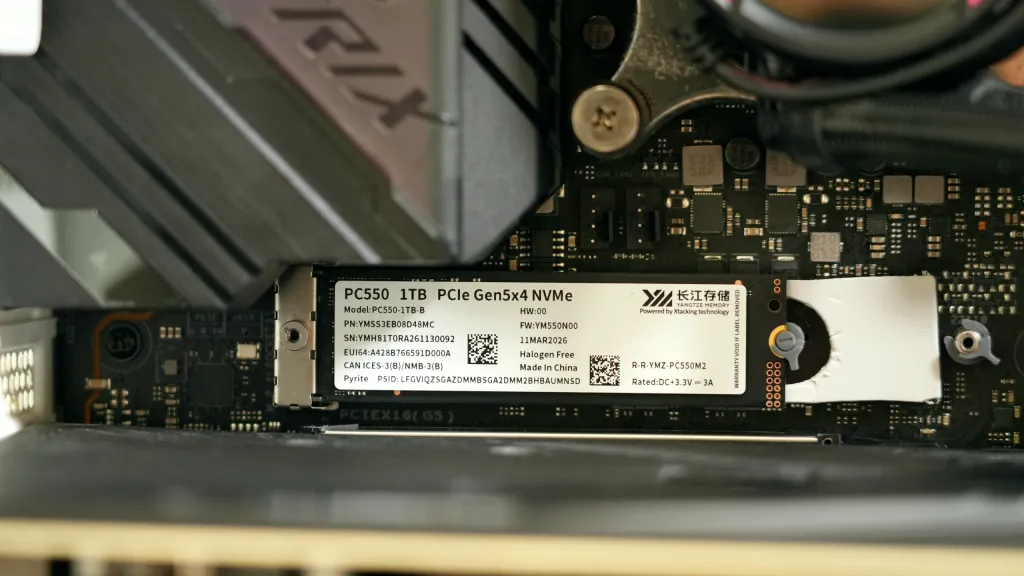
YMTC PC550 Review: A PCIe 5.0 SSD Built for Cool, Compact PCs
YMTC PC550 是一款面向笔记本、迷你主机等紧凑设备的 PCIe 5.0 SSD,重点平衡性能与发热功耗。1TB 版官方标称顺序读写最高 10500MB/s 和 9500MB/s,随机读写最高 1300K IOPS,运行功耗低于 6W。实测多项关键基准成绩超过标称值,并在高负载下保持温度可控。
以下正文同步自 动点科技 TechNode,版权归原站所有,已转换为易读排版。
PCIe 5.0 SSDs are no longer a new category. There are already many drives that can deliver very fast read and write speeds. The harder part is putting that level of performance into a laptop, mini PC, or other compact system without creating new problems with heat and power consumption. In those devices, keeping the drive cool can matter just as much as achieving a high benchmark score. The YMTC PC550 is built around that balance. In our testing, it delivered performance above its rated figures in several key benchmarks while keeping its thermal behavior under control during a demanding combined workload. The result is a PCIe 5.0 SSD that is not defined by a single peak number, but by how consistently its performance translates into practical use. Performance on paper, and beyond We tested the 1TB version of the PC550. According to YMTC’s official specifications, it is rated for sequential read and write speeds of up to 10,500MB/s and 9,500MB/s, along with random read and write performance of up to 1,300K IOPS. YMTC also lists operating power below 6W and idle power below 3mW. CrystalDiskInfo identifies the tested YMTC PC550 1TB drive. CrystalDiskMark showed that the PC550 was able to go beyond its official sequential-read rating. It reached 11,712.69MB/s for sequential reads and 9,501.92MB/s for sequential writes. The mixed workload test recorded 11,722.69MB/s read performance and 9,500.92MB/s write performance, while random read and write performance reached 1,403K and 1,789K IOPS respectively. CrystalDiskMark standard benchmark results. CrystalDiskMark mixed R70/W30 results. Rated vs. measured performance MetricRated specificationMeasured resultMeasured uplift Sequential read10,500MB/s11,712.69MB/s+11.5% Sequential write9,500MB/s9,501.92MB/s+0.02% 4K random read1,300K IOPS1,403K IOPS+7.9% 4K random write1,300K IOPS1,789K IOPS+37.6% Sequential performance is most relevant when moving large files, loading sizeable game assets or working with other bandwidth-heavy data. Random performance matters more when many small requests are being handled at once, such as during application launches or system activity. The PC550’s results in both areas point to a drive with enough headroom for demanding desktop workloads, rather than one that only performs well in a single sequential test. Sustained write performance beyond the cache Peak sequential-write specifications describe short, high-speed transfers. To examine what happens during a longer continuous workload, we used Iometer for a 1TB sequential-write test with 1MB transfers, a queue depth of 8, one worker and 100% write operations. Iometer results summary. Iometer 1TB sequential-write curve, showing the transition from cache-assisted to out-of-cache performance. The resulting curve moves from the initial cache-assisted write range into a lower, stable out-of-cache range. Across the 1TB workload, the PC550 recorded an average write speed of 2,002.69MB/s. This result is more useful for understanding sustained write behavior than a short burst benchmark, especially when the drive is handling a large file transfer or another workload that continues after the fast cache area has been used. Performance in everyday workloads The PC550 also performed well in broader storage and application tests. It scored 5,213 in PCMark 10’s Full System Drive Benchmark, with an average bandwidth of 803.70MB/s and average access time of 31 microseconds. In 3DMark’s Storage Benchmark, it achieved a score of 4,963, with average bandwidth of 845.84MB/s and average access time of 36 microseconds. PCMark 10 Full System Drive Benchmark. 3DMark Storage Benchmark. For a local AI workload, we used Ollama to load the Qwen2.5 7B model. Across three runs, the average model loading time was 2.07 seconds. That makes the model feel almost instant to launch. The PC550’s PCIe 5.0 read speeds help cut down the wait during cold starts and model switching, keeping storage from becoming the bottleneck in a professional AI workflow. For users who frequently switch models, repeat tests, run local inference, or experiment with RAG pipelines, those shorter waits can directly improve overall efficiency. Ollama and Qwen2.5 7B loading test. We also used Delta Force as a game-loading test. The test starts when the “Start Game” button is clicked in the Black Hawk Down mode and ends when loading is complete and the character-selection screen appears. This is a useful storage scenario because the game needs to bring in a large volume of map and character assets while background game services continue to operate. The PC550 completed the process in 15.38 seconds. A PCIe 4.0 reference drive on the same platform took 16.72 seconds, giving the PC550 a 1.34-second advantage in this test. Delta Force test scenario. Strong thermal performance under combined load The game-loading result shows what the PC550 can do in practice. But with PCIe 5.0 SSDs, speed is only one part of the picture. Sustained performance often comes with a noticeable thermal cost: published tests commonly place mainstream Gen5 drives in the 60°C to 70°C range under sustained load, while some earlier high-performance designs can approach 80°C when cooling is limited. Heat has become part of what users expect from Gen5 performance. To put the PC550 through a more demanding scenario, we ran the system stress test while Delta Force was running in the background. This kept the system, game, and storage active at the same time. The test continued for approximately 30 minutes, with the PC550 installed beneath the motherboard’s stock M.2 heatsink in a room maintained at around 27°C. HWiNFO temperature monitoring during the combined workload. After approximately 30 minutes, the PC550 had stayed below 50°C throughout the test. Its main temperature sensors averaged 45°C and peaked at 48°C, while the third sensor averaged 42°C and peaked at 45°C. That sub-50°C result is particularly significant for compact systems, where cooling capacity is limited and every heat source competes for airflow. The PC550 delivered PCIe 5.0 performance without adding a major thermal burden to the system, suggesting more thermal headroom for the CPU, GPU, and other components during sustained use. Together with YMTC’s below-6W operating-power rating, this gives the PC550 a practical advantage in systems where performance and thermals have to be considered together. A practical PCIe 5.0 SSD The PC550’s appeal lies in the balance it strikes. PCIe 5.0 SSDs are often judged by peak benchmark numbers, but in a real system, speed has to work alongside heat, power consumption, and the limits of the platform around it. The PC550 brings the performance needed for demanding file transfers, game assets, and local AI workloads while keeping its thermal behavior manageable under sustained use. For users building compact PCs, all-in-one systems, or other space-constrained devices, the PC550 offers a straightforward path to PCIe 5.0 performance while keeping heat and cooling demands under control. In that sense, it presents a more usable side of the PCIe 5.0 platform—one that is fast enough for demanding work, but easier to integrate into the system around it.
正文由 探How 从来源站点 RSS 同步,内容未经改写;遇到排版缺失或需要图片、视频时请以原文为准。