Data Engineering Weekly #293
The Weekly Data Engineering Newsletter
以下正文同步自 Data Engineering Weekly,版权归原站所有,已转换为易读排版。
Editor’s Note: Thinking Out Loud
I started this section basically to write what the title says. A couple of things I’ve been thinking deeply about in today's data engineering landscape. First, what makes a catalog truly open? Personally, I think the Iceberg catalog spec is the wrong step; it lets vendors build their own closed systems, limiting users' choices. Second, do we still need to do data modeling? Years of designing and building data platforms have taught me that frameworks serve an important purpose: they give people a shared language for understanding complex ideas and making decisions. A language transforms, fades, and is even born; data modeling is just a shared language. How will it evolve? Share your thoughts on these two topics in the comments; I'd love to keep the chat going.
Pinterest: Metrics Board: Building an Agent-ready Metrics Layer
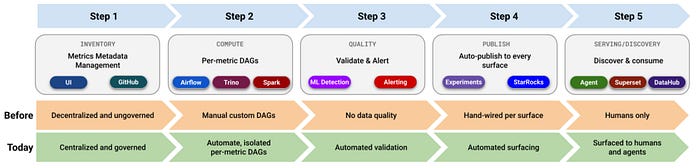
Pinterest writes about the challenges with managing the metrics at scale, and how scattered metric definitions and manual pipelines slowed experiments and made reporting harder to trust. Metrics Board uses shared metric definitions to automate calculation, quality checks, and publishing across tools. Adoption of metric/ semantic layers is increasing across the ecosystem. https://medium.com/pinterest-engineering/metrics-board-building-an-agent-ready-metrics-layer-2c8fefe68756
Chenyu Zhang: The Semantic Layer Race: Snowflake, Databricks, Fabric IQ, and Apache Ossie
As the need for and adoption of the headless semantic layer grows, it is no surprise that all the major data platforms are offering it. The author compares how Snowflake, Databricks, and Microsoft capture calculation rules and business relationships, alongside Apache Ossie’s effort to exchange definitions across tools. Reliable answers still require maintained rules, clear ownership, and assistants that ask for clarification when several meanings fit. https://fred-zhang.medium.com/the-semantic-layer-race-snowflake-databricks-fabric-iq-and-apache-ossie-9d67c5bcd90a
Event Alert: NEXT QUERY 2026 | Free Virtual Data + AI Summit | Nov 4
On November 4, NEXT QUERY 2026 brings those lessons into the open. Engineers from Apple, NVIDIA, Coinbase, Intuit, AppLovin, Microsoft AI, AWS, and Cisco will share what they built, what broke, and what they’d do differently. Here’s some of what you’ll hear:
- Coinbase and AppLovin share architecture lessons from production, and Intuit Mailchimp explains how it rebuilt its real-time customer data platform.
- Get AWS’s take on running StarRocks on EKS, see how Apple runs analytics as a managed service, and hear how Carbon Arc moved 1 PB from Trino to StarRocks.
- GPUs for analytics. NVIDIA explains why GPU execution is now practical for large-scale queries, and which workloads benefit most. 20+ talks across two tracks, hosted by PhoenixAI (the original creator of StarRocks). Free and virtual, starting at 9:00 AM PT. Can’t make it live? Register anyway, and we’ll send you the recordings afterward. https://nextquery.phoenixdata.ai/
LinkedIn: Rebuilding LinkedIn’s Tracking Infrastructure: Scaling, Migrating, and Hardening a High-Volume Event Pipeline
LinkedIn describes rebuilding its tracking pipeline where different event types competed for the same resources. The approach essentially separated workloads, removed repeated request data, and compared sampled outputs while gradually moving traffic. The new service reached 90% of production traffic with no migration-related incidents, highlighting the value of verifying what downstream systems receive and keeping changes reversible. https://www.linkedin.com/blog/engineering/infrastructure/rebuilding-linkedins-tracking-infrastructure-scaling-migrating-and-hardening-a-high-volume-event-pipeline
Meta: Scaling AI-Native Analytics Patterns at Meta
Meta writes about how teams repeatedly rebuilt common measurements, creating duplicate pipelines and inconsistent results. The article describes how its Analytics Libraries generate pipelines from reusable patterns, while agents use a tool that builds SQL from defined data models. https://medium.com/@AnalyticsAtMeta/scaling-ai-native-analytics-patterns-at-meta-b29162cb46bf
Microsoft: Flint-interactive: A language for creating interactive data visualizations
Microsoft Research’s Flint-interactive evolves the declarative grammar lineage pioneered by Vega-Lite and Mosaic for the agentic era, decoupling high-level semantic interaction specs from low-level visual rendering to eliminate the token bloat and layout fragility of LLM-generated charts. By pairing a state-machine compiler with native MCP integration, it turns traditionally static AI charts into bidirectional interfaces where user canvas selections feed directly back into multi-turn conversational data workflows. https://www.microsoft.com/en-us/research/blog/flint-interactive-a-language-for-creating-interactive-data-visualizations/
Snowflake: How we pushed CDC into Postgres, and turned replication into clockwork
Snowflake writes about challenges of keeping analytical copies of Postgres data consistent as table structures change and failures occur. A Postgres extension sends batches of changes through Iceberg tables, which Snowflake applies while keeping related updates together. Queries can also include pending changes, keeping results fresh even when destination tables are updated less often. https://www.snowflake.com/en/blog/engineering/postgres-to-snowflake-replication-mirroring/
JioHotstar: The Kafka Optimization That Saved Us $350K a Year
JioHotstar writes about slashing Kafka infra cost by inserting a stateless Go splitter service between their main ingestion topic and six downstream consumers, scanning raw Protobuf wire tags and using a custom out-of-order offset tracker to trim 7.5 KB client heartbeats down to 1.1 KB before fan-out. The article is an excellent reminder of the importance of schema design in event-stream architecture; if we get that wrong, we need a patch like the one above to fix a schema design problem in the network layer. https://blog.hotstar.com/the-kafka-optimization-that-saved-us-350k-a-year-48a0e05c3c08
Meesho: Kafka at Meesho: How Meesho-Queue Made Kafka Simple at Scale
Meesho describes how inconsistent Kafka settings and applications tied to specific clusters made tuning and migrations difficult. Meesho-Queue gives applications a stable queue ID while centrally managing settings, monitoring, and cluster assignments. This let the team move roughly 5,000 topics to its own Kafka infrastructure without requiring application code changes. https://www.meesho.io/blog/kafka-at-meesho-how-meesho-queue-made-kafka-simple-at-scale All rights reserved, Dewpeche Private Limited. I provide links for informational purposes and do not endorse them. All views expressed in this newsletter are my own and do not represent the opinions of any current, former, or future employers.
正文由 探How 从来源站点 RSS 同步,内容未经改写;遇到排版缺失或需要图片、视频时请以原文为准。