Should a medical diagnosis reshape the past? (2025)
This essay was published in the Kenyon Review in 2025. I’m sharing it here because I’m tired of emailing people the PDF, plus the re-publishing restriction period lifted. Though it came out fairly recently, it was writt…
以下正文同步自 Hacker News 最新,版权归原站所有,已转换为易读排版。
Angela Chen
Oct 28, 2026
10
2
Share
This essay was published in the Kenyon Review in 2025. I’m sharing it here because I’m tired of emailing people the PDF, plus the re-publishing restriction period lifted. Though it came out fairly recently, it was written a long time ago1; only with great self-control did I ban myself from rewriting completely while formatting in the CMS.
It’s fundamentally a personal story about a relative, but it also circles questions I’ve been asking for a decade now: How much should a medical diagnosis reshape the past? How much does biology require reconciliation?
For hours, my mother talks to the dolls. She’s lined the three of them up on the couch in the living room, the way a child might before lecturing inanimate guests about proper behavior at the afternoon’s make-believe tea party. Each time I walk by on my way to grab a glass of water from the kitchen or do laundry in the garage, I can hear her babbling.
Lindsay was mine: round hazel eyes and coarse brown hair, the only one lucky enough to be named. Nameless Doll #1 wears the oddly realistic, cranky face of a newborn. Nameless Doll #2, given to my sister, Jess, is big enough that my mother has dressed it in a child’s pink velour jacket, the miniature version of the Juicy Couture monstrosities popular at the turn of the millennium.
Are you OK? she asks them. From what I can catch, sometimes she tells them stories, but I try not to linger or listen. At lunchtime, she resists coming to the table and asks my father whether her daughters—the dolls—know that it is time to eat. Without his reassurance, she will be agitated. They have already eaten, he says. Consoled, she sits down. I sit next to her. She ignores me completely.
Source
Before my mother was diagnosed with dementia, I had little curiosity about my upbringing. Jess and I were distant from her; our father barely seemed to acknowledge why. Any discussion of this topic looped and looped because we could not make him understand what we were upset about. That she seemed to either sulk or sleepwalk? That she looked straight through us when she wasn’t yelling at us to leave her alone?
After the diagnosis, our father presented an idea, a pair of facts that would become my obsession. One: Your mother’s level of neurological degeneration was already past “moderate” when she was diagnosed at the beginning of her fifties. Two: The symptoms of Alzheimer’s—including personality changes—can begin twenty years before diagnosis.
Embedded within these facts is our father’s plea: Can’t you understand that you were unknowingly living with someone who was sick? You’d never truly known your mom—don’t you see that if you’d been with the real her, it all would have been different? Twenty years ago, I was a small child, newly arrived in the United States after a three-year separation from my parents. Twenty years ago, my sister had not even been born.
Possibility has opened; the past has become something bright and beautiful that never existed. In this new story, my mother’s absence and anger are pathology instead of choice. In this new story, my sister and I are meant to reevaluate our judgment of our mother and then forgive.
In a well-known Zen parable, a man in a boat sees another boat on the horizon. It is drifting toward him, closer, ever closer now, and he yells at the idiot steering it to stop and correct course.
He yells louder and louder, his cries faster and more frantic, but instead of turning, the oncoming boat accelerates. The boat smashes into his. After recovering from the impact, the man stands up, ready to give the other sailor a piece of his mind. Then he sees that the boat is empty. It was the wind all along. Would you be mad at the wind?
I start playing a game called “disease or disposition?” Our mother had zero friends. (Social withdrawal can be caused by dementia. And many other things.) She was apathetic to the point of nonresponsive at times, volatile at others. (Apathy and irritability are symptoms of dementia too.) She was unhappy, almost always (this was probably just depression though).
She spoke to us too honestly. Often, she told me I was “selfish to the bone” and that she’d known since I was five and didn’t offer to give up my seat on a bus to an old woman. Once she said that if she hadn’t spent so much time arranging to bring me to the States, she would still have a career. Unceasing bitterness over how her life had turned out manifested itself in periodic bursts of energy flavored with the desperate hope that this tweak would prove to be a cure-all. During one period, she became fixated on picking a new English name and constantly drew the entire family into lengthy discussions over the merits of Kayla versus Jacqueline, those two selected because she’d read that K and J were “strong” letters. New email addresses were created, then abandoned. Nothing was ever settled. (Inability to make decisions.) (Or maybe just indecisiveness.)
She did not say hello when I came home from school. Or know the names of my friends. She could have told you almost nothing about what I said, did, thought, or felt. Her ghostliness made me feel like a ghost. Hindsight suggests that some of her statements might have been jokes, but one stands out as closer to truth: that she liked us until we grew old enough to have our own thoughts and opinions. (This symptom is called “insensitivity to others.”)
Disease or disposition? I could go in circles forever, and still I’d never know. The science of how and at what rate these personality changes appear is not settled, and Dad said little about what she was like when she was younger, except that she was less melancholy. In college she’d read both War and Peace and The Red and the Black “because she was bored”; this was a shocking thing to hear about a person I had never seen pick up a book. Did she stop reading because of cognitive decline, age, sadness? Each behavior can have multiple threads of motivation.
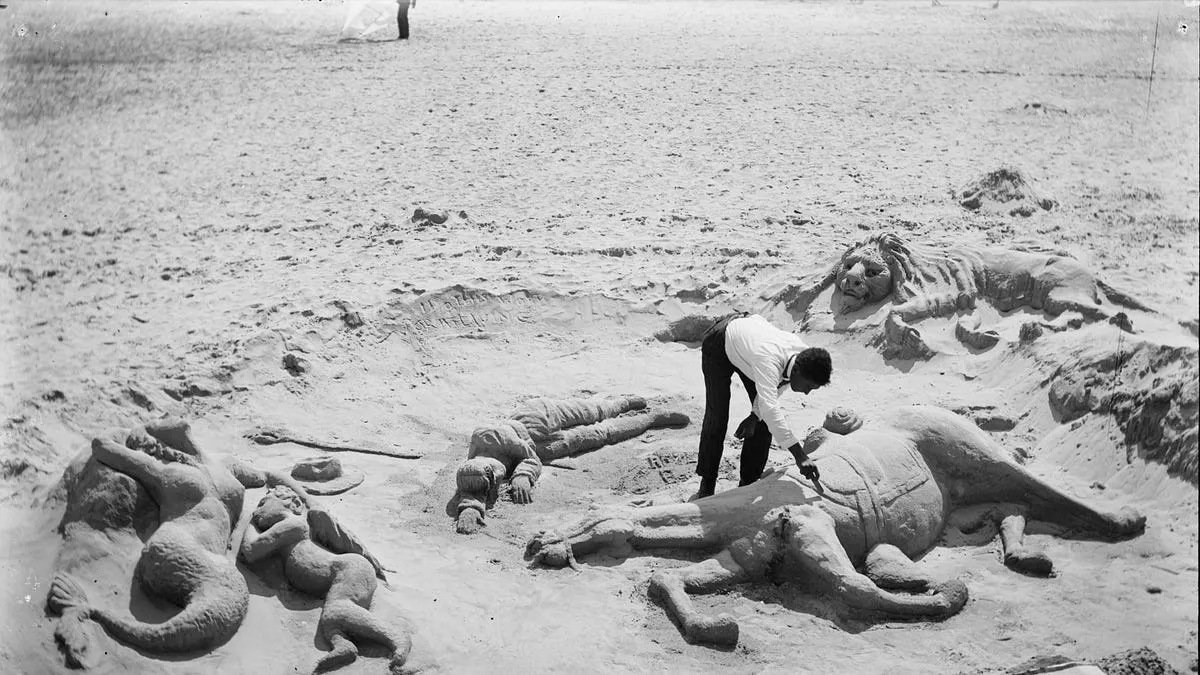
This and all further images are from Unheimliches Haus. All photo credits are either myself or Jess.
The game presents a false binary, a false precision, yet it feels necessary because I do not fully believe my dad’s story that it was the disease that made Mom a woman who said she would stop loving me if I “did something bad.” Surely, it can’t have been the wind the entire time. But I also fear that my skepticism is self-serving resentment in disguise.
I cannot remember ever liking my mother. When I was younger, I primarily felt guilt for the absence of warm feelings or desire to be close. After I grew up and left the house, rancor and blame emerged as I began finding the fingerprints of her parenting style all over my life. I glimpsed her influence each time I rolled my eyes at the people who promised they’d keep loving me.
Jess and I agreed that our striving—our frenzied motion and frenetic collections of accomplishments—was in large part because we didn’t want to be like her, helpless in misery. We strove to be verbs, not nouns; active, not passive, lest we be left behind.
There was another way I tried to be different. Our mother often erupted at us for behavior like talking to her when she happened to be in a bad mood; even as a kid, it struck me as unjust that she would scream for no good reason. I swore to be different and became devoted to emotional fairness—to not only doing the right thing but to feeling the right thing.
This last vow haunts me. If my father is right about the disease, then my once-justified coolness and contempt are instead cruelty. Such feelings had been acceptable so long as I attributed to my mother the full responsibility of being a healthy adult and parent. Such feelings would no longer be acceptable.
I am a woman in a boat, and I am furious that another boat is heading toward mine. No, that’s not right. I am a child in a boat, and I am panicked because I am alone and the person in the boat in the distance is not coming. She never comes, but with the help of others I eventually learn to sail.
Three years after the diagnosis, I move back home during the pandemic. In the house, every blind is drawn. Bits of (clean) toilet paper are everywhere. Some part of my mother believes that she lives in 1980s China, where public bathrooms leave you on your own as far as wiping materials. Her pockets overflow with wads that crinkle and disintegrate and fall out and then make trails like Hansel and Gretel’s breadcrumbs. My father and I constantly pick these up from the lawn, the floor, every bedroom.
Most days, I lock myself in my sister’s room, which I use as an office. Outside, my mother wanders the hallway or crouches in the living room, rearranging shoes on the rack until all the pairs are jumbled and one of my heels is matched with a running sneaker. She is fifty-five and cannot answer a question. She is in perfect physical health and doesn’t know how to brush her teeth. She talks to those dolls, and I try not to see. The dolls, the jumbled shoes, the blankness, every part of what goes on strikes me as unheimlich—German for “unhomelike.” The word has also been translated as “uncanny.”
My father works full time and takes care of her almost all the rest of the hours. His patience astounds. Then again: He has known her since they were in first grade and has many years of buoyant memories. One day, he forgets to lock the office door while he’s on an important Zoom meeting. I try to keep my mom from going in, and she grabs me, hits me, yells at me. I welcome it. The only time these feelings of frustration and rage are appropriate is when I am being physically attacked.
Here, the game suffuses every interaction, and more often, every time I decline to interact.
If disposition: Well, what did she expect?
“I don’t know why the dolls bother you,” my dad says. “I think this shows that your mom’s real nature is very caring.”
“I don’t think so,” I say. “I’ve read lots of case studies where Alzheimer’s makes people become predators, but I don’t think that means people’s ‘real nature’ were sexual predators all along.”
I make plans to return to New York City. On one of my last nights at home, my dad sits with me in the backyard and tells me quietly of his disappointment. He wants to feel tenderness and love and concern emanating from me, but what he feels is my reserve and what he sees is my closed door.
There’s a breeze, but the sky is cloudless, that eerie California perfection that feels incongruous with the darkness and disarray inside. My mother was the one who bothered with the yard, and so every once-living thing is now not merely dead but bleached to a yellow crisp. If I squint I can pretend it’s a plot of prairie. The wicker chair feels cool under my thighs.
“I don’t need you to take care of her,” he says. “I know you’ll do it if I ask. But I don’t feel care for her from you.”
If only I had a well of happy memories to draw on for strength. If only I had a bank of goodwill from which to make withdrawals, to fortify me to be a better person toward one who deserves compassion. He wants me to treat my mother like the mother she would have been if not for this illness, but that mother does not exist in our timeline. I want to forgive too, and if my dad is correct, then there is at once nothing to forgive and yet nothing to draw upon for strength. The mother she would have been is in some other universe, hanging out with the daughter she didn’t ignore.
“Well, she took care of me,” I said, “but I never felt care from her either.”
Each winter, I go home for Christmas and notice how my mother has lost yet another skill; then I return to New York and try not to think about it anymore. Five years after my last stint in that house, my mother requires full-time care. While caregivers help for a few hours during the day, my dad is now essentially the single father of an ever-regressing toddler. He can’t shower for more than five minutes because of what she might g
正文由 探How 从来源站点 RSS 同步,内容未经改写;遇到排版缺失或需要图片、视频时请以原文为准。