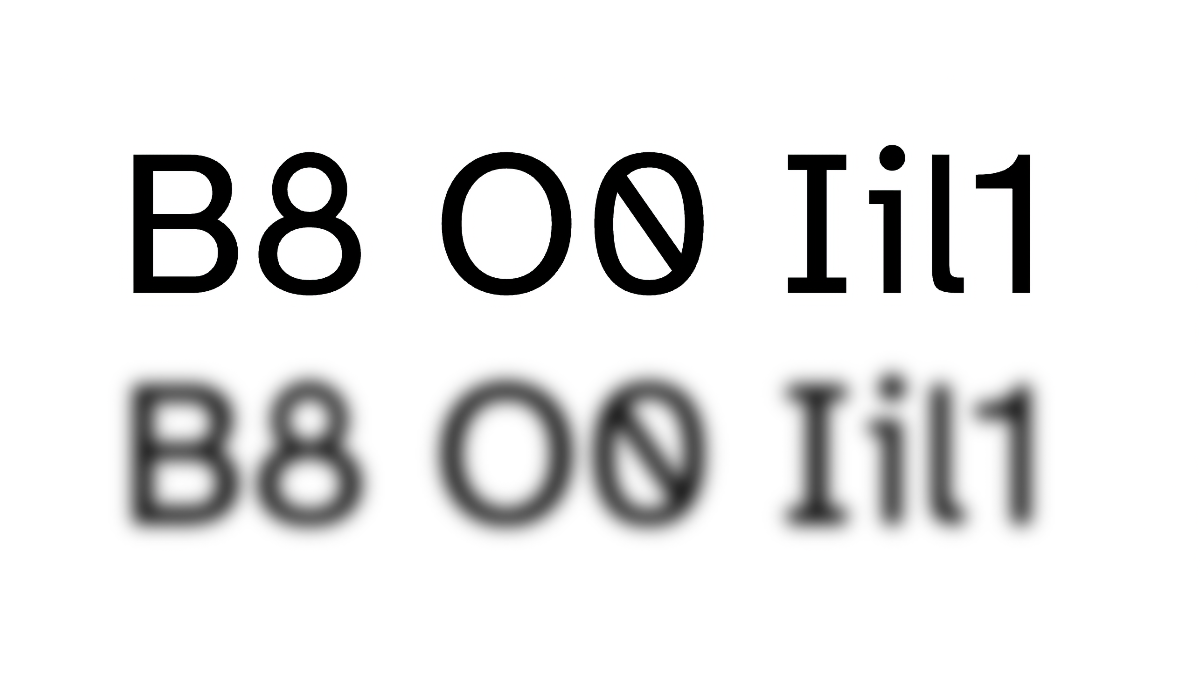
Lexica Ultralegible is a new font for low-vision readers
Lexica Ultralegible builds on the Braille Institute's Atkinson Hyperlegible with 589 glyphs per font, support for 102 languages, standard ligatures, updated kerning, and an alternative zero, and it's free under the Open…
以下正文同步自 Hacker News 最新,版权归原站所有,已转换为易读排版。
Lexica Ultralegible builds on the Braille Institute's Atkinson Hyperlegible with 589 glyphs per font, support for 102 languages, standard ligatures, updated kerning, and an alternative zero, and it's free under the Open Font License.
By Jon Henshaw in Web Development News Published Oct 15, 2026 (Updated Oct 15, 2026)
Lexica Ultralegible is designed for low-vision readers, for whom certain letters and numbers can be hard to distinguish from one another.
Lexica Ultralegible is a new typeface designed for low-vision readers. It's based on Atkinson Hyperlegible, a sans-serif typeface that was made for the same audience.
Atkinson Hyperlegible was introduced in 2019 by the Braille Institute of America and Applied Design Works, where it was designed by Elliott Scott. It started as part of the Braille Institute's centennial rebranding after Applied Design Works couldn't find an existing typeface that met its legibility goals. When they tested fonts like Times New Roman and Frutiger, partially sighted readers had trouble telling similar-looking characters apart because those fonts favor uniformity.
That's important because most of the students the Braille Institute works with aren't fully blind and don't use braille. And according to the WHO, at least 2.2 billion people have a vision impairment.
Lexica Ultralegible was originally called "Atkinson Hyperlegible Pro." It was renamed to comply with the Open Font License (the SIL license the Braille Institute used when it made Atkinson Hyperlegible available on Google Fonts in 2021) and to respect the original creator's rights, Jacob Perez, who maintains the project.
Unlike the original Atkinson Hyperlegible font, which had 335 glyphs per style and covered 27 languages, Lexica Ultralegible has 589 glyphs per font and supports 102 languages. It also adds standard ligatures (fi, ff, ffi, fl, ffl), better kerning, and an alternative zero that flips so it isn't confused with the Danish Ø.
The font is available in four styles across two weights: Regular and Italic at 400, and Bold and Bold Italic at 700. If you want to try it, you can download Lexica Ultralegible from GitHub.
If you want to use Lexica Ultralegible on your site, download the four WOFF2 files, upload them to your server, and then add the @font-face rules inline in the <head> area. I recommend preloading the fonts and including crossorigin, because they are fetched over CORS when preloaded.
<link rel="preload" href="/fonts/LexicaUltralegible-Regular.woff2" as="font" type="font/woff2" crossorigin> <link rel="preload" href="/fonts/LexicaUltralegible-Bold.woff2" as="font" type="font/woff2" crossorigin> <style> @font-face { font-family: "Lexica Ultralegible"; src: url("/fonts/LexicaUltralegible-Regular.woff2") format("woff2"); font-weight: 400; font-style: normal; font-display: block; } @font-face { font-family: "Lexica Ultralegible"; src: url("/fonts/LexicaUltralegible-Italic.woff2") format("woff2"); font-weight: 400; font-style: italic; font-display: block; } @font-face { font-family: "Lexica Ultralegible"; src: url("/fonts/LexicaUltralegible-Bold.woff2") format("woff2"); font-weight: 700; font-style: normal; font-display: block; } @font-face { font-family: "Lexica Ultralegible"; src: url("/fonts/LexicaUltralegible-BoldItalic.woff2") format("woff2"); font-weight: 700; font-style: italic; font-display: block; } body { font-family: "Lexica Ultralegible", "Atkinson Hyperlegible", Helvetica, Arial, sans-serif; } h1, h2, h3 { font-variant-ligatures: no-common-ligatures; } </style>Some additional tips include using font-display: block to ensure text displays in the web font instead of swapping to a fallback, and turning off ligatures for headings and large display text.
Jon Henshaw is the founder of Coywolf and an industry veteran with almost three decades of SEO, digital marketing, and web technologies experience.
正文由 探How 从来源站点 RSS 同步,内容未经改写;遇到排版缺失或需要图片、视频时请以原文为准。