New Proliferation Era – Why more countries will build the bomb
In 1938, nuclear fission was discovered by German chemists Otto Hahn and Fritz Strassmann. 1 year later, a warning letter was read by US President Franklin D. Roosevelt. What followed was a $39 billion (2026), 130,000-p…
以下正文同步自 Hacker News 最新,版权归原站所有,已转换为易读排版。
North Branch Media
Apr 14, 2026
2
Share
The Nuclear Foundation
In 1938, nuclear fission was discovered by German chemists Otto Hahn and Fritz Strassmann. 1 year later, a warning letter was read by US President Franklin D. Roosevelt. What followed was a $39 billion (2026), 130,000-person effort that culminated in 1945 with the first nuclear explosion in New Mexico. 3 weeks later, Hiroshima was obliterated; over 140,000 perished.
Producing the first nuclear device sealed the United States’ control over global order. In the years that followed, the US occupied Japan, NATO was established, and the dollar became the reserve currency.
This unrivaled dominance ended in 1949 when the Soviets tested their own bomb, ushering in a period of proliferation, conflict and uncertainty known as the Cold War.
Today, nuclear powers have unique privileges. These include:
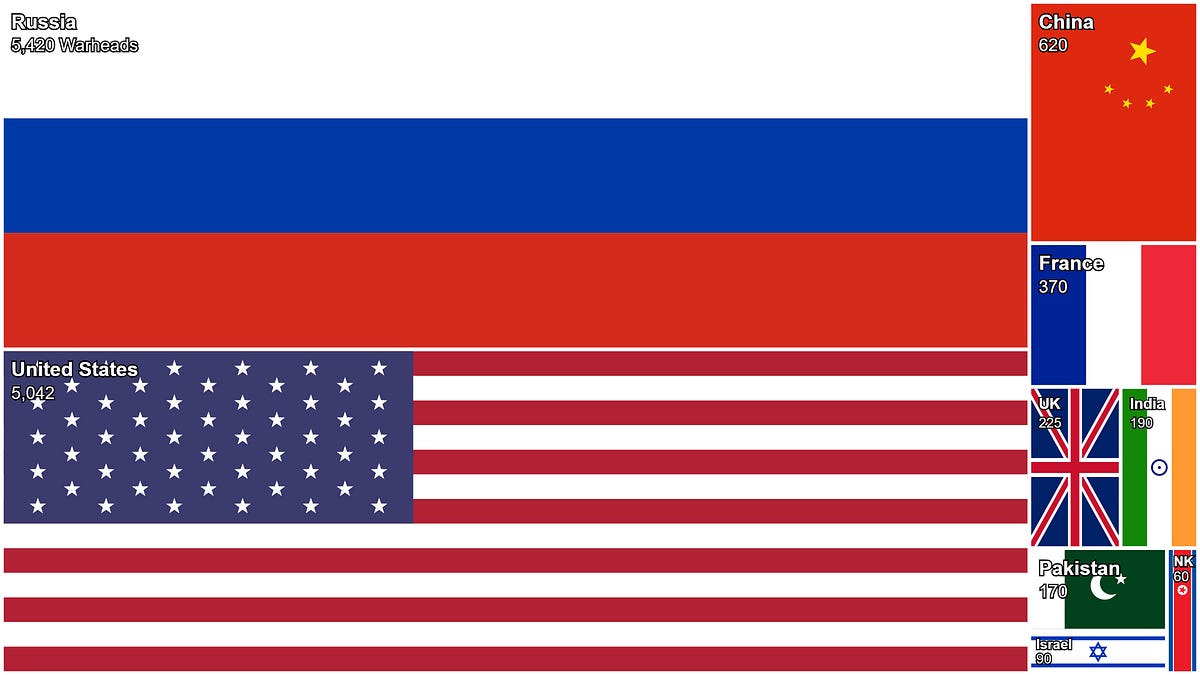
Global power. The five permanent United Nations Security Council members are the first five states to build nuclear weapons (and holders of the largest arsenals), all granted resolution veto power. This gives the UK and France influence beyond what their conventional military strength warrants.
Regional power. In 1999 — fearful of catastrophic retaliation — India chose not to invade Pakistan after being provoked in the Kargil conflict. During Russia’s 2022 invasion of Ukraine, the Biden administration restricted Ukraine’s use of long-range missiles to avoid provoking Moscow. If China invades Taiwan, the US may demonstrate similar behavior.
Regime protection. In 2013 a spokesman for the Supreme Command of the Korean People’s Army stated “This land is neither the Balkans, Iraq nor Libya,” citing examples of overthrown non-nuclear regimes. Preventing another rogue nuclear regime was also the primary motivation for the 2026 Iran War which in turn strengthened the case for acquisition.
Nuclear weapons architecture is designed to prevent first-use through Mutually Assured Destruction. States must have confidence in their adversaries’ abilities to inflict unacceptable retaliation known as second strike capability. This can be undermined by:
Location intelligence. Using warhead locations to disarm an adversary in a preemptive strike.
Interception. Ability to neutralize an incoming warhead.
Decapitation. Ability to degrade command, control, and communications kinetically or via cyberattack to prevent a launch.
Any failure to retaliate against a nuclear attack degrades future MAD confidence. MAD can be maintained through
Launch diversity and dispersion. Nuclear architecture is a triad composed of bombers, InterContinental Ballistic Missiles and submarines (SSBNs). In the air, recallable stealth bombers provide optionality. On the ground, silos can be spread across hundreds of miles creating significant targeting burdens. Road-mobile launchers are literally a moving target. Under the sea, US SSBNs maintain continuous patrol immune from enemy targeting. In coming decades, space-based deployment may be commonplace.
Interception limits. Globally, the ability to intercept ICBMs is limited. The United States employs 44 interceptors designed to counter a rogue strike from North Korea. Russia exclusively defends Moscow and can handle “1-2 modern ICBMs.” China’s interception program is also regional and unproven at scale.
Survivable launch authority. On top of deep lines of succession, the US keeps aircraft capable of launch authorization aloft continuously. Russia retains a semi-autonomous retaliation system if detonations are detected and communications fall silent.
From a nuclear power's perspective, the fewer adversaries to deter, the better. And for fifty years, an international framework was built around that logic.
Opened for signature in 1968, the UN-sponsored Treaty on the Non-Proliferation of Nuclear Weapons is currently ratified by 190 nations. It states:
Countries without weapons cannot acquire them.
The 5 original states must commit to eventual disarmament.
A pathway for signatories to develop nuclear energy.
Global weapons quantity peaked peaked at ~70,000 in 1986 and has decreased to ~12,000 today. Nuclear power went from supplying 0% of global electricity to 9% today. Only 4 additional countries developed weapons, far fewer than the 20-30 US intelligence predicted in 1963.
North Korea conducted its first successful test in 2006 and first thermonuclear test in 2017. That same year, DPRK demonstrated ICBMs capable of reaching the continental US.
In 2023, citing the war in Ukraine, Russia suspended participation in New START, the US-Russia treaty capping each country at 1,550 deployed strategic warheads.
Prior to the US strike in 2025, intelligence indicated Iran needed “less than one week” to produce enough highly enriched uranium for a weapon.
China’s longstanding arsenal of ~200 warheads is projected to exceed 1,000 by 2030.
Federation of American Scientists
Nuclear status has conferred standing no conventional capability can replicate, coerced neighbors, and protected regimes. Meanwhile, advances in technology and open-source intelligence have materially lowered the barriers to breakout. As the US's deterrence umbrella faces mounting credibility questions — strained by the limits of American security commitments, the rise of Chinese power and alliance tensions — the calculus for threshold states is shifting. The proliferation of nuclear weapons is likely to accelerate over the coming decades with more actors, larger arsenals, and weaker command architectures than ever before.
Federation of American Scientists
Interactive Nuclear Weapons Capabilities Map.
A primary reason the NPT succeeded was the United States extending its second-strike capabilities. According to the Chicago Council on Global Affairs “Rather than developing their own national nuclear capabilities, key allies in Europe and Asia opted to rely on the US nuclear guarantee instead.” This calculus is changing.
In 2023, when asked whether the US would fulfill its pledge to defend with nuclear force, only 40% of South Koreans responded yes. The Trump administration considered withdrawing from NATO several times throughout its first term. Trump also threatened to use military force against an ally in his remarks about Greenland. The credibility of the US nuclear umbrella reduces to a single question. Would the US give up San Francisco or Los Angeles for Tokyo, Seoul or Taipei? What about New York or Washington for Rome or Tallinn? At a time of accelerating global instability, the a new proliferation era is a question not of if, but when.
Time from political decision to sufficient fissile material for a first nuclear device. Breakout Scorecards.
A Nuclear World
The trajectory is clear: more countries will acquire nuclear weapons in the near future, increasing the risk of hot conflict and accidents alike. Preventing this requires action on multiple fronts.
The United States must reaffirm its nuclear commitments. Allied nations should be included in planning and financing, reducing the perception that extended deterrence is an American favor that the president can revoke.
European and Asian allies must enhance their conventional military deterrence to reduce dependence on American strength. France and the UK should formally extend their deterrents to European allies. The Indo-Pacific needs a nuclear planning group modeled after the UK-French Northwood Declaration to give Japan, South Korea, Taiwan and Australia visibility into deterrence operations to reduce breakout timeline acceleration.
New START expired in February 2026 without a replacement, leaving the US and Russia without constraints on their arsenals for the first time since the 1970s. Any successor framework must include China and its projected arsenal of 1,000+ warheads by 2030.
The US needs to invest in missile interception capability. As more unpredictable adversarial ICBMs are produced, the 44 ground-based interceptors will not suffice. Expanding and modernizing this capacity is not escalatory; it is insurance against reckless regimes.
Together, these represent the difference between a managed multipolar nuclear order and a cascade. While history suggests these will not be pursued with the urgency the moment demands, there may be no greater return on investment.
This essay was inspired by Preventing Nuclear Proliferation and Reassuring America’s Allies (2021) published by the Chicago Council on Global Affairs.
Contact North Branch Media at media@northbranch.co.
正文由 探How 从来源站点 RSS 同步,内容未经改写;遇到排版缺失或需要图片、视频时请以原文为准。