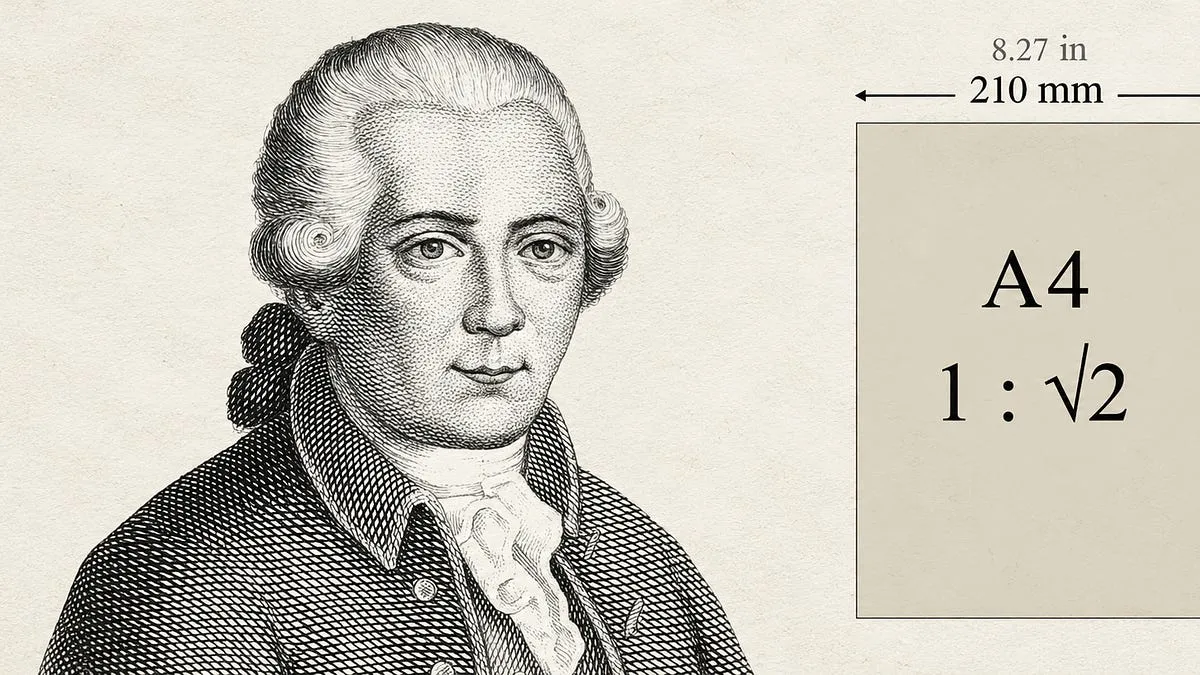
A4 Paper Is One of Humanity's Greatest Achievements
There are objects so ordinary that we stop seeing them.
以下正文同步自 Hacker News 最新,版权归原站所有,已转换为易读排版。
Snarky Gherkin (The Gherk)
Oct 14, 2026
147
51
16
Share
There are objects so ordinary that we stop seeing them.
A door hinge. A shipping pallet. A traffic light. The little plastic tab on a bread bag.
You will probably look at a sheet of it today and think absolutely nothing. Maybe it will be sitting in a printer tray. Maybe it will have an electricity bill on it. Maybe somebody at work will hand it to you with a sentence beginning, “Just quickly…”
And you will not pause to consider that the boring white rectangle in your hand is mathematically magnificent.
So I’m going to make that piece of A4 paper you barely notice blow your mind.
I’m going to take you from eighteenth-century mathematics, through German engineering and international standardisation, into the quiet machinery of global cooperation, and then, inevitably, to America looking at an elegant system used across most of the planet and saying:
It is what happens when millions of strangers agree to use the same rule.
And it may be one of humanity’s most successful inventions precisely because almost nobody ever thinks about it.
The magic is in the ratio between the short side and the long side:
That sounds like the sort of thing a maths teacher writes on the board immediately before half the class begins wondering what is for lunch.
But this particular ratio does something beautiful.
Take a sheet of A4 paper and cut it in half across the long edge.
And each A5 sheet has exactly the same proportions as the original A4 sheet.
Go the other direction and join two A4 sheets together.
Every time you halve the sheet, the shape stays the same.
That only works because of the square root of two.
DIN, the German standards body, formalised this paper-size system in 1922 as DIN 476. The base size, A0, was designed around an area of one square metre, and every smaller size follows from halving while preserving the same aspect ratio. A0 is 841 × 1189 mm: A4 lands at the familiar 210 × 297 mm.
You can scale a document from A4 to A3 and the proportions remain intact.
You can shrink A3 onto A4 without redesigning the page.
You can print two A5 pages on a single A4 sheet.
Printers, folders, envelopes, filing cabinets, photocopiers, publishing systems and office stationery can all be built around the same mathematical family.
It is a rectangle that cooperates with itself.
The really fun part is that the underlying idea predates the modern standard by well over a century.
In 1786, the German physicist Georg Christoph Lichtenberg wrote about the useful property of a rectangle with the 1:√2 ratio: halve it, and the smaller rectangle keeps the same shape. The idea later resurfaced in various attempts to rationalise paper sizes before engineer Walter Porstmann helped turn it into the DIN system in the early twentieth century.
So A4 is not the product of someone in an office in 1973 saying, “210 by 297 feels about right.”
And this is where the story becomes bigger than stationery.
Because the brilliance of A4 is not just that the maths works.
We tend to tell history through wars, elections, queens, revolutions and people dramatically signing things in large rooms.
But a huge amount of civilisation actually depends on something far less cinematic: standards.
A screw made in one factory fitting a nut made in another.
A shipping container fitting on a ship, train and truck.
A barcode being readable in another country.
A web browser understanding what another computer is sending it.
A sheet of paper fitting into a printer made somewhere else.
Standards are what allow millions of people who will never meet to cooperate without having to negotiate from scratch every morning.
Germany standardised the A-series in 1922. After the Second World War, the system spread increasingly widely, and in 1975 the International Organization for Standardization published ISO 216, formalising the A and B series internationally. The current version remains ISO 216:2007.
That postwar spread is the bit I love because the decades after 1945 saw countries increasingly build institutions designed around the idea that common systems make life easier.
International aviation standards. Shipping standards. Measurement standards. Telecommunications standards. Technical standards. The boring architecture of cooperation. And somewhere among all that sat a rectangle.
A Japanese office worker, a German engineer, a Brazilian accountant and an Australian teacher can all reach for a sheet of A4 and know exactly what they are dealing with.
Of course, most stories about global standardisation eventually arrive at the same plot twist.
Most of the world looked at the A-series and said: “This is mathematically elegant, scalable and internationally useful.”
America looked at it and said: “Interesting. Anyway, 8½ by 11.”
US Letter paper measures 8.5 × 11 inches.
Unlike A4, its proportions are not based on √2, which means if you cut it in half, the resulting sheet does not retain the same proportions.
The United States also uses Legal at 8.5 × 14 inches, and Ledger/Tabloid at 11 × 17 inches. The American ANSI system eventually formalised these sizes around the existing Letter format.
Now, to be fair to the Americans, letter-sized paper became entrenched in US commerce and administration long before international A4 standardisation became dominant, and American standards bodies subsequently built a coherent domestic system around it. The US government only settled firmly on Letter as its standard office size much later, in the early 1980s.
A4 says: Here is a mathematically elegant system derived from geometry.
US Letter says: We have always done it this way.
US Letter begins with somebody somewhere having a paper tray they did not want to replace.
That may be the most beautiful thing about it.
That is what happens when a standard succeeds completely.
Nobody gets excited about metres anymore.
Nobody walks into a hardware store and marvels that every tape measure agrees about what a centimetre is.
Nobody celebrates that an M8 bolt made in one country can fit a standard M8 nut made somewhere else.
It has become so universal across much of the world that its proportions feel natural.
They are the product of mathematics, engineering and institutions convincing people that life works better when everyone uses the same rectangle.
That is, in its own tiny way, a remarkable act of human cooperation.
There is something almost touching about that.
Human beings are very good at disagreeing.
We argue about borders, politics, religion, economics, sport, whether pineapple belongs on pizza and the correct way to load a dishwasher.
Yet billions of us can quietly agree that 210 × 297 mm is a perfectly sensible size for a document.
And behind that agreement sits an irrational number.
Cannot be expressed exactly as a simple fraction.
Yet somehow it became the organising principle for one of the most ordinary objects on Earth.
A4 is proof that civilisation is not only built through grand acts of leadership.
Sometimes it is built when somebody notices a clever property of a rectangle, somebody else standardises it, thousands of engineers and bureaucrats agree, dozens of countries adopt it, and eventually billions of people stop noticing the achievement entirely.
So next time a sheet of A4 comes out of the printer, give it a moment.
A descendant of eighteenth-century mathematics.
Eventually embedded in an international standard used across much of the planet.
A tiny monument to the idea that strangers can agree on something sensible and make everybody’s life slightly easier.
Because apparently even the square root of two could not win them all.
A bit different from the usual politics and policy, but this is exactly the sort of thing I love… taking something completely ordinary, pulling at one loose thread, and discovering there’s a whole story hiding underneath it.
If nothing else, I hope the next time a sheet of A4 comes out of the printer, you look at it with slightly more respect than you did yesterday.
正文由 探How 从来源站点 RSS 同步,内容未经改写;遇到排版缺失或需要图片、视频时请以原文为准。