The BBC Strikes Back
With so much going on right now, we pick up with an unusual Friday afternoon column to cover Trump’s defamation case against the BBC. That leaves us with the weekend to catch up on election-related litigation. Sorry abo…
以下正文同步自 Hacker News 最新,版权归原站所有,已转换为易读排版。
Joyce Vance
Oct 23, 2026
2,578
104
550
Share
With so much going on right now, we pick up with an unusual Friday afternoon column to cover Trump’s defamation case against the BBC. That leaves us with the weekend to catch up on election-related litigation. Sorry about the extra work, especially on a Friday!
Last Sunday, in my The Week Ahead column, I wrote to you about Trump’s $10 billion defamation lawsuit against the BBC. Discovery is underway. The president’s lawyers argue the BBC deceptively edited footage of Trump’s January 6 speech to omit him telling a crowd gathered in Washington, D.C., that day to march “peacefully and patriotically” to the Capitol. The BBC apologized for omitting the part Trump wanted included from the montage it aired.
We took up the case because Don Trump Jr., Jared Kushner, and Ivanka Trump, who the BBC says have “personal knowledge” and records that are relevant to Trump’s claims, have been using the Secret Service to duck subpoenas. This has been going on since August, and with the court-ordered discovery deadline approaching in December, the BBC asked a judge for help and obtained permission to serve the subpoenas by alternative means, such as certified mail or service on attorneys of record.
But the court docket in this case is replete with discovery disputes. That’s nothing new for Donald Trump, but he is, after all, the plaintiff in this case. Keep in mind, this is his lawsuit. He brought it. His lawyers are pursuing it, and he would have known going into it that he and his adult children would be subject to discovery. He knew a deposition was coming when he filed the lawsuit, and presumably, if he wants to proceed, discovery needs to take place.
One dispute involves the BBC’s demand for information about the number of applications for Mar-a-Lago club membership and the amount of dues paid, which the BBC says is a “uniquely effective litmus test of Plaintiff’s reputation.” That’s an essential element to prove damages in a defamation case, and something else Trump would have known was coming when he filed the lawsuit. But he seems determined to fight discovery in his own case tooth and nail.
Now, there’s more, involving Donald Trump personally. He doesn’t want to be deposed, something else that was entirely predictable. Trump had agreed back in July to an October 16 deposition, but his team had gone radio silent on the details in the weeks leading up to the deposition.
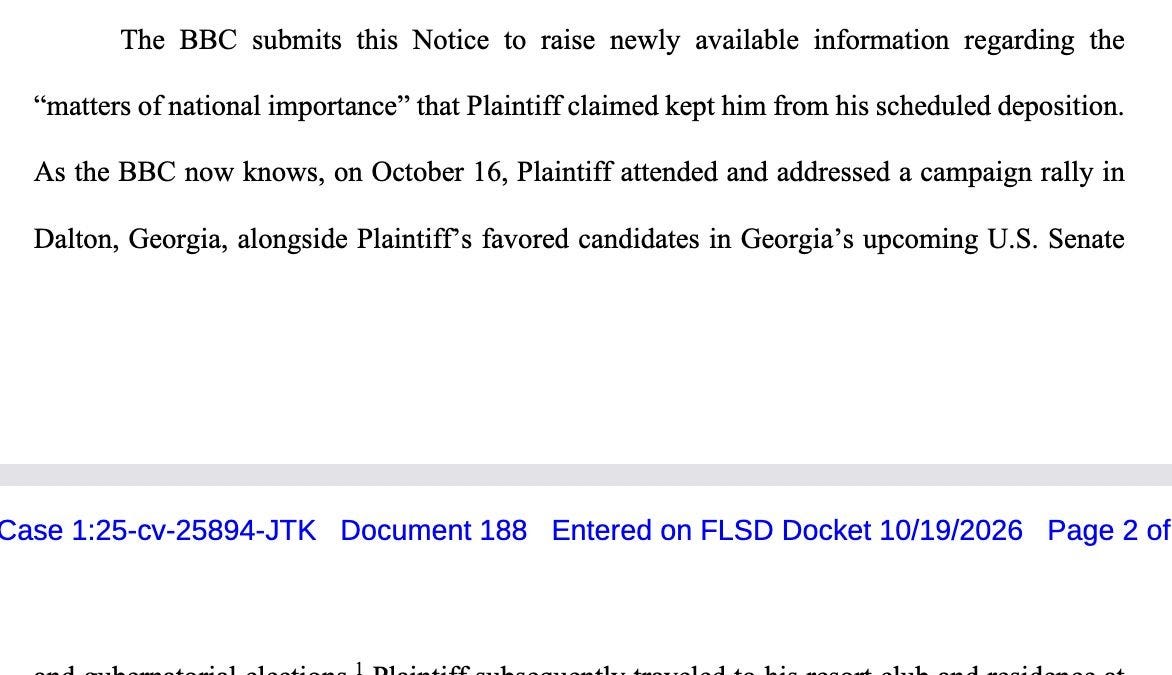
Just in advance of the date, Trump’s team notified the BBC’s lawyers that “the President is no longer available for his deposition on October 16 due to other matters of national importance” and that counsel would “endeavor to provide you with a replacement date by the end of this week.” They did not. They did say that “Plaintiff [Trump] would make himself available for a deposition in the second or third week of January 2027,” but did not provide any specific date, according to the BBC’s filing.
Subsequently, the BBC enlightened the court about the pressing matters on Trump’s calendar that would interfere with his deposition: a rally in Georgia and a fundraiser at Mar-a-Lago.
The BBC asked the court to compel Trump to sit for his deposition. On Thursday, a federal magistrate judge ordered Donald Trump to sit for his deposition on or before December 11, and told his team to comply with the discovery process. If they don’t, they could face sanctions, which can include dismissal of the case under the Federal Rules of Civil Procedure. So which will it be? A pre-Christmas dismissal or a deposition? My money is against Trump sitting down to be grilled by opposing lawyers.
A British Company, the BBC is schooling American media on the First Amendment. It is pushing back on points like Trump’s rejection, without explanation, of videotaping the deposition. That’s a fairly standard move to preserve evidence. Instead of rolling over like CBS did when Trump brought a widely criticized defamation case against them over a 60 Minutes interview, the BBC is fighting back. Paramount settled that case, coughing up $16 million. Here, it doesn’t look like that’s going to be the outcome, which makes this a case worth following.
The BBC is doing something important, refusing to be intimidated by a powerful person trying to use the legal system to punish criticism and discourage scrutiny. That’s what Civil Discourse is about, too. Our work here involves holding powerful people accountable, no matter who they are. We’re a community that understands how much is at stake.
正文由 探How 从来源站点 RSS 同步,内容未经改写;遇到排版缺失或需要图片、视频时请以原文为准。