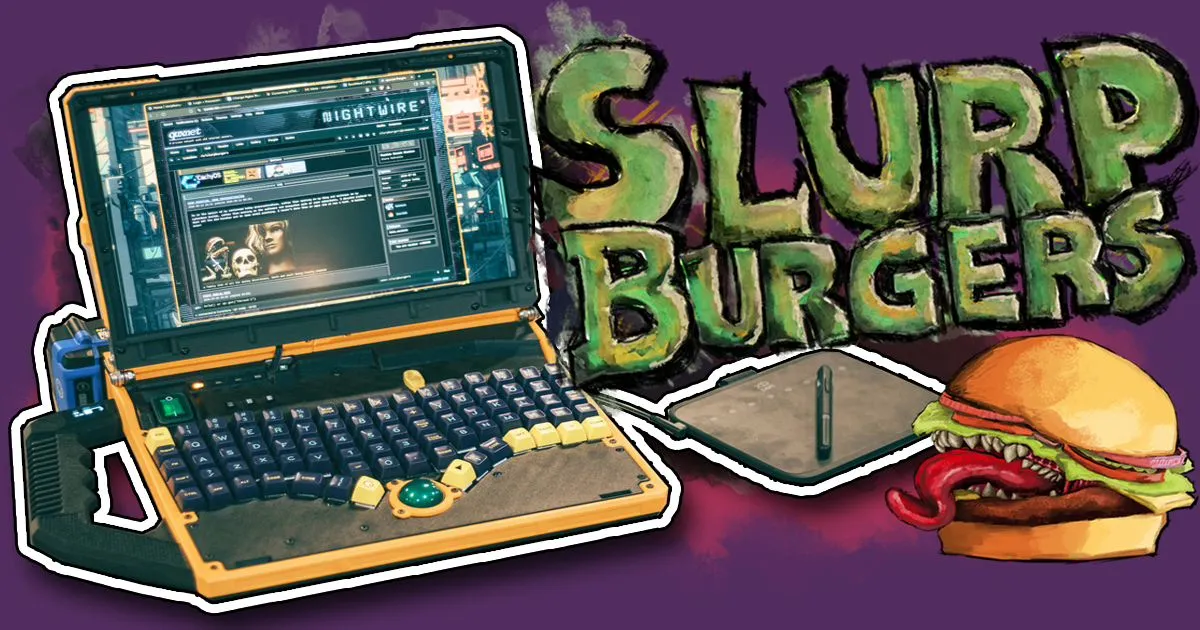
The Slurptop: A home-built luggable that runs on power tool batteries
Prior to completing this project I didn't have a modern laptop. I also had never tried out a trackball mouse. After completing a Writerdeck and a Cyberdeck based on Raspberry Pi SBCs, I felt that it would be incredibly …
以下正文同步自 Hacker News 最新,版权归原站所有,已转换为易读排版。
Prior to completing this project I didn't have a modern laptop. I also had never tried out a trackball mouse. After completing a Writerdeck and a Cyberdeck based on Raspberry Pi SBCs, I felt that it would be incredibly useful to have a full-fledged x86 portable computer. You know, a laptop. Why not spend two months designing, building, and refining a laptop myself instead of just hitting up Best Buy for a new laptop that's ready to go? I mean, I don't have good justification beyond "because I can, and I want to", but sometimes that's all the justification you need!
At the outset of the design process I started looking at Intel N50 and N100 mITX motherboards and PicoPSU power delivery, but started getting discouraged at the price prospect of something that was more expensive than a Raspberry Pi, consumed more power, didn't offer much more computing power than a Pi, and consumed significantly more power. That's when I figured if I was heading in a high power draw x86 setup, why not start shopping out some mini PCs?
That's where I found some decently spec'd out units with laptop processors and integrated graphics. These, I figured, would fit the bill for a machine that would be destined for some coding and light design work. Next up would be figuring out the power delivery.
Since my last folding screen Cyberdeck, I've been really enjoying designing within the Cyberpunk aesthetic. One of the aesthetic aspects that I felt the last build was missing was improvised part selection. Then I had the thought of powering the unit with a 24v power tool battery. The design aesthetic and the improvised hardware selection dovetailed beautifully in the design of the power delivery. The mini PC I bought had a 19v/5a power supply, and my power tool batteries were 24v. With a properly spec'd boost/buck converter, that should work perfectly both on the aesthetic requirement as well as the power and current requirement.
Now we get to the fun stuff: sketching out the design.
If you're interested in Cyberdecks, I'm sure you've seen a plethora of devices. From slabs without a hinging screen, to vintage computer style raising screens (like I used on my gray Cyberdeck), to absolutely awesome sliding designs like u/Personalitysphere's sliding modular Cyberdeck. I wanted something that would have the rough form factor of a laptop.
With the form factor decided on, the next step in every project I do is to gather up all the components, grab my calipers, and get to measuring and modeling in Blender. I make "good enough" 3d models of EVERYTHING. It's tedious and time consuming, but I wouldn't do it any other way. You can package everything so much nicer when using this method, and you run into WAY fewer problems during the assembly stage, WAY fewer redesigns and reprints, etc. This is the "measure twice" process when building a device like this, even though it's more along the lines of "measuer ten thousand times". Very worth it, and I highly recommend approaching things from this direction. Not to mention you're honing your ability to measure and model things, which is invaluable as a desinger.
After establishing the layout of the individual components, I start going through a process of sketching out designs and layouts. Usually I have a pretty clear vision of what I'm going for at this point, but a lot of design elements are "discovered" at this stage. It's also where some hard choices have to be made because establishing certain design elements sets you down a road where if you choose to go a different direction you can't just CTRL+Z you're way out of. You have to delete a LOT of work sometimes.
I'll jot out some of the notable design choices and processes that I went through:
正文由 探How 从来源站点 RSS 同步,内容未经改写;遇到排版缺失或需要图片、视频时请以原文为准。