Against Mathematics
It is well known that the man who first made public the theory of irrationals perished in a shipwreck in order that the inexpressible and unimaginable should ever remain veiled. And so the guilty man, who fortuitously t…
以下正文同步自 Hacker News 最新,版权归原站所有,已转换为易读排版。
doomslide
Oct 24, 2026
42
8
17
Share
It is well known that the man who first made public the theory of irrationals perished in a shipwreck in order that the inexpressible and unimaginable should ever remain veiled. And so the guilty man, who fortuitously touched on and revealed this aspect of living things, was taken to the place where he began and there is for ever beaten by the waves.
In a previous essay I argued that mathematics is effectively dead. And yet, lo and behold, it is still with us, alive and kicking. It would not be the first animal to keep walking about after its death. More than eighty years ago, a farmer in Fruita, Colorado successfully decapitated a rooster by the name of Mike, only to watch him tour the country for eighteen months beside a two-headed calf. Fruita still holds a race in his honor called Run Like a Headless Chicken. As it turns out, very little of a chicken is in its head.
We have been running a similar experiment in mathematics for a while now. There will no doubt be disagreement as to when the head came off, since the chicken has yet to notice. Was it 6 October 2026? 10 August 2014, in Pittsburgh, USA? Perhaps it was the afternoon of Monday 3 September 1928, in Bologna, Italy? It depends which head you mean; mathematics always had more in common with the calf anyhow. A short history of heads, then, in order of appearance.
In the beginning there was the head, or rather two heads, one to think and one to talk. Then came writing, so the talker learned to write while the thinker learned to read. Eventually there was more to read than one head could handle so the reader split again, into a blind head that checks and a slow head that digests. The writer was never split, and has not let the other two forget it: the proud head. For most of the last century all three heads were expected to sit on a single neck: teaching, refereeing, publishing.
Michael de Villiers, who studies how proof is taught, counts six functions of proof: verification, explanation, systematisation, discovery, communication and intellectual challenge. Six is a lot of heads, even for a calf. Discovery is the proud head. Explanation, systematisation and communication the slow head. Verification the blind head. Intellectual challenge is the reason anyone puts up with the arrangement. It should have been obvious that, of the three, the blind head was the easiest to replace, and there was no shortage of volunteers to say so.
One of them was John Horgan, a staff writer at Scientific American, author of The End of Science (1996) and The End of War (2012). In October 1993 he announced “The Death of Proof.” Mathematicians, he suggested, might at last have to admit what scientists already had: that their claims are only “true until proved false.” The blind head, he argued, was falling behind. His evidence? A geometer found new surfaces on a computer screen before he could prove they existed. The geometer took it personally. He and a colleague found a surface that closed up perfectly on the screen, missing by less than a pixel, and named it after Horgan. It was true until proved false, though not by them.
Horgan’s most decorated witness was William Thurston, who read the article in draft and, Horgan says, “liked the overall thrust.” When it came out, Thurston wrote to the magazine that “a more appropriate title would have been ‘The Life of Proof,’” and that this was “a golden age for mathematics and for proof.” Horgan rang him to ask what the hell. Thurston explained that the article might hurt his efforts to reform the profession. He had reason for precaution: three months earlier, he was among the accused.
That July, Arthur Jaffe, a pioneer in the rigorous study of quantum field theories, and Frank Quinn, a titan of four-dimensional topology, banded together to publish an essay in the Bulletin of the American Mathematical Society sardonically titled Theoretical Mathematics. As they saw it, it all started with the physicists, who over the previous decade were handing mathematicians spectacular results without proofs. Many of these physicists, they noted, have neither training for nor interest in rigor, and mathematicians developed rules of thumb to protect themselves, one of which was to regard any paper by Edward Witten as theoretical (derogatory). (A sensible precaution, seeing as three years earlier he merely became the first and only physicist ever to win the Fields Medal.) Worse, mathematicians started adopting the same standards.
Proof, Jaffe and Quinn argued, is what keeps the literature “extraordinarily reliable,” and reliability is what “permits steady and efficient advance.” A big claim without a proof scares everyone off: “rigorous mathematicians tend to flee the shadow of a big claim,” leaving behind “a dead area.” Whoever proves it later is proving the claimant’s theorem and names are often sticky. Thurston’s offense was a proof of his geometrization conjecture, announced for a large class of cases and never fully published, “a grand insight delivered with beautiful but insufficient hints.” Grigori Perelman went around it ten years later, then famously rejected the Fields medal and a million dollar prize for doing so.
Jaffe and Quinn’s proposed remedy was to put the blind head in charge of the labels. Speculation should say “conjecture” instead of “theorem,” ideally with a flag in the title that would follow it into every citation, like a quarantine flag on a boat. Whoever supplied the proof should get a major share of credit. They called this “truth in advertising.” They also called for “family values.” It was 1993, history was over, the World Wide Web was brand new and peace in the Middle East was only weeks away. We can forgive them.
Thurston’s reply came the next year, under the title On Proof and Progress in Mathematics. He set aside how mathematicians prove theorems, and even how they make progress. The right question, per Thurston, is “How do mathematicians advance human understanding of mathematics?” Slow heads have found their advocate.
He proceeds to tell a story against himself: the death of mathematics, in microcosm. As a graduate student, he proved theorems faster than he could write them up. Within a couple of years, he writes, “a dramatic evacuation of the field started to take place.” People told him, “not as a complaint, but as a compliment,” that he was killing the field. Soon he left it too.
He misunderstood what people wanted. He thought it was answers, when “more than the knowledge, people want personal understanding,” and, “in our credit-driven system,” theorem-credits as well. He took those too. So with three-dimensional geometry he did the opposite, since what mathematicians needed from him was “to learn my ways of thinking, and not in fact to learn my proof.” He counted the the revision of his notes into a high quality book among his “non-credit-producing activities.” The book came out three years later as Volume 1. Volume 2 never appeared.
Whether mathematicians exist to produce theorems or understanding was a lovely thing to argue about in 1994, the way the true purpose of the horse must have been a lovely thing to argue about in 1900.
The Bulletin printed fifteen responses, ranging from polite disagreement to Mandelbrot. Saunders Mac Lane, a co-founder of category theory, thought Jaffe and Quinn were far too lenient with speculation. He put the matter in theological terms (“we are not saved by faith alone, but by faith and works”) and concluded that “mathematics rests on proof - and proof is eternal.”
As promised, Benoit Mandelbrot. The father of fractals accused Jaffe and Quinn of trying to “set up a police state,” with “a world cop” beyond its borders. Since mathematics, he insisted, should belong to no self-appointed group, he refused to call what the American Mathematical Society does plain “mathematics” and named it instead after the street in Providence where the Society has its headquarters: “Charles mathematics,” a coinage he proposed to use “in this comment, and never again.” He then proceeded to use it seventeen more times.
For René Thom, another Fields medalist, rigor is optional and understanding is not: it is “unethical,” he writes, “for a mathematical researcher to use a result the proof of which he does not ‘understand,’” unless he is trying to disprove it. On the next page he proposes a taxonomy of his own, each with a little drawing:
Rigor is a Latin word. We think of rigor mortis, the rigidity of a corpse. I would classify the (would-be) mathematical papers under three labels:
-
a crib, or baby’s cradle, denoting “live mathematics,” allowing change, clarification, completing of proofs, objection, refutation.
-
the tombstone cross. Authors pretending to full rigor, claiming eternal validity, may use this symbol as freely as they wish. This kind of work would constitute “graveyard mathematics.”
-
the Temple. This would be a label delivered by an external authority, the “body of high priests.” This body could initially be made up of the editors in chief of the “core” papers as suggested by Jaffe-Quinn. Its task would be to bestow the label at least on those [tombstone] papers with sufficient promise to justify close examination. Later on, the IMU could decide on a permanent procedure to establish the priestly body, allowing for a relatively quick turnover of people in charge, with equitable worldwide geographic representation. One might suppose that such an institution could last a very long time. Should it however eventually come to grief, the unattainable nature of absolute rigor would be thereby demonstrated.
Note that the temple is for the crosses: much like a saint, a paper has to be dead before it counts as proper mathematics.
Seriously though, what are these bozos arguing about?
Well, the three heads run at different speeds, for different pay. The proud head must be quick: in publish or perish, second place perishes. The blind head is slower, and unpaid. The slow head is slower still, and counts for nothing.1 Its pay comes late, once a result is old enough to teach. When one head outruns another, something dies: Jaffe and Quinn called it a dead area, Thurston an evacuation, and his colleagues, meaning it kindly, killing the field.
Morris Hirsch, a topologist at Berkeley, made Horgan’s case from inside the profession: the blind head leaving the slow one behind. Checking can be divided you see: the blind head splits into a hundred referees, each with a hand on a different part of the elephant. Understanding has to fit in one head. Hirsch’s example was the classification of finite simple groups, declared complete in the early 1980s on what he put at fifteen thousand pages. Was there “an expert who claims to have read it all and verified it”? It was “overwhelmingly probable that 15,000 pages contain mistakes,” and some of the parts, he heard, were farmed out and never finished. “Can we rely on it?” He put his last question to the calf: “Who’s in charge here, anyway?”
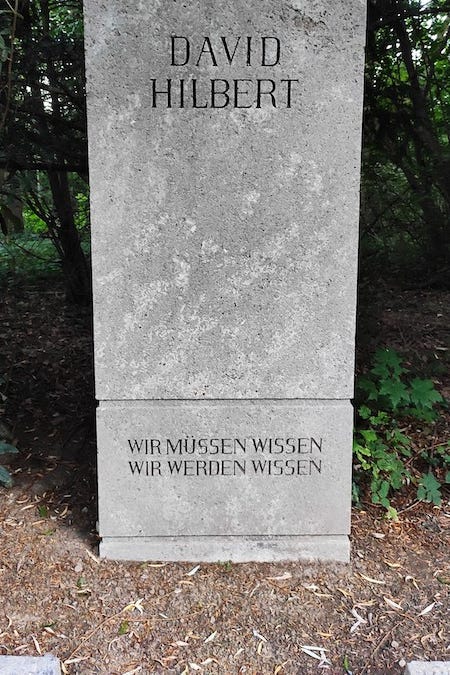
It should come as no surprise that the authority in charge is dead, and in fact has been buried for eighty-three years at this point. Here lies David Hilbert, who in 1912 became the last man to know all of mathematics by outliving the last man to know all of mathematics.
His reputation began with a bad referee report. “Hilbert has scorned to present his thoughts following formal rules,” Paul Gordan wrote to the editor of the Mathematische Annalen; “he thinks it suffices that no one contradict his proof.” The paper was about invariants, Gordan’s domain of expertise. Twenty years earlier Gordan constructed explicitly by hand what Hilbert now proved implicitly had to exist, all at once. Hilbert replied that he was “not prepared to alter or delete anything,” and that this was, “with all modesty,” his “last word.” The editor printed it as it stood. Legend gives Gordan a shorter report: “Das ist nicht Mathematik. Das ist Theologie.”
正文由 探How 从来源站点 RSS 同步,内容未经改写;遇到排版缺失或需要图片、视频时请以原文为准。