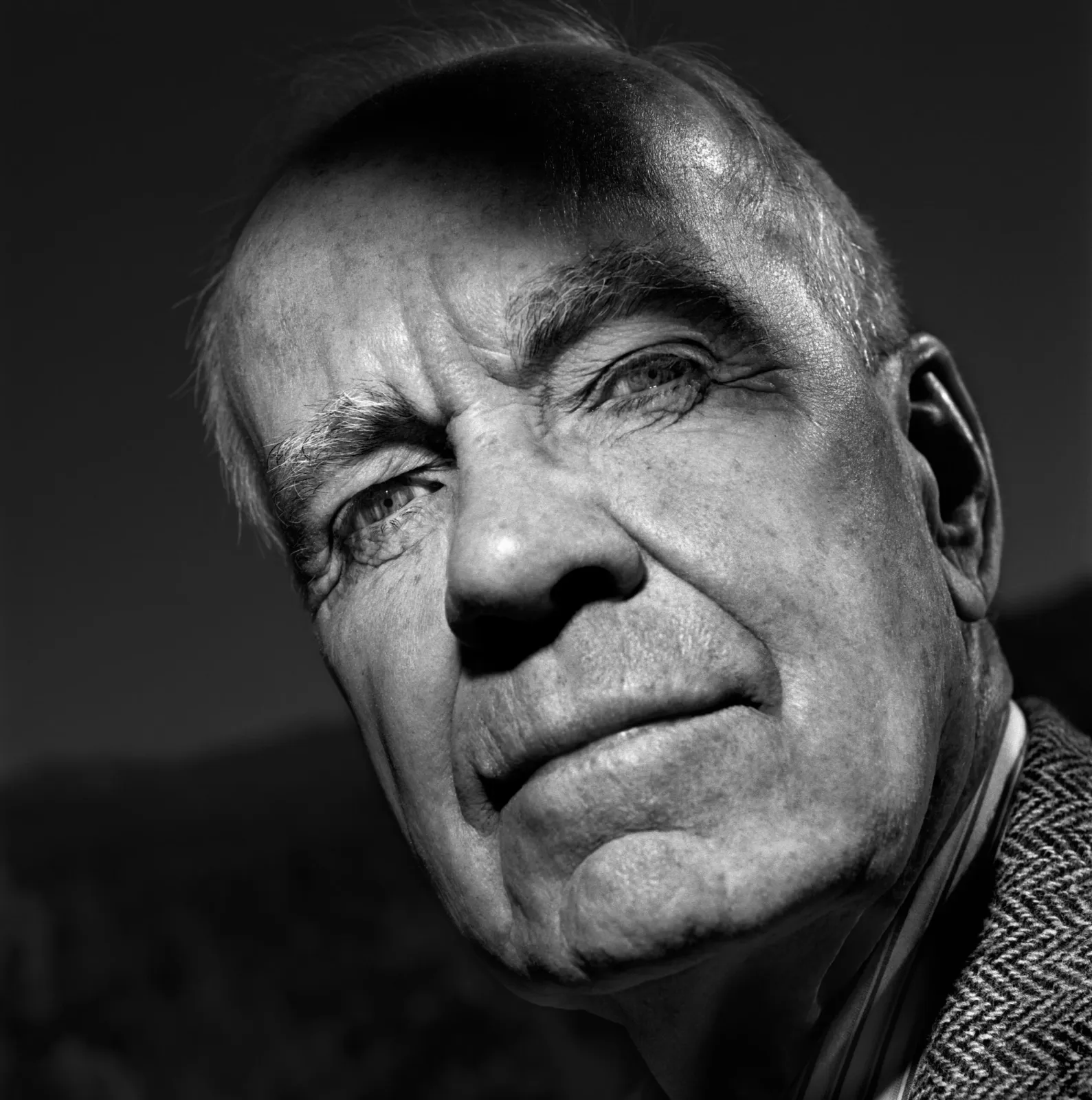
The Style Is Father of the Man
Cormac McCarthy: A Legacy Revisited, by Tracy Daugherty. St. Martin’s Press. 528 pages. $35.
以下正文同步自 Hacker News 最新,版权归原站所有,已转换为易读排版。
Cormac McCarthy: A Legacy Revisited, by Tracy Daugherty. St. Martin’s Press. 528 pages. $35.
The novels of Cormac McCarthy stand out in American literature like a mountain range, not only for their eminence but their solitariness and inhospitality. What contemporaries staked out adjacent terrain? And what younger writers could follow McCarthy to such majestic, desolate ground? During the late Sixties and the Seventies, when metafictional and postmodern colleagues produced collagelike stories or simulacra of historical novels that cast doubt on the very possibility that language could adequately represent the world, McCarthy seemed possessed instead by a sort of holy naïveté, never doubting that words could be a fit for things. During the Eighties, notable in American letters for plainspoken “dirty realism” about present-day life, McCarthy put out Blood Meridian, a novel of the mid-nineteenth century U.S.-Mexico borderlands and one of the more baroque creations in the language. Come the Nineties, DeLillo and Pynchon continued to deliver paranoid and playful social anatomies like those that had influenced a younger generation of writers then coming into their prime. McCarthy, for his part, hardly tips the brim of his hat in the direction of postwar capitalism as it parts the saloon doors.
The jagged sierra of McCarthy’s work created its own weather, that’s to say. Pessimistic, somber, and unironic in attitude, not to mention largely devoid of sex, TV, and even—except in No Country for Old Men (2005)—pickup trucks, his fiction scarcely seems to belong to the American culture, literary or otherwise, of the half century and more during which the books were first published. Or so you might say until you set about inventorying a gun show’s worth of firearms on display across twelve novels, and calculating the average murder rate for the same dirty dozen. The bloodshed is chiefly the doing of hard-bitten, taciturn characters averse to domestication—usually these are men without women, and usually they’re on the move—who don’t go in much for book learning either. In the early novels of this extraordinarily fluent and resourceful stylist, equipped to the outer limits of English by his own wide reading, the main characters are often as not illiterate miscreants who might burglarize any building before a library. The overall image of masculinity in McCarthy—some sanguinary, itinerant isolato too unlettered to know any such words—comes off as a weirdly earnest cartoon drawn on the basis of western and noir films as well as those nineteenth-century novels D. H. Lawrence had in mind when he declared: “The essential American soul is hard, isolate, stoic, and a killer.” In this other sense, then, McCarthy’s highly idiosyncratic novels turn out also to be as all-American as spree killings and Coca-Cola, an unopened can of which survives the end of the world in The Road (2006) to supply the sole taste of joy that the novel’s nameless protagonist can offer his unnamed son while they hide out from cannibalistic gangs.
There had been cannibals, too, in Outer Dark (1968), McCarthy’s second book. Both that novel and The Road, like the many novels in between, string together more or less unconnected episodes of peril and escape in the manner of the picaresque, to use a lit-crit term for that view of human events best summed up as “one damned thing after another.” Whether on the run through the backwoods Tennessee of McCarthy’s boyhood or pushing a shopping cart past the jackknifed tractor trailers and abandoned gas stations of the postapocalypse (regions that may be one and the same: at one point the father in The Road points out “the house where I grew up”), or traveling on horseback along the U.S.-Mexico border, as in the novels of McCarthy’s middle period, his heroes—not often the right word for them—travel alike through a physically derelict and socially disorganized world of much violence and cruelty, “the world shrinking down about a raw core of parsible entities,” as The Road has it.
McCarthy’s prose will run increasingly clear over his career, even as the stream flows along the same bed. In Outer Dark, the male lead abandons a newborn, the product of incest with his sister, in a clearing, where it “howl[s] execration upon the dim camarine world of its nativity.” Camarine refers here to the color of a certain berry and also gives some idea of what might be called, without scorn, the dark purple of McCarthy’s early prose, which requires a good dictionary to hand. By the time of the Border Trilogy (1992–98) and after, the sentences are more often bare notations of physical action, in concatenated sequence or paratactic blocks. In No Country for Old Men, a hit man is about to be dispatched by a rival in the same line of work: “He closed his eyes and he turned his head and he raised one hand to fend away what could not be fended away. Chigurh shot him in the face.” This is the cosmic crime scene that McCarthy has worked all along, but the style in which he files his reports has changed. And his protagonists will also undergo a modification, even a reversal, in their moral nature. If Culla Holme in Outer Dark readily orphans his son, this is the last thing the father in The Road would do: “My job is to take care of you,” he reminds his boy. “I was appointed to do that by God.”
The rather neat opposition of these Oedipal situations—a father abandons his son; a father devoutly protects his son—is something I noticed only while reading Cormac McCarthy: A Legacy Revisited, by the veteran literary biographer Tracy Daugherty, the first life of the writer and a story, among other things, of a man with a vexed relationship to being a son and father. Biographies of course do nothing to explain or “solve” a writer’s work, to say where the cannibals come from. But biographical research can suggest the ways in which the work is a kind of solution to the problem of the life, or a series of solutions (none of them quite satisfactory, or the next one, proposed in the next book, wouldn’t be necessary). In the case of McCarthy, Daugherty’s biography is especially useful as a guide to the abiding life problem beneath the temporary artistic remedies, given that McCarthy’s fiction itself offers so few clues about his human career and the novelist produced no memoirs or personal essays and granted few interviews. According to Daugherty, McCarthy liked to tease people by calling his third novel, Child of God (1973), about a necrophiliac serial killer, “semi-autobiographical.”
Charles McCarthy Jr.—not yet Cormac—was born in Providence, Rhode Island, in 1933; obviously he was not yet a Southerner either (as in the first half of his itinerary as a novelist), much less a Westerner (as in the second) who would die in an adobe house north of Santa Fe. The Catholic family was a large one—he was the third of six—and well-to-do, professional, civic-minded. The year after McCarthy was born, his father, a Yale Law grad, took a job with Roosevelt’s Tennessee Valley Authority in Knoxville. Charles McCarthy Sr. had risen to assistant general counsel to the TVA by the time the family moved into a ten-room affair with extensive grounds, complete with rock gardens and ponds stocked with fish. Not far away were shantytowns along the river as well as forests and caves.
The TVA encompassed land reclamation, malaria eradication, and the construction of hydropower dams in service of regional electrification. Later on, electricity from the TVA helped produce swords as well as plowshares: aluminum for Air Force planes, and eventually enriched uranium to be shipped from Oak Ridge, Tennessee, to Los Alamos, New Mexico. The journey of this fissile material has its analogue in McCarthy’s fiction. The Crossing (1994) ends, appalled, with the New Mexico cowboy Billy Parham woken early one morning by “the white light of the desert noon,” witnessing the Trinity test unawares. And in McCarthy’s fiction, Daugherty plausibly discerns a sort of delayed but permanent rebellion against the technological modernity and improving intentions embodied by McCarthy’s father and his TVA. The novelist’s early characters often come from hard-luck families of the kind displaced in their thousands to make room for the TVA’s dams and reservoirs, and Daugherty quotes McCarthy’s words from an unpublished transcript with a journalist:
The whole notion that somehow or another the world can be improved . . . and that everybody will live in harmony and peace happily ever after is a really dangerous and lunatic notion.
More immediately, McCarthy and his father, who was not above beating his son, were at odds on other grounds. “I felt early on I wasn’t going to be a respectable citizen,” McCarthy told the same journalist. “I hated school from the day I set foot in it.” He inclined more toward acting—a passion of his mother’s—and also liked hunting, fishing, taxidermy, drawing. After high school, he was inexplicably wearing sandals year-round—one of Knoxville’s earliest hippies, according to the later testimony of a friend—and roistering with drinking buddies who sometimes ended up in jail. In 1951, he enrolled at the University of Tennessee, but he rarely attended classes and after his first year was asked not to return. Afraid of being drafted to fight in Korea, he enlisted in the Air Force. At a base outside Fairbanks, Alaska, he worked as a broadcaster for the Armed Forces Radio and Television Service.
Daugherty writes that “the raw edges of the Alaskan interior’s ice-bound wilderness” impressed themselves on McCarthy’s sensibility: “Their beauty, their indifference.” Not apparently attached to any citation, the claim is one of many that come off as poetic license on Daugherty’s part. The allure of such expediencies is understandable: McCarthy doesn’t seem to have left behind extensive diaries or journals, nor to have had many of the long-running epistolary relationships common to writers of earlier times. (The invention of the telephone has no doubt been a disaster for the biographer’s art, only partly reversed by email.) There is no sign either that McCarthy granted interviews to Daugherty, who is forced to rely heavily on his conversations with the writer’s surviving family and friends, often conducted decades after the events they concern. The resulting paucity of contemporaneous documentation or words from the horse’s mouth surely explains Daugherty’s resort to speculative passages—but these are substitutes for genuine discoveries that, wherever they patch a gap, only underscore the want of the real thing.
In Alaska, McCarthy had a lot of time on his hands, and the main event of his military career, it appears, was reading certain novelists. The rapt extravagance of Faulkner’s third-person prose and his expert ear for dialogue; the comma-shy and detail-laden sentences of the early chapters in Joyce’s Ulysses; Melville’s fearless handling of dark, philosophical themes in the ruinous quest plot of Moby-Dick (“probably the best novel I ever read”)—all of these would later exercise a legible influence on McCarthy. At the time, these writers simply set the course of his life. After his honorable discharge, he enrolled again at the University of Tennessee, with the aid of the G.I. Bill, where he took writing classes and read modern poetry. He published stories in the student lit mag and even won a prize of $125.
McCarthy dropped out before receiving his degree, but did meet on campus Lee Holleman, a fellow writer whom he married in 1961. The pair moved to Chicago, Lee taking work at an ad agency and McCarthy in an auto-parts store. Never a skillful typist, McCarthy asked his wife to type sections of the novel he was working on. (Later in life, he will rely on other women and then his younger son for the same service.) In 1962, Random House expressed interest in publishing The Orchard Keeper, his first novel; McCarthy and his wife moved to a far
正文由 探How 从来源站点 RSS 同步,内容未经改写;遇到排版缺失或需要图片、视频时请以原文为准。