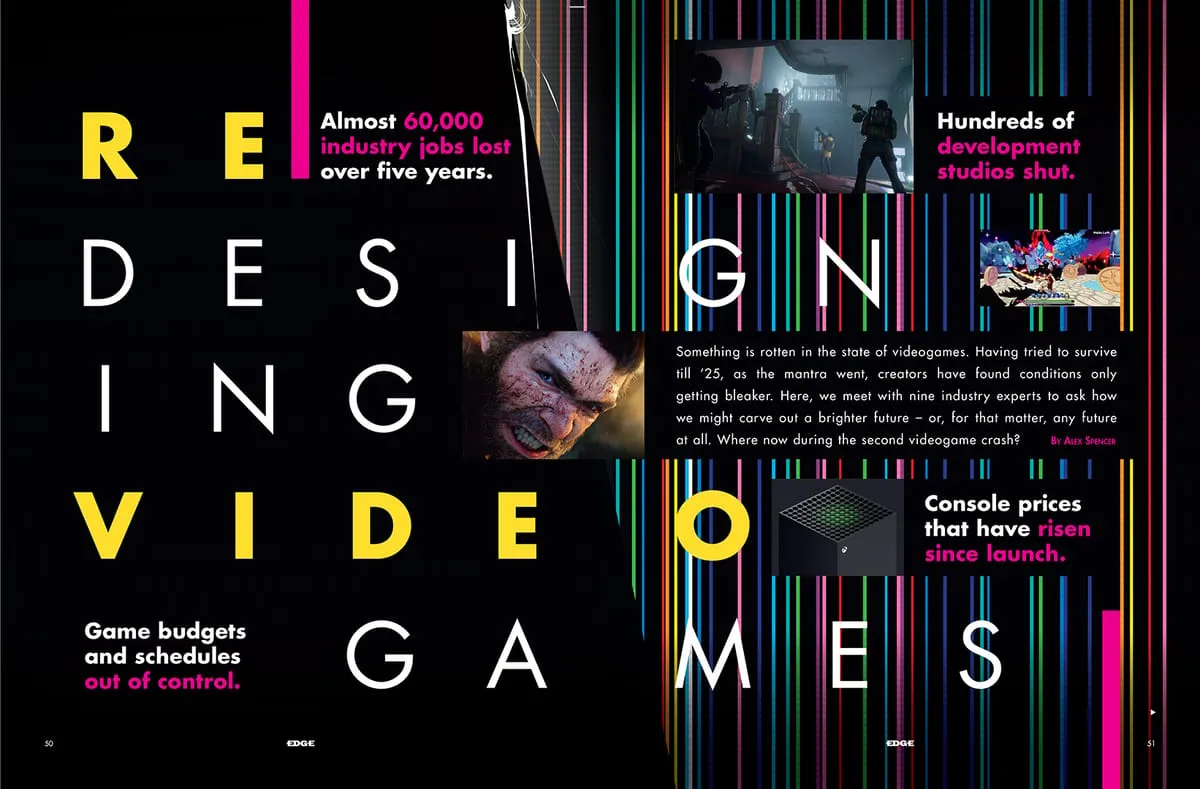
The game industry is broken – can we fix it?
Satvat says he’s hearing more about development teams “trying to right-size” – and not only at the indie end of the scale. “A game that’s been made by one or two people, that’s great,” he says. “But I’m more interested …
以下正文同步自 Hacker News,版权归原站所有,已转换为易读排版。
Satvat says he’s hearing more about development teams “trying to right-size” – and not only at the indie end of the scale. “A game that’s been made by one or two people, that’s great,” he says. “But I’m more interested in what would have been a 50-to-60-person team becoming a 20-person team, and the 400-person team becoming a 100-person team, as people are trying to find more efficient ways to do things.”
Wildflower Interactive is one such example. The core Coven Of The Chicken Foot team is 11 people, Straley says. “But we co-dev with an audio company, and all our rigging and modelling is outsourced. These are people we’ve built relationships with, and try to integrate into the team as much as possible. It’s not like we send it off to the Philippines and they just crank out stuff.” Co-development “is, so far, the best solution we have,” Straley continues. He says it offers a balance between the large standing teams of traditional game development “where you’re burning money between projects”, and “the Hollywood model”, where everyone is a contractor brought on for the project and then dissolved, which also doesn’t allow for the magic that happens when teams work together for a long time. “People have been saying for years that you can’t make The Witcher 3 or GTAV as your first game,” Satvat says. “The only reason something like Elden Ring or [the output from] Nintendo is possible is because you have the same people working together and iterating over five or six titles.”
Of course, there is another way of reducing team sizes, of which Satvat says he’s seen increasing evidence. “That phenomenon of the 50-person teams becoming 20, I think the reason a lot of people are doing that – or believe they can do that – is because they have all these tools like Claude,” he says. AI tooling is another part of Epic’s pitch for UE6, with integrations for Claude, Gemini and the like, but Satvat is not convinced they make a difference. “Are you actually getting a measurable productive gain in what you’re doing because you’re using these tools?” he asks. “I’ve seen firms that made staff reductions because they thought they could, due to AI, and are now realising that they cut too many people and are hiring back.”
In fact, according to Koster, improved tools have never been the deciding factor when it comes to game budgets. Back in 2005, he’d expected the arrival of UE3 and Unity to bring down the cost of creation – but his research shows that wasn’t the case. “We have better tooling today than we’ve ever had before,” he says. “It’s just that those things have not reduced the cost for the median game as much as the costs have risen.”
Beyond the decisions of individual developers, Koster believes there’s only one thing that can reduce costs – and it is in the hands of history. “Our industry is cyclical,” he says. “Unless we hit the singularity, a platform will come along that changes things.” For Koster, when it comes to the content arms race, this kind of technological reset is “historically, the only way out I’ve seen”.
The constituent parts of this hypothetical platform are that “it needs to provide a new affordance, meaning there has to be gameplay you cannot get except on that platform”. This would bring in new players, or give existing ones a reason to try the new platform for themselves. The platform also has to be “worse for making traditional games – because that means the big incumbents cannot just transfer their expertise, come in and dominate”. But most important of all? “The number-one biggest thing this new platform needs,” Koster says, “is to have shitty graphics.”
He cites previous examples of this kind of reset: Flash-powered browser games, social games on Facebook, motion controls on Wii, and – most recently and significantly – mobile. If those new platforms stick around, he says, “they eventually catch up, and then the costs rise in exactly the same way,” until the cycle begins all over again. “But we haven’t had a new platform come along to reset that cost curve in a long time. Like, a long time.”
Koster doesn’t know what form this reset might take – “it might be that we have to wait for [gaming on] AR glasses” – but he’s adamant about what it isn’t: “AI is not a platform reset, where costs get lower. AI is just a computer getting bigger, and so the gas will keep filling it.” And while AI’s proponents might talk about it democratising creation, it’s far from the great equaliser we need. “It is actually incredibly expensive, in the end, so most of the benefit flows upwards,” Koster says. “AI is changing things very rapidly, and it also doesn’t matter.”
There is another possibility here, Satvat suggests, and it might actually stem from one of the biggest challenges facing the industry right now. “The fact that hardware prices are out of control, and consoles are becoming unaffordable, I think is going to have a major impact on developers focusing on design rather than how fancy a game looks, or going heavy on [hardware] demands,” he says. “That seems a pretty obvious conclusion for the foreseeable future.”
There are notes for hope here, and potentially strategies for survival, but they’re not the active steps towards reshaping the industry we’d hoped for. If that is possible – which is not guaranteed – then it almost certainly requires taking a much wider view of the issues at hand.
正文由 探How 从来源站点 RSS 同步,内容未经改写;遇到排版缺失或需要图片、视频时请以原文为准。