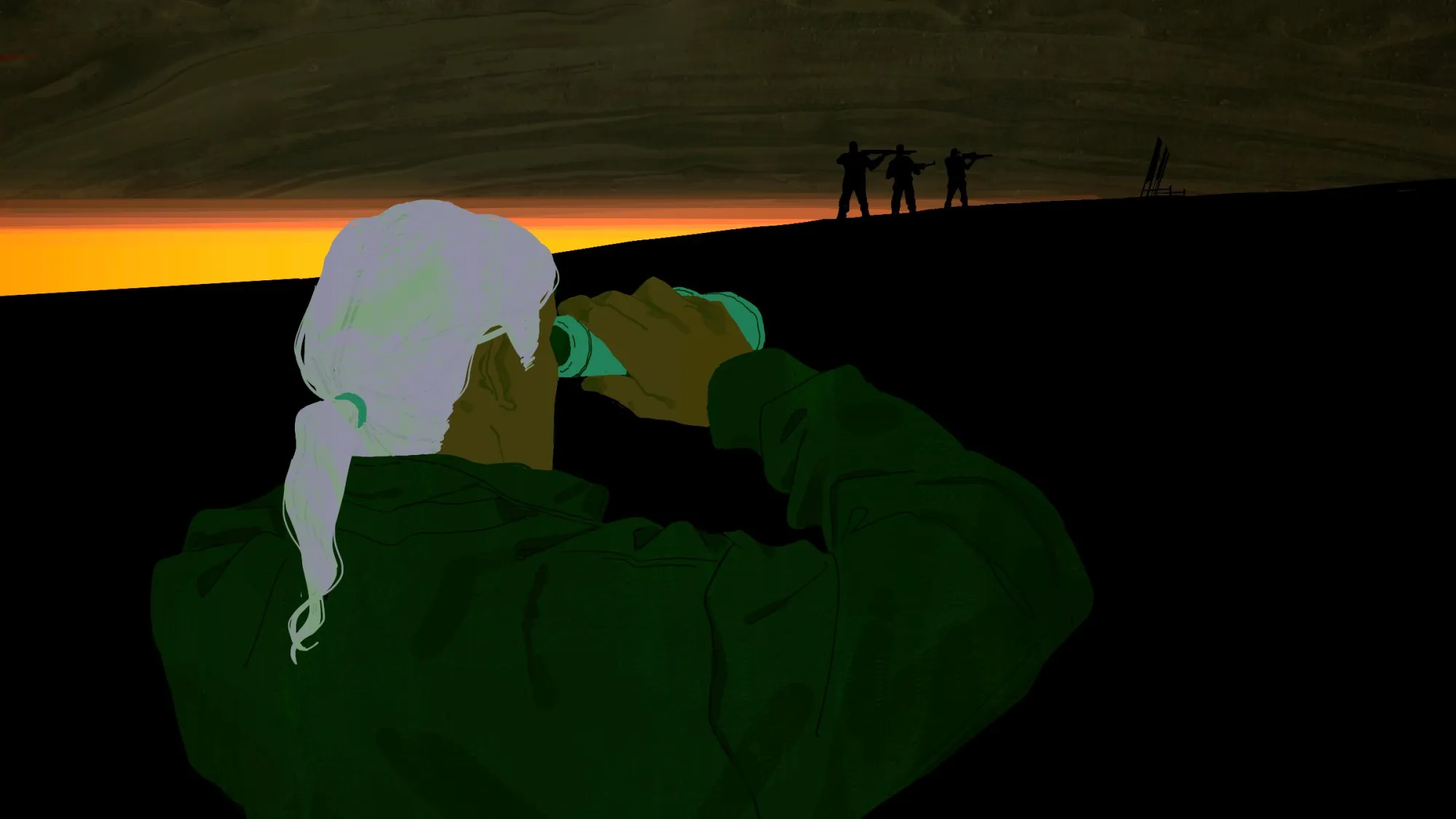
A Mole Infiltrated the Highest Ranks of American Militias (2025)
These highlights were written by the reporters and editors who worked on this story.
以下正文同步自 Hacker News,版权归原站所有,已转换为易读排版。
These highlights were written by the reporters and editors who worked on this story.
John Williams kept a backpack filled with everything he’d need to go on the run: three pairs of socks; a few hundred dollars cash; makeshift disguises and lock-picking gear; medical supplies, vitamins and high-calorie energy gels; and thumb drives that each held more than 100 gigabytes of encrypted documents, which he would quickly distribute if he were about to be arrested or killed.
On April 1, 2023, Williams retrieved the bag from his closet and rushed to his car. He had no time to clean the dishes that had accumulated in his apartment. He did not know if armed men were out looking for him. He did not know if he would ever feel safe to return. He parked his car for the night in the foothills overlooking Salt Lake City and curled up his 6-foot-4-inch frame in the back seat of the 20-year-old Honda. This was his new home.
He turned on a recording app to add an entry to his diary. His voice had the high-pitched rasp of a lifelong smoker: “Where to fucking start,” he sighed, taking a deep breath. After more than two years undercover, he’d been growing rash and impulsive. He had feared someone was in danger and tried to warn him, but it backfired. Williams was sure at least one person knew he was a double agent now, he said into his phone. “It’s only a matter of time before it gets back to the rest.”
In the daylight, Williams dropped an envelope with no return address in a U.S. Postal Service mailbox. He’d loaded it with a flash drive and a gold Oath Keepers medallion.
The documents laid out a remarkable odyssey. Posing as an ideological compatriot, Williams had penetrated the top ranks of two of the most prominent right-wing militias in the country. He’d slept in the home of the man who claims to be the new head of the Oath Keepers, rifling through his files in the middle of the night. He’d devised elaborate ruses to gather evidence of militias’ ties to high-ranking law enforcement officials. He’d uncovered secret operations like the surveillance of a young journalist, then improvised ways to sabotage the militants’ schemes. In one group, his ploys were so successful that he became the militia’s top commander in the state of Utah.
Now he was a fugitive. He drove south toward a desert four hours from the city, where he could disappear.
I’d first heard from Williams five months earlier, when he sent me an intriguing but mysterious anonymous email. “I have been attempting to contact national media and civil rights groups for over a year and been ignored,” it read. “I’m tired of yelling into the void.” He sent it to an array of reporters. I was the only one to respond. I’ve burned a lot of time sating my curiosity about emails like that. I expected my interest to die after a quick call. Instead, I came to occupy a dizzying position as the only person to know the secret Williams had been harboring for almost two years.
We spoke a handful of times over encrypted calls before he fled. He’d been galvanized by the Jan. 6, 2021, storming of the Capitol, Williams told me, when militias like the Oath Keepers conspired to violently overturn the 2020 presidential election. He believed democracy was under siege from groups the FBI has said pose a major domestic terrorism threat. So he infiltrated the militia movement on spec, as a freelance vigilante. He did not tell the police or the FBI. A loner, he did not tell his family or friends.
Williams seemed consumed with how to ensure this wasn’t all a self-destructive, highly dangerous waste of time. He distrusted law enforcement and didn’t want to be an informant, he said. He told me he hoped to damage the movement by someday going public with what he’d learned.
The Capitol riot had been nagging at me too. I’d reported extensively on Jan. 6. I’d sat with families who blamed militias for snatching their loved ones away from them, pulling them into a life of secret meetings and violent plots — or into a jail cell. By the time Williams contacted me, though, the most infamous groups appeared to have largely gone dark. Were militias more enduring, more potent, than it seemed?
Some of what he told me seemed significant. Still, before the package arrived, it could feel like I was corresponding with a shadow. I knew Williams treated deception as an art form. “When you spin a lie,” he once told me, “you have to have things they can verify so they won’t think to ask questions.” While his stories generally seemed precise and sober — always reassuring for a journalist — I needed to proceed with extreme skepticism.
So I pored over his files, tens of thousands of them. They included dozens of hours of conversations he secretly recorded and years of private militia chat logs and videos. I was able to authenticate those through other sources, in and out of the movement. I also talked to dozens of people, from Williams’ friends to other members of his militias. I dug into his tumultuous past and discovered records online he hadn’t pointed me to that supported his account.
The files give a unique window, at once expansive and intimate, into one of the most consequential and volatile social movements of our time. Williams penetrated a new generation of paramilitary leaders, which included doctors, career cops and government attorneys. Sometimes they were frightening, sometimes bumbling, always heavily armed. It was a world where a man would propose assassinating politicians, only to spark a debate about logistics.
Federal prosecutors have convicted more than 1,000 people for their role in Jan. 6. Key militia captains were sent to prison for a decade or more. But that did not quash the allure that militias hold for a broad swath of Americans.
Now President-elect Donald Trump has promised to pardon Jan. 6 rioters when he returns to the White House. Experts warn that such a move could trigger a renaissance for militant extremists, sending them an unprecedented message of protection and support — and making it all the more urgent to understand them.
(Unless otherwise noted, none of the militia members mentioned in this story responded to requests for comment.)
Williams is part of a larger cold war, radical vs. radical, that’s stayed mostly in the shadows. A left-wing activist told me he personally knows about 30 people who’ve gone undercover in militias or white supremacist groups. They did not coordinate with law enforcement, instead taking the surveillance of one of the most intractable features of American politics into their own hands.
Skeptical of authorities, militias have sought to reshape the country through armed action. Williams sought to do it through betrayals and lies, which sat with him uneasily. “I couldn’t have been as successful at this if I wasn’t one of them in some respects,” he once told me. “I couldn’t have done it so long unless they recognized something in me.”
If there is one moment that set Williams on his path into the militia underground, it came roughly a decade before Jan. 6, when he was sent to a medium-security prison. He was in his early 30s, drawn to danger and filled with an inner turbulence.
Williams grew up in what he described to me, to friends and in court records as a dysfunctional and unhappy home. He was a gay child in rural America. His father viewed homosexuality as a mortal sin, he said. Williams spent much of his childhood outdoors, bird-watching, camping and trying to spend as little time as possible at home. (John Williams is now his legal name, one he recently acquired.)
Once he was old enough to move out, Williams continued to go off the grid for weeks at a time. Living in a cave interested him; the jobs he’d found at grocery stores and sandwich shops did not. He told me his young adulthood was “a blank space in my life,” a stretch of “petty crime” and falling-outs with old friends. He pled guilty to a series of misdemeanors: trespassing, criminal mischief, assault.
What landed Williams in prison was how he responded to one of those arrests. He sent disturbing, anonymous emails to investigators on the case, threatening their families. Police traced the messages back to him and put him away for three years.
Williams found time to read widely in prison — natural history books, Bertrand Russell, Cormac McCarthy. And it served as a finishing school for a skill that would be crucial in his undercover years. Surviving prison meant learning to maneuver around gang leaders and corrections officers. He learned how to steer conversations to his own benefit without the other person noticing.
When he got out, he had a clear ambition: to become a wilderness survival instructor. He used Facebook to advertise guided hikes in Utah’s Uinta Mountains. An old photo captures Williams looking like a lanky camp counselor as he shows students an edible plant. He sports a thick ponytail and cargo pants, painted toenails poking out from his hiking sandals.
Many people in Utah had turned to wilderness survival after a personal crisis, forming a community of misfits who thrived in environments harsh and remote. Even among them, Williams earned a reputation for putting himself in extreme situations. “Not many people are willing to struggle on their own. He takes that struggle to a high degree,” one friend told me admiringly. Williams took up krav maga and muay thai because he enjoyed fistfights. He once spent 40 days alone in the desert with only a knife, living off chipmunks and currants (by choice, to celebrate a birthday).
Williams struggled to get his survival business going. He’d hand out business cards at hobbyist gatherings with promises of adventure, but in practice, he was mostly leading seminars in city parks for beer money. He would only take calls in emergencies, another friend recalled, because he wanted to save money on minutes.
Then around New Year’s in 2019, according to Williams, he received an email from a leader in American Patriots Three Percent, or AP3. He wanted to hire Williams for a training session. He could pay $1,000.
Finally, Williams thought. I’m starting to get some traction.
They had agreed there’d be no semiautomatic rifles, Williams told me, so everyone brought a sidearm. Some dozen militiamen had driven into the mountains near Peter Sinks, Utah, one of the coldest places in the contiguous U.S. Initially they wanted training in evasion and escape, Williams said, but he thought they needed to work up to that. So for three days, he taught them the basics of wilderness survival, but with a twist: how to stay alive while “trying to stay hidden.” He showed them how to build a shelter that would both keep them dry and escape detection. How to make a fire, then how to clean it up so no one could tell it was ever there.
As the days wore on, stray comments started to irk him. Once, a man said he’d been “kiked” into overpaying for his Ruger handgun. At the end of the training, AP3 leaders handed out matching patches. The ritual reminded Williams of a biker gang.
He’d already been to some shorter AP3 events to meet the men and tailor the lesson to his first meaningful client, Williams told me. But spending days in the woods with them felt different. He said he found the experience unpleasant and decided not to work with the group again.
This portion of Williams’ story — exactly how and why he first became a militia member — is the hardest to verify. By his own account, he kept his thoughts and plans entirely to himself. At the time, he was too embarrassed to even tell his friends what happened that weekend, he said. In the survival community, training militias was considered taboo.
I couldn’t help but wonder if Williams was hiding a less gallant backstory. Maybe he’d joined AP3 out of genuine enthusiasm and then soured on it. Maybe now he was trying to fool me. Indeed, when I called the AP3 leader who set up the training, he disputed Williams’ timeline. He remembered Williams staying sporadically but c
正文由 探How 从来源站点 RSS 同步,内容未经改写;遇到排版缺失或需要图片、视频时请以原文为准。