Learning to live with Waymos
https://web.archive.org/web/20261015123002/https://www.newyo..., https://archive.li/fj7oR
以下正文同步自 Hacker News,版权归原站所有,已转换为易读排版。
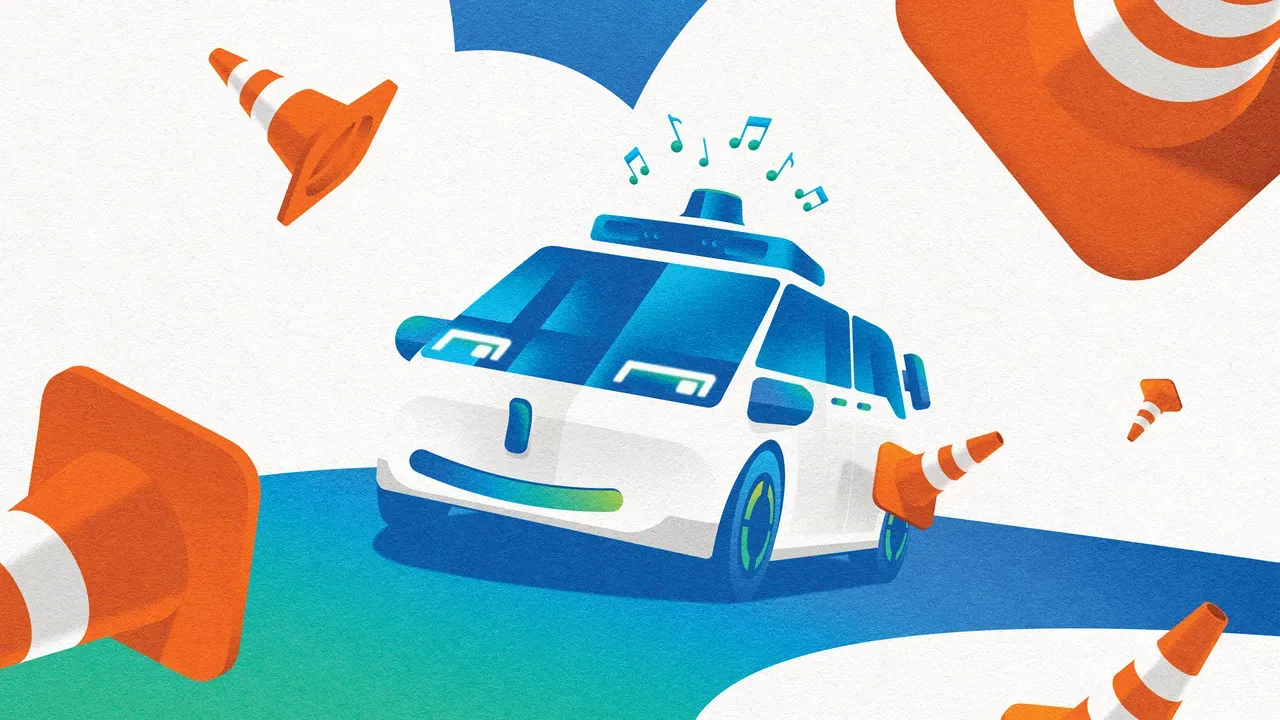
Before I’d ridden in a Waymo, I had wondered about the wheel. What was it doing up there? One answer, a boring one, is as follows: it is fulfilling a legal mandate. Existing safety standards assume that cars have steering wheels, and, because Waymo’s vehicles are regulated as cars, so do they. Besides, the company has spent much of its decade-long existence retrofitting normal cars with self-driving technology; the wheel is largely a vestigial inheritance. But perhaps it’s more than that. “We were very curious about whether people would react positively or negatively to the fact that the wheel turned,” Megan Neese, Waymo’s “Head of Insights,” told me recently. We were sitting in her employer’s San Francisco offices. Neese has been at the company since 2019, when it began offering fully driverless rides to the public; she was tasked with gauging passenger reactions. It was not hard to see how a wheel steering on its own might look spooky—the suggestion of a ghost in the machine. Yet, to Neese’s surprise, riders reported that it reassured them. It seemed to convey that the car’s actions were “recognizable; they’re relatable; they’re continuing to happen.” (Similarly, when a Waymo’s windshield wipers wipe, it’s mostly for you. The Driver doesn’t need them.) The wheel thrills you, it unnerves you, it gives you a vague feeling that you could grab it if you really wanted to. It makes the car seem both familiar and magical—the Jetsonian sweet spot for a product whose makers would like to take over the world. And, at the moment, that is what Waymo is trying to do. Waymo has a fleet of more than four thousand cars in fifteen cities across the U.S. In San Francisco, the company recently surpassed Lyft in market share. More than thirteen hundred Waymos whir and glide in the region, the lidar sensors that spin in hat-like domes atop their roofs giving them an air of busy importance. The company has set its sights on D.C., New York, London, Tokyo. Its intended message is clear: Waymo is coming. Now humans are learning to live alongside the machines. Waymos, like data centers, provide a ready vessel for strong reactions to the broad sweep of technological change. The benefits and risks of A.I. can seem hazy, but cars are big and solid, and Americans love them. “It might be some custom L.L.M. that causes someone to lose their job,” Bryant Walker Smith, a law professor at the University of South Carolina who studies autonomous driving, told me. “But they’re never going to see that. They’re going to see the car going down the street without anybody in it.” When a small team of Google engineers first began tinkering with self-driving Priuses, an Obama-era optimism about technology’s promise still prevailed. The product of their work arrives at a moment when its appeal is not quite as apparent as it might once have been. If autonomous driving is the future, it’s a future you can visit in San Francisco. This summer, I rode to the company’s downtown offices in a Waymo Ojai—a puffy periwinkle van that made me think of a marshmallow Peep. I was in the belly of the Peep. I was accompanied by a young spokesperson named Sandy Karp. She told me that she’d become interested in A.V.s as a student; she’d been impressed with Tesla’s comms strategy, which seemed to keep people enamored with its cars even when its cars kept catching fire. At the offices, Karp steered me briskly past open-plan tables and upholstered nooks, past signage announcing corporate fun. In the cafeteria, we passed a loitering robot approximately the size and shape of a podium, with a central compartment for trays and bins. “READY TO BUS,” a digital ticker around its top read. I yelped with surprise when I first saw it: I knew that guy! There is a near-identical robot to be found at Jalsa, an Indian restaurant in my Brooklyn neighborhood, where its presence inspires the same frisson of novelty as a hands-off steering wheel. Jalsa has excellent food, leisurely service, and a robot waiter of unclear utility. Slowly, always slowly, and always in the company of a human server, the robot transports dishes to diners’ tables, where the human server distributes them. Still, a hush falls over the dining room when it enters, and it can delight a small child by singing “Happy Birthday,” regardless of whether it is anyone’s birthday. Wow, one can’t help thinking. A robot. Here it is. But why? There are many things humans do that are difficult to imagine any machine improving upon, but driving is not one of them. Human drivers possess abundant and obvious shortcomings. The ad touts “a driver that never blinks, never gets tired or angry or has a few too many.” Waymo’s cars are “ten times safer” than those with human drivers, the ad declares—a crisp figure that recurs throughout company materials. A decade ago, Elon Musk told reporters that, if their skepticism turned the public against autonomous vehicles, they would be “killing people.” Waymo offers a more measured version of the same general argument: cars don’t kill people; people kill people. As a response to “Why?,” “Because” is an answer that carries a whiff of impatience. Just trust us; you wouldn’t understand. The text of the “Because” ad is Safety; the subtext is We don’t actually hate humans—“wonderful, complex humans,” as the voice-over puts it, faintly passive-aggressive or else just patronizing. “Not because humans aren’t enough, but because they’re everything.” The initial answer to the question of why we might build robot cars was “For a million dollars.” In 2004, the Pentagon hosted a contest that promised a cash prize to the winner of a driverless race through the desert. None of the entrants even finished that race, but, a year later, five vehicles completed a follow-up. Google hired the Stanford professor behind the winning team, a German machine-learning expert named Sebastian Thrun, and a Berkeley grad student named Anthony Levandowski. Relentlessly enterprising and six feet seven, a literally oversized character, Levandowski had entered an autonomous motorcycle, Ghost Rider, which started the course and promptly fell over. He’d neglected to turn on the program that kept it upright. Ghost Rider wound up in the Smithsonian’s collection anyway, a monument to grand ambition foiled by user error. In 2009, Google’s new Project Chauffeur set about reconfiguring a fleet of Priuses that Levandowski had bought at a San Jose Toyota dealership. The project retained a spirit of playful competition. The team structured their efforts around mastering ten difficult routes on California’s roads, toasting their triumph with a bottle of cheap champagne that they signed and saved. They sent their first solo passenger on an autonomous trip through Austin in 2015, along a route painstakingly calibrated to be manageable but not too boring. “I knew where, from a certain park, squirrels were likely to jump out,” Chris Ludwick, a product manager on the team, told me. In 2016, the project, which is still largely owned by Google’s parent company, was renamed Waymo. By this time, a new industry had arisen. Ridesharing provided a business model for autonomous cars, and rideshare companies were eager to eliminate the expense of human drivers. Levandowski defected to Uber, allegedly taking fourteen thousand confidential design files with him. (In 2020, he was convicted of stealing trade secrets; he was later pardoned by Donald Trump.) Tesla and Uber had embraced a Wild West image; Waymo was doing its autonomous driving in hybrid Chrysler minivans. Arizona became the first real A.V. sandbox and, in 2018, the site of the first A.V. pedestrian death, when an Uber test vehicle struck a woman crossing the road at night. The safety driver, it later emerged, was watching “The Voice” at the time of the crash. Waymo’s next challenge is to bring the public on board—which it sees as a matter of communicating its benevolent intentions. “We have to make sure that people get a baseline education,” Justin Kintz, who runs public policy, told me. In the places where Waymo now operates, it is possible to see an unlikely dream becoming a human reality, in all its wonderful complexity. In San Francisco, Waymos have become an urban fixture. One tech executive in her thirties told me that she’d once shocked a roomful of sexually adventurous partygoers by saying that she’d given her husband a blow job under a coat in the back seat of a Waymo. “But you could lose your Waymo account!” she remembers them responding. (“I did read the terms and conditions after,” she told me.) The city has seen its share of self-driving hassles—as when a power outage in December, 2025, took out traffic lights across the city, and hundreds of confused Waymos stalled in the streets. Still, Slade liked them. “I can be a tech optimist,” he told me. Sometimes he took one when he wanted to do karaoke on the go. “You can sing your heart out without annoying anyone,” he said. (The vehicles let riders link their Spotify accounts, a feature that nearly every Waymo user I spoke to mentioned.) Soon enough, Slade and his fiancée were singing in comfort, approaching the 101 on-ramp. Waymo began offering freeway service only recently, in late 2025, and, as Slade’s car reached the top of the ramp, he was conscious of entering unknown terrain. Traffic was at a standstill. A right-hand lane was closed, and everyone was merging left. The Waymo seemed to know that something unusual was happening: a notification appeared on a touch screen in the back. “Remote specialists are monitoring this issue,” it read. “The safest place for you is in the car.” Slade was tentatively game. “We’re, like, ‘O.K., this is kind of interesting?’ ” he recalled. He began filming the ride on his phone. After the car tried to merge, it veered to the right, as if to pull onto the shoulder. What it found there was a lane closed off for roadwork. Slade’s car evidently regarded this empty lane as a place of untrammelled freedom: just a few cones stood between a Waymo and the open road. “It went through the cones,” Slade said, “then instantly sped up to highway speeds.” Ahead was a construction site; the Waymo galloped toward it. Slade pushed a button to call support and was told that an agent would be with him shortly. Sirens are audible in his video, as police chase the bolting Waymo, which deftly navigates around trucks, lights, and workers, and over broken pavement. Slade wondered whether he could grab the wheel, then remembered reading somewhere that it wouldn’t work. (This is correct: touch the wheel and the car will pull over; keep trying and it may call support, but it won’t let you steer.) Slade was unsure what else to do. No agent had yet come on the line. Eventually, the car exited the highway and pulled off into the nocturnal quiet of a random peninsula neighborhood. Once the Waymo was at rest, an agent picked up. “That looked like a stressful experience,” Slade remembers her saying. “Would you like to continue the ride?” “No,” he said. They would not. Nor would they like to remain in the car while awaiting their Uber home. They would like to get out, immediately. By the next morning, Slade had posted his footage on X. Waymo paused freeway service and issued a software recall. Waymo offered Slade three forty-dollar ride credits. Otherwise, he has not heard from the company. Slade was physically unharmed. The experience was not, therefore, anything that would dent Waymo’s “ten times safer” stat. The figure refers to a ninety-two-per-cent reduction in crashes causing “serious injury or worse.” This is a remarkable achievement, and although outside evidence is limited, researchers generally view it as promising. Yet crash statistics alone fail to capture the range of incidents that might freak somebody out. On the Fourth of July, Waymos in San Francisco drove over fireworks being set off in the street. One car caught fire; another just kept driving until its unnerved passengers requested
正文由 探How 从来源站点 RSS 同步,内容未经改写;遇到排版缺失或需要图片、视频时请以原文为准。