We hug: Individual differences predict emotional touch memories
Paper's citation count computed by Dimensions.
以下正文同步自 Hacker News 最新,版权归原站所有,已转换为易读排版。
Paper's citation count computed by Dimensions.
Sum of Facebook, Twitter, Reddit and Wikipedia activity.
Roles Conceptualization,
Formal analysis,
Methodology,
Writing – original draft
Affiliations School of Psychological Science, University of Bristol, Bristol, United Kingdom, Department of Psychiatry and Psychotherapy, University Hospital Bonn, Bonn, Germany
Roles Methodology,
Writing – review & editing
Affiliations Faculty of Psychology, Counselling and Psychotherapy, The Cairnmillar Institute, Melbourne, Australia, Research Department of Clinical, Educational and Health Psychology, University College London, London, United Kingdom
Roles Data curation,
Project administration,
Resources,
Writing – review & editing
Affiliation School of Psychological Science, University of Bristol, Bristol, United Kingdom
Affiliation Research Department of Clinical, Educational and Health Psychology, University College London, London, United Kingdom
Roles Conceptualization,
Funding acquisition,
Writing – review & editing
Affiliation School of Psychology, University of Sussex, Brighton, United Kingdom
Roles Conceptualization,
Data curation,
Methodology,
Project administration,
Writing – review & editing
Affiliation School of Human Sciences, Institute for Lifecourse Development, University of Greenwich, London, United Kingdom
Roles Conceptualization,
Supervision,
Writing – review & editing
Affiliation Research Department of Clinical, Educational and Health Psychology, University College London, London, United Kingdom
Roles Conceptualization,
Funding acquisition,
Methodology,
Project administration,
Supervision,
Writing – review & editing
Affiliation School of Psychological Science, University of Bristol, Bristol, United Kingdom
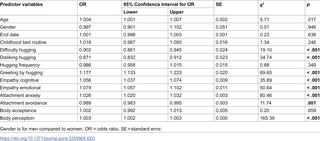
Hugging is a ubiquitous form of social touch, yet little is known about how individual differences shape the remembrance of such experiences. In a large-scale survey (N = 15,049), we investigated whether various traits predict the likelihood of recalling a hug for its positive emotional impact and the reasons why it was remembered. Participants were recruited through promotion on public broadcasting programs (BBC) and other media. Overall, 69.5% of participants reported recalling a hug for its positive emotional impact. In regression analyses, empathy, body perception, and attachment-related anxiety were associated with a higher likelihood of such recall, whereas attachment-related avoidance was associated with a lower likelihood. Men were more likely than women to report physically arousing hugs as the most memorable. These findings suggest that hugs are predominantly remembered because they convey comfort, support, and understanding, and that individual differences shape autobiographical memories of hugging.
Citation: Dueren AL, Jenkinson PM, Vafeiadou A, Koukoutsakis A, Hammond C, Bowling NC, et al. (2026) Why we hug: Individual differences predict emotional touch memories. PLoS One 21(10): e0359868.
https://doi.org/10.1371/journal.pone.0359868
Received: April 19, 2026; Accepted: September 19, 2026; Published: October 28, 2026
Copyright: © 2026 Dueren et al. This is an open access article distributed under the terms of the Creative Commons Attribution License, which permits unrestricted use, distribution, and reproduction in any medium, provided the original author and source are credited.
Data Availability: Data were extracted from the Touch Test. The complete Touch Test questionnaire, data and code used for this study, and pre-registration are available on OSF: https://osf.io/t4wek/overview?view_only=d9bd02b7be25436aa00a16f729ca0cac, DOI: https://doi.org/10.17605/OSF.IO/T4WEK.
Funding: MJB was supported by the ESRC [ES/R007527/1] and Leverhulme Trust [RF-2025-350]. The Touch Test was commissioned by the Wellcome Collection. AF’s time was supported by a European Research Council Consolidator Award [ERC-2018-COG-818070] and under the European Union’s Horizon 2020 research and innovation programme (Consolidator grant agreement No 818070 for project METABODY). There was no additional external funding received for this study.
Competing interests: MJB is author of When we Touch/ Touch Matters published by a commercial publisher. This does not alter our adherence to PLOS ONE policies on sharing data and materials.
Affection Exchange Theory (AET) postulates that humans have an innate need to share affection with others and that there are individual differences in how people like to show and receive affection [1]. One common type of affective full body touch is hugging. Hugs can convey a range of meanings, such as greeting or comforting someone [2] and they occur in a range of settings [2–4]. Furthermore, hugging has been associated with positive outcomes on stress measures and improved daily mood [5–12]. Previous affective touch literature has already proposed several pathways by which social touch benefits health, including improved stress coping, modulation of stress‑hormonal and cardiovascular systems, and oxytocin‑mediated bonding and emotion regulation [10,13–15]. Accordingly, current models suggest that affective touch experiences throughout life are related to mental and physical health [14]. Additionally, Fairhurst, McGlone and Croy propose a hybrid communication model of affective touch in which a sender’s affective intent is conveyed through touch to a receiver, whose perception is shaped by bottom-up sensory input, top-down contextual and multisensory factors, and reciprocal feedback between both individuals [16]. These models imply that clarifying the meanings of hugs may be helpful for understanding their health‑related impact. This is especially relevant because most mechanistic work so far has focused on generic affective or social touch (e.g., stroking, cuddling), whereas the specific emotional qualities and appraisals of hugging episodes have rarely been examined explicitly [10,13–15]. Here, we investigate whether hugs are generally remembered as emotionally salient experiences and whether individual differences are related to the emotions associated with hugging. Based on AET, we predict that people generally perceive hugs as emotionally meaningful because they are a way of exchanging affection. Moreover, we predict that individual differences in the specific emotions elicited by hugging are related to psychological traits and experiences, and demographic factors, that have been related to affective touch perception previously (outlined below). We use a UK survey sample to address these questions and specify the investigated individual differences below.
One factor that has been researched heavily in relation to affective touch is gender [17–20]. Regarding hugs, men have shown different lateralisation and arm crossing patterns when hugging other men compared to women [3,21,22]. Furthermore, women were found to experience a stress buffering effect of hugs that was absent in men [12]. Regarding the experience of hugs, it is not clear whether there are gender differences; however, men have previously been found to interpret other people’s behaviours more sexually than women [23]. Here, we address the question of whether men and women differ in the reasons why they remember past hugs.
In addition to gender, previous experiences of touch can influence how touch is evaluated [24–27]. For instance, childhood touch experiences can influence the perception of touch and touch behaviours in adulthood [24–26]. Such research has been conducted primarily with regard to the long-lasting effects of childhood sexual abuse [24,25]. However, it is unclear whether less extreme and negative childhood touch experiences also influence adult perception of hugs. In adulthood, it has been reported that the perception of slow, caressing stroking (activating “c-tactile” mechanoreceptors) differs between people: Individuals who experience affective touch more frequently in everyday life were found to evaluate slow stroking as more pleasant than individuals who experience affective touch less often [27,28]. Yet, whether the quantity and quality of hugging experiences in everyday life influence the emotional value placed on hugs remains unclear.
Another topic that has been researched increasingly in relation to affective touch, but rarely in relation to thoughts about hugging, are attachment dimensions. Attachment describes how individuals relate to other people in close relationships [29]. Insecure attachment can be specified into avoidant or anxious attachment dimensions, with people scoring high in attachment avoidance often displaying a high level of independence and self-sufficiency in interpersonal relationships [30]. Individuals scoring high in attachment anxiety, on the other hand, tend to experience distress when facing separation [30]. People scoring higher on measures of attachment avoidance often dislike affective touch such as slow, caressing stroking or cuddling [15,31–33], whereas the opposite seems to be true for people scoring high in attachment anxiety [26,32,34,35] however, also see the conflicting findings by [15,31,36]. We do not currently know how attachment dimensions influence views on hugging, but based on the work on other forms of affective touch, it seems likely that attachment dimensions also relate to the perception and interpretation of hugs. One proposed pathway is that childhood touch experiences impact attachment dimension, which in turn alters the perceived pleasantness and emotional salience of affective touch [33,37].
An additional trait that may relate to attitudes towards hugging is empathy. One use of the term empathy is to describe a sharing of someone else’s affective state, based on the perception and understanding of the other’s emotion [38,39]. Previous research has linked empathy to both one’s own tactile experience [40] and to the observation of other people’s tactile experiences [41–43]. Individual differences in trait empathy have also been linked to structural brain differences in areas of the brain associated with tactile perception, including the somatosensory and insular cortex [44,45]. These studies suggest that there may be a relationship between individual differences in trait empathy and tactile processing, but the relationship between empathy and hugging has to our knowledge, not been investigated.
Another trait that has been researched in relation to affective touch perception is body image. Previous research has found that individuals with pathological body image perceive affective touch differently from controls. For example, patients suffering from anorexia nervosa perceive (c-tactile) affective touch as less pleasant than healthy controls [46–48]. A review of relationships between eating disorders and sexual behaviours noted that anorexia nervosa and bulimia nervosa have also been related to lower sexual desire and higher sexual dysfunction compared to healthy controls [49]. However, evidence regarding affective touch perception and body image in nonclinical populations is scarce. One study of healthy participants found that individuals who are less satisfied with their body experience a greater longing for hugs, which the authors interpret as nurturing touch [50]. Thus, for healthy participants there is some evidence suggesting that the meaning of affective touch might relate to body image; however, it is unclear whether body image in healthy people relates to the likelihood of remembering an emotionally meaningful hug.
Here, we sought to assess whether participants experienced an emotionally meaningful hug in their lives and, if so, why they remember it. Furthermore, we analysed how individual differences in attachment dimensions, self-rated trait empathy, body acceptance and body perception, and individual differences in opinions about hugs relate to these questi
正文由 探How 从来源站点 RSS 同步,内容未经改写;遇到排版缺失或需要图片、视频时请以原文为准。