A Requiem for Bumble
As a proud (and recently engaged!1) Bumble alumnus, it warms my heart that my exclamation point-laden messages will be used to train models meant to judge the compatibility between two agents, each of them a digital rep…
以下正文同步自 Hacker News 最新,版权归原站所有,已转换为易读排版。
Joe Hovde
Oct 29, 2026
32
20
7
Share
As a proud (and recently engaged!1) Bumble alumnus, it warms my heart that my exclamation point-laden messages will be used to train models meant to judge the compatibility between two agents, each of them a digital representation of a human suitor2.
The dating app, which was founded in 2014 and went public in 2021, is being bought for $1.3 billion by Ithaca Holdings, an AI-focused holding company3 started by former Meta and Instacart execs.
It’s a disappointing outcome for the company, which has had a rather toxic relationship with the public markets since its IPO:
Bumble was founded in 2014 as a female-centric dating app where women sent the first message. It grew quickly and I think of it as one of the defining consumer apps of the 2010s, both because of its success and its techno-optimist ethos.
But like many of the software companies of its era, its business and its world-changing ambitions eroded in the 2020s. The company’s share price obviously tells the story of a company that struggled to live up to Wall Street’s growth expectations; for a qualitative angle I consulted my coworker and Gen-Z consigliere, who sits directly within Bumble’s target market:
Another interesting window into the dilution of Bumble’s brand is the gradual disappearance of its mission statement at the beginning of its annual reports:
Presumably the 2022 addition of “Kind Connections” to the mission statement took many thousands of dollars of meeting time to align on
By 2025, the mission statement only appeared in plain text in the report and was much simplified, with the equitable language removed:
It may be that Bumble changed its mission statement to avoid the wrath of the new Trump admin in its quest to police DEI practices. But it’s also a case in point that when grand ideas of what technology can do for society collide with market forces, the market tends to take precedence.
It seems likely to me that Bumble pushed to monetize its user base too aggressively and too early, leaving it vulnerable to Hinge. Based on average revenue per paying user (a somewhat crude measure of average price), Bumble was pricing nearly 50% higher than Hinge at the time of its IPO, and more than double Tinder:
Data from the public filings of Bumble, Match Group and Grindr.
My guess is the focus on monetization around the IPO dampened Bumble’s free user growth and gave Hinge a window to innovate on features that Bumble missed.
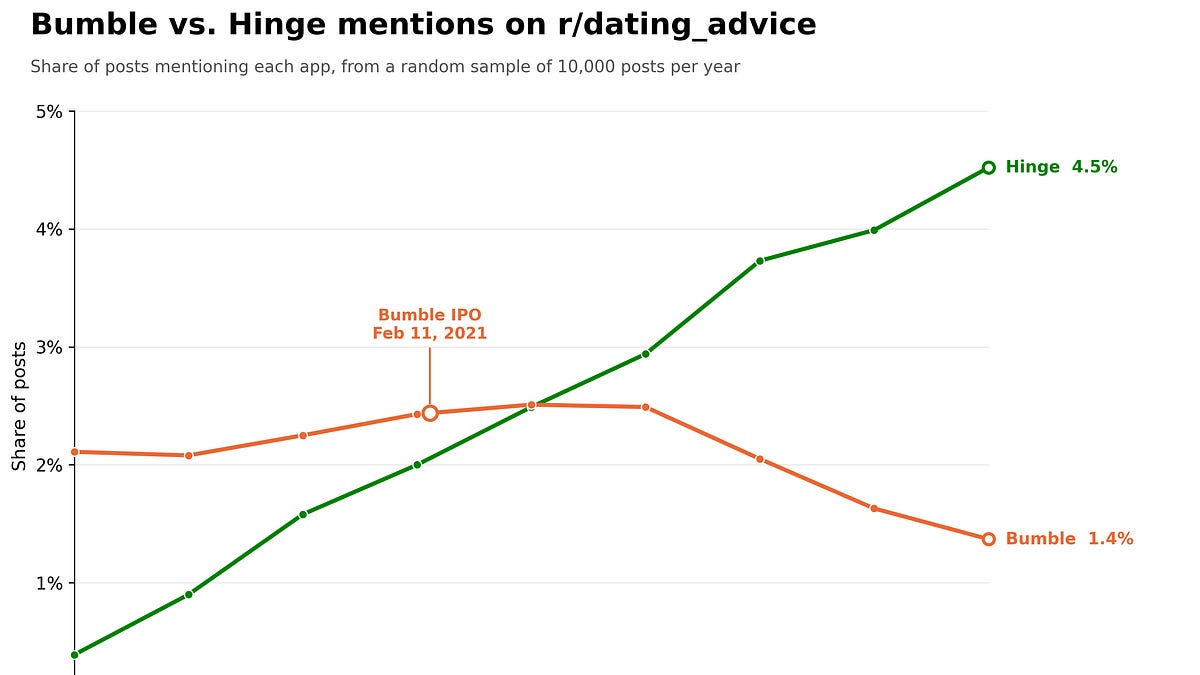
Soon after it went public, there were signs of softness in Bumble’s growth. For example, in 2022, Hinge surpassed Bumble in mention frequency on the r/dating_advice subreddit:
This softness in user engagement took a year or two to flow through to its paid user numbers. Bumble was clearly working hard to to hit its financial targets as a newly public company, but paid user growth eventually slowed before peaking in 2024; it looks like Bumble will finish 2026 with fewer paid users than Hinge:
Interestingly, Tinder4 hit a similar peak in paid users in 2022; I wonder if it is just really tricky to scale a paid dating app past a certain point, both because as it scales users are less and less similar to each other, and because as you ratchet up monetization, cheaper services pop up and swipe users away:
It will be interesting to see if Match Group, which owns both Tinder and Hinge, can manage Hinge’s growth such that it avoids the same peak and decline that Tinder and Bumble hit
How can Ithaca turn Bumble around?
Given these struggles, it’s not surprising that an ailing Bumble got taken out by private capital. But I am struggling to understand Ithaca’s thesis that Bumble will become more valuable as AI advances:
This tweet lays out the thesis for the Bumble acquisition
I do agree that as an increasing share of our everyday interactions are with machines, meaningful human contact will be scarcer and more valuable (it’s hard to flirt with the barista pouring your coffee if the “barista” is a humanoid robot, and “you” are a Muse agent with API access to the humanoid robot’s ordering software, and the “coffee” is a virally-colored Yuzu-Pistachio matcha with creatine foam5). But I’m not sure that means there are tailwinds to the dating app industry.
We can visualize Bumble’s revenue as a function of active users and average revenue per user as follows:
I find it oddly comforting to visualize a company’s business model like this. I recommend this article if you’d like to learn more about metrics trees
In buying Bumble, Ithaca is betting on its ability to do at least one of the following:
I guess if Bumble comes out with a feature called, like, The Love Language Model™6 that vectorizes your entire iMessage history and matches you to people that Opus 5.5 thinks you’re perfectly compatible with, maybe they can generate enough curiosity to reignite user growth.
But AI also makes it much easier to spin up a dating app, and the category will be particularly competitive because it’s more fun to build a dating app than, say, an enterprise CRM.
Just as CPG fragmented into lots of niche DTC brands, I expect there will be lots of micro-dating apps competing with the big generic ones. These will often be ephemeral and come from people with an existing audience organized around common interests. Logging into a dating app will begin to feel more like going to a house party than a giant music festival; this is a good early example from Emily Sundberg last Valentine’s Day:
Bumble can participate in this fragmentation by having a portfolio of more bespoke experiences for different audiences (Match Group already does this; it owns some 25 worldwide dating properties). But it doesn’t strike me as a favorable trend for incumbent companies.
Romantic! Match group’s portfolio, from its 2025 annual report
Get more users to stick with Bumble
I can believe that, given enough people on the service, advanced AI can do a better job matching people than the run-of-the-mill machine learning algorithms that Bumble was built on. Just as stronger AI helps Meta better target Instagram ads, dating apps will be able to better match users, which should marginally improve user retention.
But dating apps, at least those with the ostensible goal of creating monogamous relationships, have the strange property of being rewarded for a job well done by the users deleting the app7. So better matching is a double-edged sword; if it really works, then user retention is capped because everyone meets their perfect match in the first few weeks and then leaves.
In this sense, apps like Tinder that are built for more casual, repeated dalliances are better businesses, as there is no structural churn problem (although Tinder has clearly found its reputation as a hookup app to be limiting in other ways, and is actively working to break out of it):
Survey from a recent Match Group annual report. Tinder is also struggling to find growth and is working to update its image by rebranding and launching group events
Raise Prices
Ithaca can try to raise prices on Bumble’s existing products to increase revenue, but this seems dangerous given it seems like the company hit a pricing ceiling several years ago. I do think some users will pay a lot for an LLM-based matchmaking concierge, as human matchmakers can charge hundreds or thousands of dollars per month; I imagine this is partially what Ithaca is underwriting in the acquisition.
This seems like the clearest option for Ithaca to substantially grow Bumble’s revenue. One could imagine AI-powered therapy sold to couples after they match (or, less charitably, to each individual once they break up). Maybe an AI-supercharged Bumble will swallow up the entire relationship software stack — replace The Knot and Zola to plan your wedding, TripAdvisor and Fora to book your honeymoon, Zillow to sell you a house.
But I doubt it. It seems more likely that it goes a more dystopian route and uses its training data to create and sell AI companions, which are apparently already drawing more of users’ time than dating apps.
Whatever the case is, Ithaca’s got their work cut out for them, and it will be interesting to see the implications of this giant technological wave on one of the most fundamental of human activities. I’m inclined to be cynical about it, but then I remember that I’m part of a dating app success story and sometimes things work out!
Thanks for reading! If you liked this article, you might also enjoy this one about big companies’ political leanings or this one about David Protein’s bizarre product expansion and strategy.
I’m enjoying the book Yoga by Emmanuel Carrère. It’s calm and melancholy and was perfect to listen to while walking around Burlington (above). Thank you Elena for the recommendation!
I recently loved The Day of the Jackal, an old and very cool movie about a plot to assassinate de Gaulle, after asking my movie friends for movies that have the same feeling as a John le Carré novel. The trailer captures its atmosphere well.
This essay by Hilary Gridley about figuring out what you’re meant to be doing was rather inspiring; her articulation of “the way the world seems to open up to people who put themselves out there” captures a lot of what I find appealing about writing publicly.
Princes and Thieves, Matthew Cole’s new book about Jared Kushner’s financial entanglements in the Middle East, is really interesting so far. I find it hard to resist the cloak and dagger stuff, even though it’s weird to treat politics like an entertainment source. Let me know if you read it too.
If you have a recommendation for a wedding vendor that you feel particularly excited about, let me know! Photographers, magicians, sleight of hand artists, master pickpockets, illusionists etc.
Bumble’s founder Whitney Wolfe Herd has shared ideas for several years about how LLMs can do a better job matching people than traditional dating apps mechanics do, and Bumble is currently testing an LLM-based dating assitant.
The holding company structure differs from a traditional private equity fund in that the principals buy companies without the intention of selling them. Bending Spoons is another interesting example of a holding company that’s acquired a bunch of software businesses, improved their operations, and plans to hold them for the long term. I enjoyed this interview with their founder.
If you’re interested in Tinder’s business, this article from Bristlemoon Capital is a few years old but goes in depth on it.
I have developed a perverse fondness for Blank Street since writing about them years ago; I think it’s somewhat beautiful how cleanly they’ve converged on slinging algorithmically optimized colorful drinks to underemployed 23 year olds
If the Ithaca guys read this, I hereby authorize you to use the Love Language Model brand name; just send me a fruit basket, or something
Hinge embraces this tension with their “designed to be deleted” slogan. This is a clever ad that sticks with you, but that does not change the underlying business model challenge it highlights.
正文由 探How 从来源站点 RSS 同步,内容未经改写;遇到排版缺失或需要图片、视频时请以原文为准。