What's at Stake in Serbia's Election
The Belgrade Arena erupts in choreographed cheers. Aleksandar Vučić, who resigned as president of Serbia last month in order to run for prime minister in Sunday’s parliamentary election, steps up to the podium. His spee…
以下正文同步自 Hacker News 最新,版权归原站所有,已转换为易读排版。
The Belgrade Arena erupts in choreographed cheers. Aleksandar Vučić, who resigned as president of Serbia last month in order to run for prime minister in Sunday’s parliamentary election, steps up to the podium. His speech, broadcast by 46 TV channels simultaneously, is an ode to the achievements of his Serbian Progressive Party (SNS) to date. “Who could have imagined today’s Serbia ten or fifteen years ago?” he asks. Indeed. Outside the arena, shadowy figures wait with handfuls of cash. Vučić’s ‘supporters’ must be compensated for their time - the going rate is 3,000 dinars (around 26 EUR).
Some of them work for the regime in other capacities, too: as human ‘bots’ who flood social media with saccharine praise of Vučić and lies about their fellow citizens, or as thugs sent to create chaos at protests. Others make an honest living but can’t resist the rally’s easy money (the minimum hourly wage in Serbia is 371 dinars). Many of these low-income citizens routinely accept an even more lucrative offer: selling their vote.
At least, the privately employed do. Those who work for state-owned or SNS-linked enterprises are often simply coerced. Bands of burly black-clad ‘activists’ then go door-to-door on election day, making sure that the party’s illegally acquired votes materialise. “Whenever I showed up with the guys,” a former ‘activist’ recently confessed, “people would get scared and go out to vote without much discussion”. Fraud is difficult to track because it is dispersed across municipalities and because most SNS ‘secure votes’ are acquired before the election, beyond the view of electoral observers. While it doesn’t confirm anything illicit, a look at 11,722 polling station documents from the most recent parliamentary elections in 2023 indicates that strong SNS results were concentrated in polling stations where there were fewer observers, and in municipalities with lower wages and a higher share of state employment.
Fig 1. SNS vote share per polling station vs number of observers, 2023
Fig 2. Percentage of stations where SNS received 70% or more, by municipality, 2023
Behind the SNS-led United Serbia electoral list is a pyramidical mafia that controls all levels of government, the judiciary, the military, the police, public services and most media. Behind the opposing Student List, however, is one of the largest sociopolitical movements per capita of the 21st century.
Much of Serbia has been in intermittent revolt since November 2024, when a train station canopy - one of the regime’s countless poor-quality, financially suspect construction projects - collapsed, killing 16 people. University students blockaded their faculties for the remainder of that academic year and set out to transform the country from the ground up. They hiked and biked to town after town, village after village, assembling a broad social coalition against corruption and injustice. Wherever they went, locals greeted them with exuberant cheers, tearful embraces and homemade snacks. Citizen assemblies (zborovi) modelled on the students’ faculty plenums sprang up across the country, flinging open the door to civic participation. A society battered by years of misrule is now blossoming with the joy of comradeship and buzzing with excitement at the prospect of change.
Vučić has struggled to respond. Interventions by his thugs - breaking a student’s jaw with a baseball bat and hitting an 89 year-old protester with a car, for instance - have been counterproductive. In March 2025, SNS set up a campsite in a public park opposite the Parliament and filled it with an assortment of ex-convicts and lowlifes pretending to be patriotic students wanting to return to their studies - their suspicious age range and inability to sing the national anthem notwithstanding. This anti-student movement was already a subject of ridicule due to association with an earlier piece of graffiti reading ‘pupils back to school’ that had managed to misspell the word pupils, đaci, as ćaci. The encampment, known as ćacilend (‘land of ćaci’), was reinforced with tractors and veterans of the notorious Red Beret unit ahead of the largest protest in Serbia’s history on March 15, 2025. But the students cut the event short before the ćaci could do more than hurl a few stones. Likely from next door to their quasi-paramilitary encampment, a military-grade sound cannon was fired into the crowd of over 400,000 during 16 minutes of silence for the victims of the train station disaster. A stampede was miraculously avoided.
The students continued doggedly on their quest. Regular protests sustained momentum. When Vucic finally called elections last month, the students unveiled their electoral list, populated by academics, professionals, farmers and public figures. Their agenda: to uproot corruption and build a normal, functioning country.
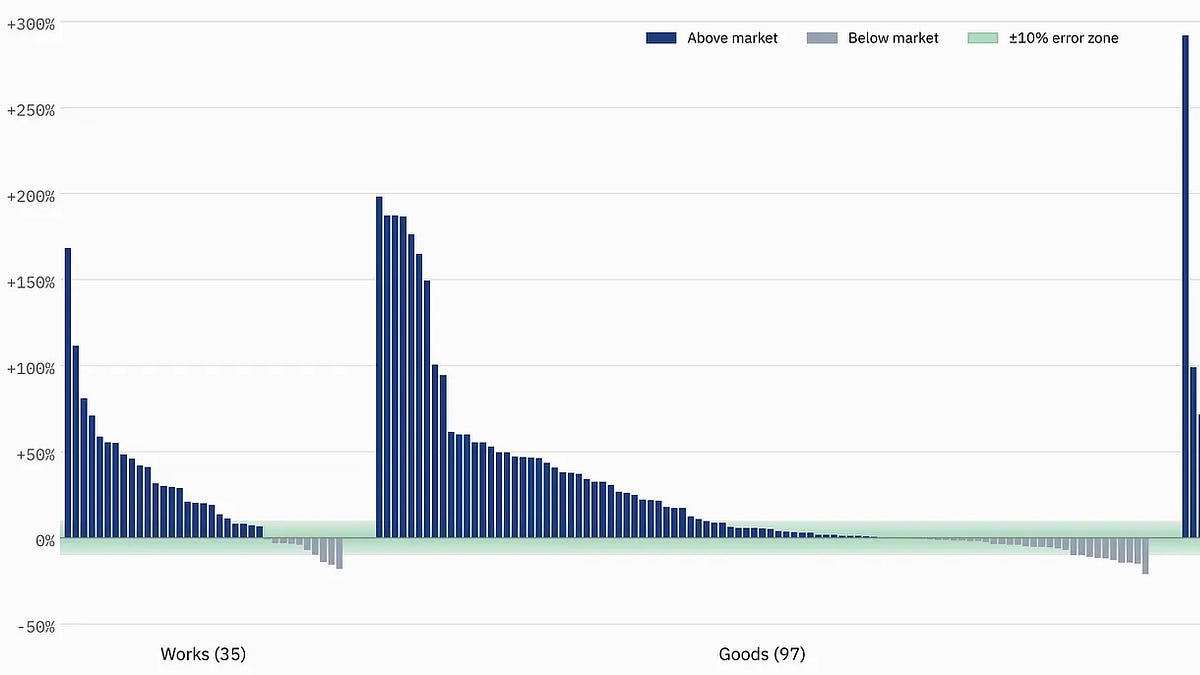
SNS currently maintains a two-track legal and bureaucratic system. Vucic’s Serbia is a place where his kum (best man) can careen around the capital in his McLaren while on cocaine, crash into another car and cause injuries, receive a mere 85 EUR fine and have the police officer who leaked the incident report arrested. The party’s embezzlement is prolific. Investigative journalists have unveiled innumerable scandals, but the total scale of theft remains speculative. While an insufficient basis for firm allegations, my analysis of a sample of 161 large public procurement contracts 2021-2025 indicates an average per-contract markup of 21.8% beyond a ±10% error zone. Extrapolating by contract type, 3.6 billion EUR out of the 34.6 billion that passed through the public procurement online portal in the past five years may be unaccounted for. Extending the ‘works’ rate to off-portal megaprojects, this figure rises to around 5.3 billion EUR. That’s around 470,000 times the average annual net salary in Serbia.
Fig 3. Markup by sector, sample of public procurement contracts, 2021-2025
Sunday’s election is not a test of popular opinion - the people have already chosen. Over the past two years, they have chosen to unite to bring down a regime that has stolen their elections and their money for over a decade. They have also chosen their future, and the fellow citizens they trust to guide them towards it. The election will not be fair. But the mood on the streets is electric. If they turn out in sufficient numbers to drown out the SNS army of illegally secured voters, the Serbian people will finally reclaim their country.
Thank you to Bekalu Terefe for assisting with the contract data analysis.
正文由 探How 从来源站点 RSS 同步,内容未经改写;遇到排版缺失或需要图片、视频时请以原文为准。