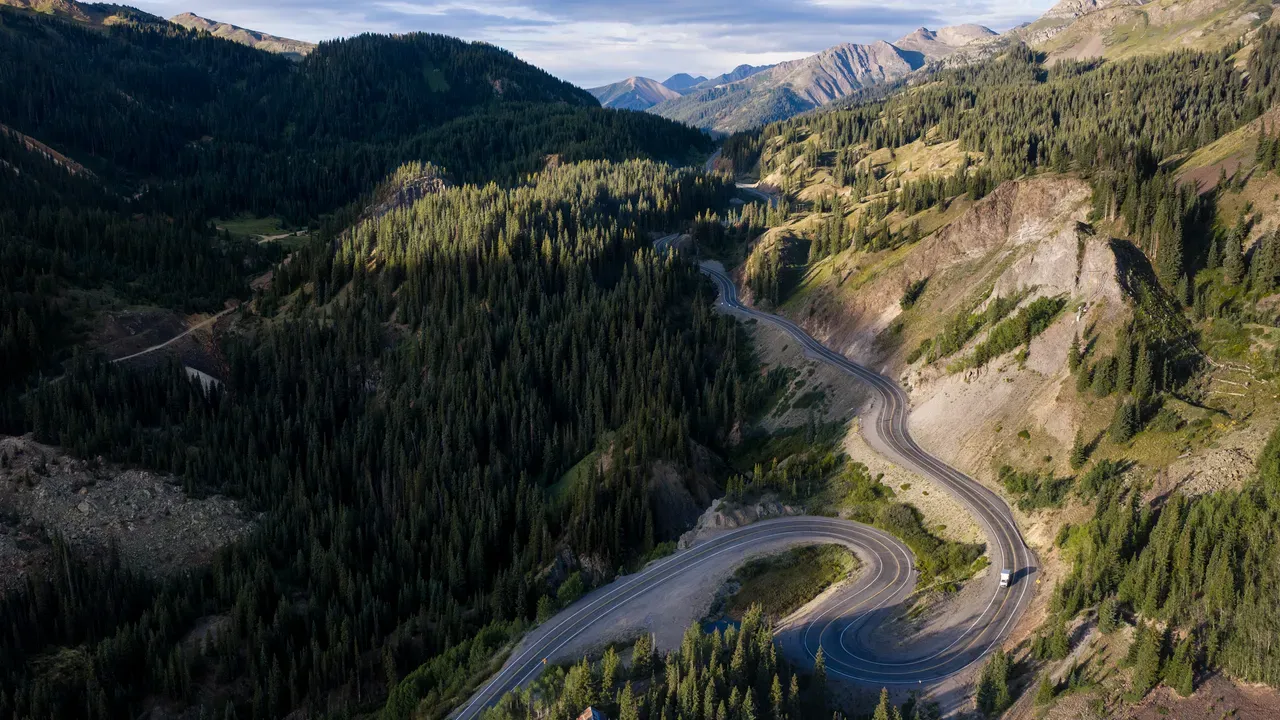
Why Doesn't Anyone Want to Fix One of America's Scariest Roads?
Visitors are more likely to be concerned with what lies below. Many sections of the road have a sheer drop of more than four hundred feet, and there are no guardrails, because of the need to push snow off after avalanch…
以下正文同步自 Hacker News,版权归原站所有,已转换为易读排版。
Visitors are more likely to be concerned with what lies below. Many sections of the road have a sheer drop of more than four hundred feet, and there are no guardrails, because of the need to push snow off after avalanches. When the route was constructed, in the eighteen-eighties, it was considered one of the greatest achievements in road engineering in the American West. Its purpose was to serve the silver and gold mines of the San Juan Mountains, but almost immediately the road also began to attract tourists. At some point in the early twentieth century, for reasons that are now obscure, the section above Ouray became known as the Million Dollar Highway. In 2013, USA Today featured the Million Dollar Highway; the Death Road, in Bolivia; the Highway of Death, in Iraq; and nine other infamous routes in an article titled “World’s Most Dangerous Roads.” Less than a year later, the paper’s “10 Best Bucket-List Road Trips” also included the Million Dollar Highway. Strictly speaking, there’s nothing contradictory about the same road appearing on both lists, although it helps explain why the Ouray County coroner used the phrase “attractive nuisance” when we talked about the road recently. People can behave erratically on the Million Dollar Highway. There has been at least one instance in which a driver got into a heated argument with her passengers, pulled over, kicked them out, and then, in full view of everybody, accelerated straight off the edge, to her death. One man travelled all the way from the Netherlands just to propel himself off the road. The G.P.S. data on the Dutchman’s phone showed that he had driven repeatedly up and down the highway before choosing one of the most dramatic drop-offs. Occasionally, a vehicle seems to vanish. Last year, early on the morning of August 5th, a tourist from Oregon named Adam Hynes was approaching one of the most treacherous sections of the gorge when he looked ahead and saw a silver Honda Civic moving in reverse. Hynes found it strange that somebody would be driving backward in such a spot, but then his view was obscured as he went around a sharp bend. By the time Hynes came out of the turn, the Honda was gone. Hynes dropped a pin on his phone. There was no signal, so he continued down the highway until he was able to call 911. Then he circled back and parked at a pullout not far from the pin. The gorge was so precipitous that Hynes couldn’t see the bottom, but he had a DJI Mavic 3 drone. He set the machine aloft, and its camera captured the Honda, which had fallen three hundred and twenty feet—about the height of a thirty-story building. The silver vehicle lay upside down in the Uncompahgre River, crumpled like an aluminum can. When an accident occurs on a steep part of the road, police and emergency services wait until skilled climbers arrive. On that morning, a call went out to the Ouray Mountain Rescue Team, a local volunteer organization that is staffed with many expert climbers. Two members, Jeff Skoloda and Tim Pasek, arrived and strapped into harnesses and helmets. They climbed down a rope that led to a Tyrolean traverse, a fixed cable that runs over the river to the other side of the gorge. After that, they installed a rope on the far cliff wall and rappelled down to the Honda. It took them about twenty minutes to reach the wreckage. As Skoloda approached, he couldn’t tell how many people were inside. He is in his fifties, a successful sculptor and metalworker who owns a large workshop in Ouray. Since joining Ouray Mountain Rescue, in 2000, he has helped recover more than a hundred bodies, often in treacherous terrain. Many have been climbers, skiers, or other recreationalists, but some were found in vehicles that tumbled off the Million Dollar Highway. When Skoloda kneeled beside the Honda, he heard a scream. Until then, the men had assumed that they were involved in a recovery operation. Now they tried to open the doors, but the Honda was too damaged; a handle broke off in Skoloda’s hand. The screaming sounded like a young girl, but the voice was muffled and hard to hear above the rushing river. They couldn’t see her face, because that side of the car had landed against a large boulder. But there was a small gap in the broken window on the other side, and Pasek reached in and touched a bare foot. “Can you feel that?” he asked. “Yes.” “Are you hurt?” “Yes!” Pasek used his emergency radio to tell rescue services on the road above that there was a survivor. They asked him to estimate how old she was, in order to figure out what size equipment might be necessary. The tumbling vehicle had left a long trail of debris across the sheer cliff—shoes, clothes, books, papers, luggage. Near the end of the trail, a children’s book was lying in the dirt. Pasek picked it up: “A to Z Mysteries: The Zombie Zone.” He has two children of his own. He looked at a page and made a guess—“I think she’s probably about ten.” Skoloda attended that training exercise, and he still has vivid memories of the school bus flying through the void and then sticking into the side of the mountain. “It kind of lawn-darted into place,” he told me recently. After the vehicle came to rest, the rescue team helped twenty volunteers climb down and position themselves inside the bus. The volunteers wore moulage makeup that resembled blunt-force injuries, and each of them had a script to follow. Two mannequins were also placed inside—fatalities. For the next two hours, the rescue team practiced cutting into the bus with extrication tools, and they made triage and evacuation decisions based on the role-played injuries of the volunteers. A temporary morgue was set up on the Million Dollar Highway. That particular training has not been repeated, but people still think a lot about school buses and children on the highway. A mass-casualty event would overwhelm the resources of a rural community. I coach the high-school track team in Ridgway, and on two occasions I’ve driven a busful of teen-agers to a meet via the Million Dollar Highway. The school has strict rules: If I’m driving a fourteen-passenger bus and the weather is good, I can take the highway. But, if we’re in a larger bus or the forecast is bad, we’re required to follow a longer route, to the west, that avoids steep drop-offs. The middle school used to take field trips south, in order to visit historical sites, but that stopped a few years ago, after bus drivers expressed concern. Nowadays, all field trips head in other directions. In essence, many residents live with their backs to the steepest sections of the highway. The orientation was the opposite in the old days, when all attention was directed to the highlands. In 1882, major silver deposits were discovered in the Red Mountain Mining District, south of Ouray. Government surveyors had declared that it was impossible to build a road through the gorge, and Ouray had tried twice without success. Another settlement, Silverton, lay on the far side of Red Mountain, and the communities vied to see which could become the main transport hub. In 1883, La Plata Miner, a Silverton newspaper, mocked the competitor’s ambitions: “The people of Ouray say they will build a road to Red Mountain. How absurd and ridiculous.” That summer, Ouray contracted with a man whose nicknames included “Hebrew Pathfinder of the New West” and “Moses Who Piloted San Juan out of the Wilderness.” Otto Mears was born in Russia, to Jewish parents, in 1840; his mother came from what is now Latvia, and his father was English. Both parents died before Mears was three, and he was passed off among relatives who didn’t want to care for him. At the age of nine, he was shipped on a lumber freighter from Russia to England; a year later, he was sent to the United States. He received almost no formal education, and he worked full time from age eleven, eventually finding odd jobs in California mining towns. He observed that miners and prospectors were usually poor, whereas people involved in transport and merchandise thrived. During the Civil War, Mears enlisted with the Union Army, which sent him to the Southwest. At the end of his service, he received an assignment to bake bread for soldiers, which allowed him to profit from the leftover flour. After saving some money, Mears opened the first sawmill in southwestern Colorado, along with a flour mill, both of which supplied the military. He was a genius at figuring out frontier businesses that complemented one another. He helped found towns in southern Colorado, and he started newspapers that promoted those towns; sometimes he also acquired government contracts to build their roads and deliver their mail. The Ute Indians were the dominant tribe in the region, and Mears was one of the few whites who learned to speak their language fluently. He served as the federal government’s translator in treaty negotiations, and he became a close friend of Chief Ouray, the tribe’s most important leader. Mears’s greatest talent was for road-building. In Colorado, which didn’t become a state until 1876, there was little public money for infrastructure, and entrepreneurs could pay a few dollars to the local government for the right to build a toll road. In the course of two decades, Mears created a network of almost four hundred and fifty miles of roads. He had no engineering background, but he often laid out routes himself. South of Ouray, many sections had to be blasted out of eight-hundred-foot cliffs. Workers were suspended by ropes: they drilled holes in the quartzite, packed the holes with dynamite, lit long fuses, and gave a signal to be yanked up to safety as quickly as possible. According to “The Road That Silver Built,” a history of the highway’s early years, there were reports that five of Mears’s workers died. The road was open for traffic in less than six months. Mears set up a tollgate, charging a dollar for a horse and rider and five dollars for a team and wagon. He reportedly collected more than a hundred thousand dollars from his roads in a single year, and Ouray boomed. After Silverton lost the race to Red Mountain, local officials contracted with Mears, who then built their road, too. For good measure, he purchased stock in a silver mine near the pass where the two routes came together; for a spell, the mine paid an annual dividend of forty-five per cent. After four years of operating the Ouray road, he sold it to the town. Mears was, by all accounts, unsentimental about his origins. When dictating his autobiography, he covered his childhood—the dying parents in Russia, the orphan shipped off to England and America—in fifteen sentences. He became heavily involved in Colorado politics but usually behind the scenes, and he seemed to hold no high ideals or scruples. He often paid bribes, and he did everything possible to resist organized labor. When most of the Utes were inevitably driven out of Colorado—after every treaty had been broken by the Americans and violence had ensued—Mears helped negotiate the terms of their departure. As the Army escorted the Utes out, Mears charged them tolls for using his roads. He also acquired contracts that allowed him to profit from developing a supply chain that served the Utes’ new home, in a part of Utah so desolate that even the Mormons didn’t want to live there. In 1911, a motorcar drove up to Red Mountain Pass. The dealership that sponsored the journey described it as “one of the most remarkable, perilous, and daring trips ever undertaken by an automobile on the American continent.” By the following decade, people had started using the phrase “Million Dollar Highway.” This didn’t refer to the cost of Mears’s original project, which had been about a hundred and forty thousand dollars. In the nineteen-twenties, a series of road improvements were made for a total of about a million dollars, which may have been the source of the name, although some maintain that it came from the spectacular views. Mears died at the age of
正文由 探How 从来源站点 RSS 同步,内容未经改写;遇到排版缺失或需要图片、视频时请以原文为准。