You Are Losing Weight. Why Are You So Angry?
Dieting can make you snap at the people you love. Hunger is unpleasant, and your mind blames whoever is nearby. A steep deficit makes it worse.
以下正文同步自 Hacker News 最新,版权归原站所有,已转换为易读排版。
Dieting can make you snap at the people you love. Hunger is unpleasant, and your mind blames whoever is nearby. A steep deficit makes it worse.
You started losing weight and it is working. The scale is moving, your clothes fit better. And you snap at your partner over the dishes, lose patience in traffic, and find your coworkers unbearable by four in the afternoon. You are not turning into a worse person. You are hungry more often than you used to be, and hunger changes how everything around you looks.
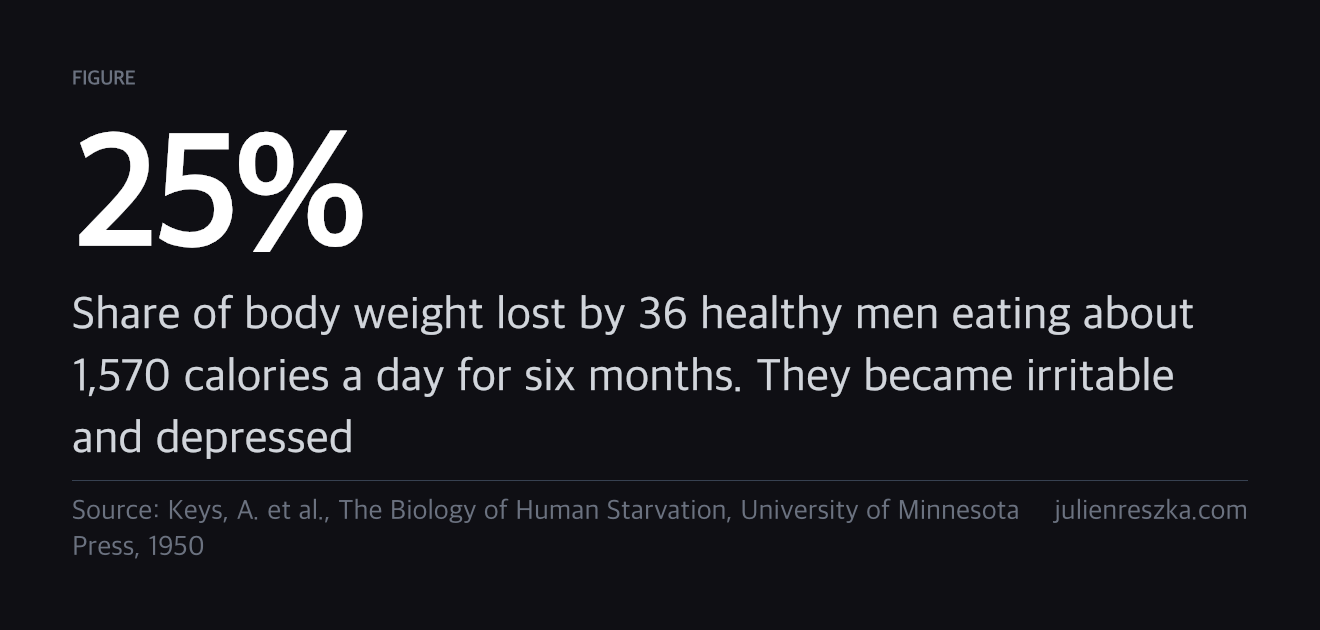
The extreme version of this is old. In the Minnesota Starvation Experiment during World War II, 36 healthy young men ate about 1,570 calories a day for six months and lost roughly a quarter of their body weight. They became irritable, depressed, and obsessed with food, and movies they used to laugh at no longer amused them. That was semi-starvation, far beyond any sensible diet. But the same effect shows up at everyday scale. In a 2022 field study, 64 adults rated their hunger and mood five times a day for three weeks. In a 2010 trial, women were put on a three week diet. The results:
The last one matters because the two effects were separate. A diet adds stress from two directions: your body runs low, and the constant arithmetic of what you can and cannot eat wears on you.
Why does hunger turn into anger at someone in particular? In experiments at the University of North Carolina, hungry people rated neutral symbols as more unpleasant, but only after seeing a negative image first. In the lab, hungry students whose computer crashed, and who were then blamed for it, reported more stress and hatred and judged the researcher as harsher. Students who had first spent a few minutes writing about their own feelings did not. Hunger feels bad, and when something frustrating happens, your mind attributes that bad feeling to the person in front of you instead of to your stomach.
The good news is that irritability is not the price of losing weight. In the CALERIE trial, 220 healthy adults spent two years trying to eat 25 percent less, and in practice managed about half of that. Compared with people who ate normally, they lost about 17 pounds and reported better mood, less tension, and better sleep. A modest deficit kept up over time did not make people angry. A steep one, run on willpower and long gaps without food, is what the hunger studies describe.
So the goal is not to stop losing weight. It is to lose it without spending your days on the edge of hunger:
If the irritability comes with weeks of low mood, losing interest in things you used to enjoy, or thoughts about food that take over your day, raise it with a doctor. Aggressive restriction can slide into disordered eating, and that is not something to push through alone.
Otherwise, treat the anger as information. It is telling you the deficit is too steep or the gaps between meals are too long. Adjust the diet, not your opinion of the people around you.
If dieting is making you short-tempered, shrink the deficit before you blame yourself or anyone else. Eat protein early, keep hard conversations away from mealtimes, and say you are hungry out loud when you feel it.
Both free to try, no login needed. Results saved locally in your browser.
You are finally losing weight, and you have never been this short-tempered. You snap at your partner, lose patience with coworkers, and feel angry for no clear reason. Is irritability just the price of getting in shape?
All comments are manually moderated by the author.
Thanks — your comment is queued for moderation.
Thanks — your reply is queued for moderation.
正文由 探How 从来源站点 RSS 同步,内容未经改写;遇到排版缺失或需要图片、视频时请以原文为准。