Show HN: Imp, an LLM Server for RTX 50 GPUs, Written by Claude Code
RTX 5050 to 5090 · RTX PRO 2000 to 6000 · one docker run · OpenAI and Anthropic API · built-in chat · Linux or WSL2
以下正文同步自 Hacker News 最新,版权归原站所有,已转换为易读排版。
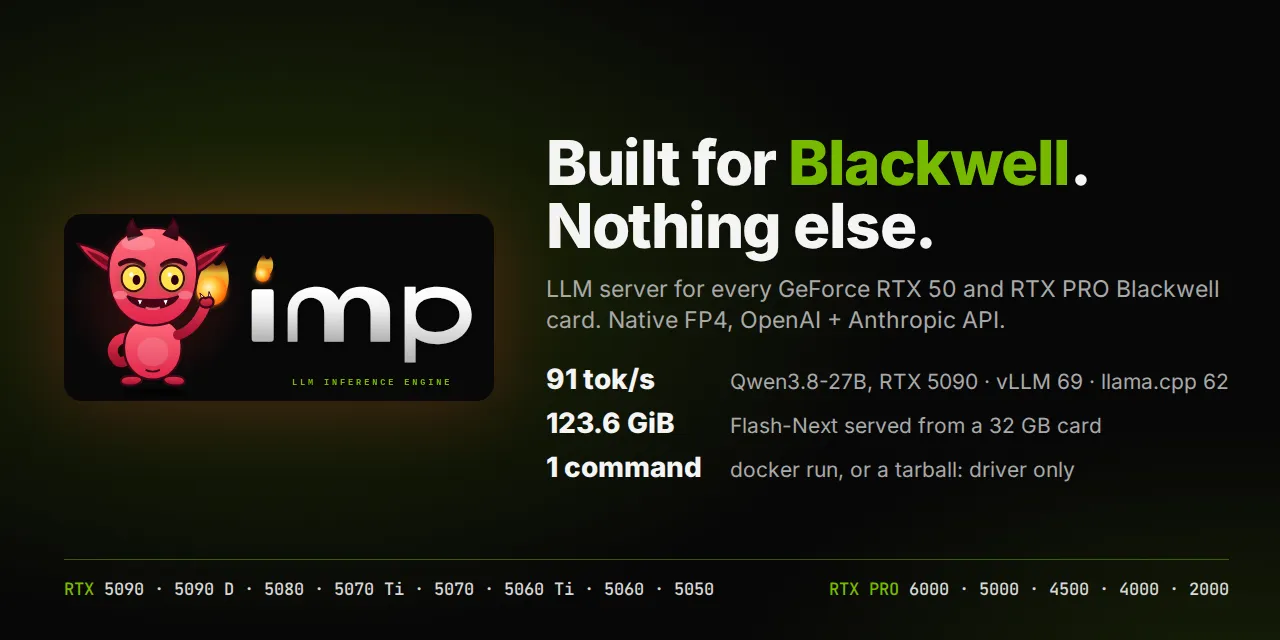
Built for Blackwell. Nothing else.
RTX 5050 to 5090 · RTX PRO 2000 to 6000 · one docker run · OpenAI and Anthropic API · built-in chat · Linux or WSL2
imp is an LLM server for one GPU generation only: NVIDIA Blackwell sm_120a, every GeForce RTX 50 and RTX PRO Blackwell card. It is for people who run models on their own single card and point chat apps and coding agents at it (OpenAI and Anthropic API: Claude Code, Codex, any OpenAI client). Built and tuned on one RTX 5090, it uses what that chip has: native 4-bit (FP4) math, its tensor cores, its memory bandwidth. One container, no CUDA toolkit or Python on your machine, MIT.
Qwen3.8-27B, tokens/s imp vLLM 0.31.0 llama.cpp
one user 96.3 69.9
32 users at once (total) 1979.1 1414.2
one user, same Q4_K_M GGUF file 77.1
62.9
32 users at once, same GGUF file 1365.2
178.7
Server API, 300-token greedy answers to short prompts, median of 3 fresh-server trials, each engine on its defaults; imp and vLLM read the same NVFP4 checkpoint, imp and llama.cpp the same GGUF file. No speculative decoding in the one-user rows (imp NVFP4: switched off; imp GGUF: its default drafts nothing, 77.7 with all of it forced off). With the model's own MTP draft head on in both engines (imp: --max-batch 1), 6 real chat prompts: imp 126.49, vLLM 116.84; on short template completions the two are within noise. Ranges, commands, raw logs: docs/BENCHMARKS.md. tokens/s = how fast the answer appears (a token is about ¾ of a word).
Bigger than the card: the 123.6 GiB Qwen3.8-Flash-Next answers at 92.1 tokens/s for one user on a 32 GB RTX 5090, its experts in host RAM (how).
One chip. Tested on the RTX 5090; every other sm_120a card (RTX 5050 to 5090 D V2, RTX PRO 2000 to 6000 Blackwell) runs the same kernels, VRAM decides the model (which card). No multi-GPU, no CPU, no other GPU: use llama.cpp for breadth, vLLM for many GPUs.
Dense models under heavy load: vLLM led Qwen3-14B at 32 users (-7.6 %, 2026-09-02); prompt reading on dense GGUF is level with llama.cpp, not ahead (BENCHMARKS.md).
Models bigger than the card depend on host RAM, PCIe and how often the topic changes the set of busy experts.
One maintainer, no GPU in CI: every GPU test and benchmark runs on the maintainer's RTX 5090; issues are welcome, answers are not guaranteed. Every gap with its number: docs/LIMITATIONS.md.
Jump to: Which model? · Install · Bigger than VRAM · Using it · How it works · All the docs
You want Take Why
Not sure Qwen3.8-27B NVFP4 (the install example) reads text and images, fits a 32 GB card with room for a long context (24 GB: short context)
the fastest replies, or a 12-16 GB card Qwen3-8B Q8_0 (8 GB card: Qwen3-4B Q8_0) the fastest of the GGUF sweep; picks per VRAM: which card
more knowledge, still fast Qwen3.6-35B-A3B mixture of experts: large, but only a small part works per token
another model family gpt-oss-20b or Gemma-4-26B-A4B both in the GGUF sweep
the biggest model, and ~68 GiB of free RAM Qwen3.8-Flash-Next NVFP4 bigger than any card's VRAM: the experts live in host RAM (below)
Will it fit? Weights plus the KV cache (the model's memory of the conversation) must fit in the card's VRAM (8 GB on an RTX 5060 up to 96 GB on an RTX PRO 6000, per card). imp sizes the context to what is left after the weights, and refuses at load a model whose experts do not fit instead of running it wrong. Every family that loads, with its size: docs/MODELS.md.
Two file formats, no conversion step: a GGUF file (as used by llama.cpp) or a SafeTensors directory in NVFP4 (NVIDIA Model Optimizer, llm-compressor, or imp's own imp-quantize). Your own BF16/FP8 checkpoint: docs/QUANTIZATION.md.
You need: one of the cards above, Docker with the NVIDIA Container Toolkit, Linux or Windows with WSL2. No build: the image comes from ghcr.io. Checklist: docs/QUICKSTART.md.
git clone https://github.com/kekzl/imp && cd imp
scripts/stage-model.sh kekzle/Qwen3.8-27B-NVFP4-vllm ~/models/Qwen3.8-27B-NVFP4-vllm # 1. weights, 19.2 GiB download
docker run --gpus all -v ~/models:/models -v imp-cache:/home/imp/.cache/imp
-p 127.0.0.1:8080:8080 ghcr.io/kekzl/imp:latest --model /models/Qwen3.8-27B-NVFP4-vllm # 2. serve
Ready when the log says Server listening: open http://localhost:8080. Measured with exactly this command: 96.5 tokens/s for one user (6 real prompts, 400 tokens each), first token after 27-29 ms, 19.7 GiB of the card in use. The imp-cache volume keeps converted weights and the measured memory plan for the next start.
No Docker: every release attaches imp-<version>-linux-x86_64.tar.gz (CUDA libraries bundled, needs only the NVIDIA driver): docs/DEPLOYMENT.md. Shortcut: --model hf://<org>/<repo>[:<file>.gguf] downloads inside the container (needs --user "$(id -u):$(id -g)" on a bind-mounted ~/models): docs/CONFIG.md. Full walkthrough: docs/QUICKSTART.md. Your card's numbers: scripts/bench-community.sh prints a block to post in Discussions.
Mixture-of-experts models use a few experts per token. When the experts do not fit, imp keeps them in pinned host RAM, caches the busiest on the card (least recently used out) and copies a missing expert over PCIe when a token needs it. Nothing to configure: imp decides at load.
Qwen3.8-Flash-Next (nvidia/Qwen3.8-Flash-Next-NVFP4, 123.6 GiB, 56.25 GiB of experts) on one RTX 5090:
You need: a 32 GB card or bigger, the host RAM above free, 123.6 GiB of disk. With less RAM imp reads missing experts from disk instead (at a 40 GiB container limit: 46.9..60.0 tokens/s, v0.50.0, CHANGELOG.md). Speed depends on PCIe (test card: PCIe 5.0 x16) and on how often a conversation changes topic.
STAGE_DIR=~/models/Qwen3.8-Flash-Next-NVFP4 scripts/stage-model.sh nvidia/Qwen3.8-Flash-Next-NVFP4 ~/models/Qwen3.8-Flash-Next-NVFP4
docker run -d --name imp-server --gpus all -v ~/models:/models -v imp-cache:/home/imp/.cache/imp
-p 127.0.0.1:8090:8090 ghcr.io/kekzl/imp:latest --model /models/Qwen3.8-Flash-Next-NVFP4 --host 0.0.0.0 --port 8090
Ready when docker logs imp-server prints Server listening on http://0.0.0.0:8090. More: docs/QUICKSTART.md.
In the browser: http://localhost:8080, the built-in chat: saved conversations, sampling controls, live tok/s, server metrics, GPU energy per answer (tour).
Your apps and coding agents: an "OpenAI-compatible" provider with base URL http://localhost:8080/v1; Anthropic apps: http://localhost:8080/v1/messages. The model id is the file or directory name (GET /v1/models).
Tool calling, JSON output, streaming on every API dialect; which fields work: docs/API.md.
Thinking models: the reasoning comes back in reasoning_content, the answer in content.
Proxy, API key, metrics: docs/DEPLOYMENT.md. Without the server: imp-cli in the image, or the C library (include/imp/imp.h).
Something went wrong? Slow replies, 503, empty content, a stalled stream: docs/TROUBLESHOOTING.md, or an issue with the server log.
How does it work?
One chip generation, no compromises for others. Every Blackwell sm_120a card multiplies 4-bit numbers (NVFP4) directly; imp keeps weights in that format and computes on it, where portable engines unpack to 16 bits or skip the format.
Everything is its own: file loaders, tokenizer, the conversation memory (a paged KV cache shared between requests), the GPU kernels. No framework underneath.
Replay, not re-launch. Each answer step is recorded once as a CUDA graph and replayed, so the CPU does not hand the GPU thousands of small jobs per token.
Guess, then check. A cheap drafter proposes the next tokens, the model checks them all in one pass and keeps what it agrees with: same answer, fewer passes.
Many users at once: requests share the card (continuous batching), a repeated prompt prefix is read once (prefix caching).
What exists and what is tested: docs/FEATURES.md. The whole design: docs/internals/ARCHITECTURE.md. Every doc by layer and reader: docs/README.md.
I want to … Read
run it, step by step docs/QUICKSTART.md
know which API fields work, which models load docs/API.md, docs/MODELS.md
know why it is this fast, or this slow docs/PERF.md, docs/internals/BENCHMARKING.md
understand or replace a kernel docs/internals/KERNELS.md
know where imp loses, and why no multi-GPU docs/LIMITATIONS.md, docs/DESIGN_DECISIONS.md
build from source (docker compose build imp-server, tracks main), or contribute CONTRIBUTING.md
work on it as an AI agent CLAUDE.md
How this was built
Every line of imp was written by an AI coding agent (Claude Code). The repository keeps its own audit trail: docs/audit/, docs/MISSION_JOURNAL.md.
MIT. See LICENSE. One kernel file is adapted from Apache-2.0 code (SageAttention); the APA prefill (src/compute/apa/) is kekzl/apa under MPL-2.0. Licence texts and notices are in THIRD_PARTY_LICENSES.md, shipped in the image at /usr/share/doc/imp/.
正文由 探How 从来源站点 RSS 同步,内容未经改写;遇到排版缺失或需要图片、视频时请以原文为准。