The Faux-Vintage Photo: Full Essay
1) the assumption is that the starting point is a low quality (noisy, grainy) photo.
以下正文同步自 Hacker News 最新,版权归原站所有,已转换为易读排版。
-
the assumption is that the starting point is a low quality (noisy, grainy) photo.
-
what is the "modern" processing technique that would contrast a vintage approach?
The answer here is that there isn't any modern processing technique (such as HDR) that can mask a poor quality photo. So rather than fight the tide, using a vintage filter embraces the quirkiness of the smartphones' weaknesses rather than try to enhance.
awesome essay. lots to say in response. I collected my thoughts here: http://learnoutlive.com/how-social-media-killed-the-moment/ - in any case - keep up the great work!
dunno. thought maybe people got sick of making wacky faces and delegated that job to the scenery.
very interesting post. when reading it i jotted a note saying "how does the simulation negate 'authenticity'? what if 'authenticity' is merely an culturally dynamic aesthetic, and not some essential quality?". i'm very interested in the assumption that you appear to make that 'authenticity' is 'authentic', basically, the idea of authenticity itself. what existential function demands it? i can only hope to discover more of your writings & bibliographies!
How about the rise in popularity of Lomography, shooting with the many "Toy", film cameras that are becoming more and more popular. These cameras are authentically producing the "look" Instagram and Hipstamatic are imitating, yet are not mentioned at all in the article.
I would wager that the market segment populated by Holga and Lomo derivatives is the only segment of analog photography that has shown any growth at all in the past few years. Considering their relatively parallel upwards trends, I think you have missed some important information.
Absolutely brilliant. Thank you for the nice read.
Excellent piece. "Documentary vision" nicely names the phenomenon; I'd written about it without the benefit of such an apt phrase. I'm working on similar issues from the perspective of the history of memory practices. Tend to think the visual nature of social media remembering/documenting accents the presence of the absent thing rather than its "past-ness." I'm going off of Ricoeur's distinction between the Platonic and Aristotelian views of memory; the presence of the absent thing vs. the remembrance of a past in time. Perhaps the faux-vinatage look is a gesture toward the acknowledging the pastness of the present absence.
Lots to think about here, as I've been doing research on nostalgia culture for the last few years, but two things jump immediately two mind:
-
I'm not so sure that social media services as they exist now are really invested in in treating the present as a potentially documented past--it is nearly impossible to access old statuses, updates, notes and comments on the social media platforms that are dominant today, which is one way that social media in 2011 is considerably different from, say, LiveJournal in 2002. In fact, I think one of the ways these services encourage constant user updates is to de-emphasize the potential of your posts to last, and to continuously demand new content to keep you from slipping into the past.
-
Jameson's argument about nostalgia in Postmodernism regards the inability of postmodernist culture to represent its immediate material conditions. But as this essay itself shows, the movement towards nostalgia in contemporary culture, and its affective power, are deeply historical. In other words, I'm not so sure that nostalgia necessarily = the simulacrum, and lots of the best writing on nostalgia has worked to go beyond Jameson's characterization of it in 1983 (Richard Dyer's Pastiche, for example).
PS - I wish I could edit that comment to make it sound less snooty (that first paragraph...who says that?). M'bad. I think it's a really interesting essay that could productively go in a lot of important directions.
oh this sounds like haven I is so intrigued with this load of infinitely cyclical regress
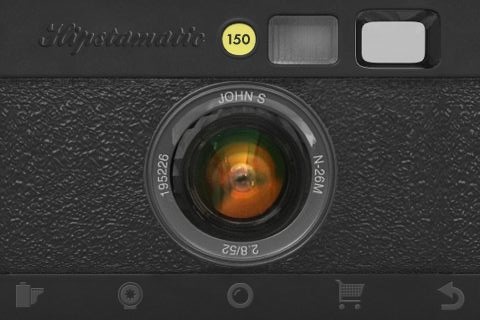
I think Hipstamatic speaks more to the polaroid experience. We all know that polaroids didn't have great quality, but they did offer the ability to capture a moment. Taking a picture with a polaroid camera was part of the experience. It required patience, it was exciting to watch it develop.
Instagram allows the user to add several different filters to the image after the fact. While Hipstamatic requires you to choose your lens, film, and flash BEFORE you shoot, and then requires that you wait for it to "develop".
I think that Instagram and Hipstamatic both produce a similar look, but I think that the experience is much different. For me, Hipstamatic brings back the nostalgic feeling of an old film camera and a darkroom.
Too many aspects of the "feel" and experience of these apps are being glossed over.
Too bad that often we can't see that whatever quality the 'unadulterated' versions of these images really WILL form the patina of the future. How is it that we view the present as so pristine?
Seriously both apps over filter the hell out of photos. I want to see your photographic vision, not hipstamatic. That being said, there are always exception and composition remains king. What I notice is with the bar lowered for entry, the ubiquitous posting and sharing to Flickr, etc, what the curator is left with is just more rubbish to sift through. Good photos still rise to the top. Even among millions of pictures of over processed shoes, feet, people walking, coffee cups, cats, and other cliches.
I think you missed the true heart of the matter with this social age. It feels really good to get near instant feedback and praise from your peers when you take and post a photo. That is what is driving this new creative market, people's feeling of accomplishment and worthiness based on peer and complete stranger feedback.
I feel like instagram is more a sharing platform and less a photo app, and hipstamatic is an app up you buy when you first get an iPhone and you quickly move on to better photo apps one you realize you photos all look hipstamatic and not your own style. For pro level alternatives, I suggest filterstorm and iris photo studio as well as photogene.
I am heading to NYC to moderate an apple talk on portraits with an iPhone this Thursday at the upper west side apple store and I will be discussing many of these points with the interviewee Jim Darling.
Haha, please excuse the typos / weird grammar. My iPad keyboard really hates me tonight, or I should just type slower and check what I am writing.
Nathan, I wonder about the extent to which you find 'nostalgia for the present' in social media to be (at least phenomenologically) different from the type experienced by and inherent to pack-rats, obsessive diarists and others I might call 'self-curators.' In other words, the type of 'documentary vision' you describe is not only cultivated by people who see the world as a potential past to be consumed by others, but is also cultivated by people who see the world as a potential past to be revisited for themselves later. What is the difference or significance of any difference between using that filter with the expectation of consumption by OTHERS (implicit in social media engagement), and simply the use of that filter for oneself?
I worked at an Amusement Park during college as many people in my family have. For a few years now I've been working on making a movie about the place and my experience/feelings about it. When I started the piece I picked up a copy of Simulation and Simulacra but wasn't able to really comprehend its significance with what I was doing. About 3 years have passed and I've really gotten nowhere on the project. At the present I have been using my Holga and Super 8mm for various projects. I have to be honest and say that in reading this post, things just sort of clicked for me and I think I've found a new direction for this project. Thank you!
Hey! I took that NPR pic at the top. How cool to see it being used in this way.
I don't know about nostalgia. But, I do know that with "regular" digital photography these days there are endless modifications you can make photo editing software. For me, the beauty of Hipstamatic is that it freezes a moment in time that DOES NOT lend itself to endless editing and adjustment.
In this age of easy to reproduce and easy to edit, there is something comforting about a moment frozen in time.
Great essay and nice writing. You've done an interesting job of articulating on a very intangible concept. It would be nice to see a bit more citation and research to balance out some of the longly worded ideas you've presented. However, I know this isn't your finished dissertation, so no big deal. Another small suggestion would be to replace cache with cachet. I think that was the word you intended to use, otherwise the use of cache in that sentence didn't seem quite apposite.
It feels like the use of these apps doesn't actually allow the user to be more creative, but actually promotes some lethargy towards actually making a well composed, exposed, and timed photograph. The apps actually seems to counterbalance/cover-up the user's inexperience and laziness with a catchy mask that allows him or her to say, "Look, I'm an artist too."
Nice to see my grid of Hipstamatic film and lens combinations being used in a thoughtful essay, as opposed to one which just outright slams users of these apps as not being 'proper photographers' - a good balanced debate here!
But, I'd appreciate a link to my website in the article footer too, thanks :)
正文由 探How 从来源站点 RSS 同步,内容未经改写;遇到排版缺失或需要图片、视频时请以原文为准。