The Shrugflation Triangle: How AI, Oil, and Treasuries Are Impacting the Economy
This piece was written in several cities - Durango, Colorado, Chicago, St. Louis, Las Vegas, New York City, Cleveland, and Tulsa, Oklahoma. I love traveling because I get to talk to so many different people about how th…
以下正文同步自 Hacker News 最新,版权归原站所有,已转换为易读排版。
763
105
131
Share
Good morning from Tulsa, Oklahoma!
This piece was written in several cities - Durango, Colorado, Chicago, St. Louis, Las Vegas, New York City, Cleveland, and Tulsa, Oklahoma. I love traveling because I get to talk to so many different people about how they experience the economy, and I’ve told some of those stories here. The goal of the piece is to connect a lot of dots that tend to float by one another, and to hopefully provide a comprehensive explanation of the three core factors in the economy right now – AI, Treasuries, and oil – and talk about how they feed into one another.
0:00
-56:31
Audio playback is not supported on your browser. Please upgrade.ALSO NOTE: This piece is really long. So it’s likely cut off in your inbox. Right now, my plan for this Substack is to publish one very in-depth essay about once a month. I find that it allows me to spend more time within the ideas and make sure that I am publishing something that feels worthy of your time and attention. So to those who have been so supportive (and so patient between pieces), I am very appreciative - more to come!
The paperback version of In This Economy? came out!! Yay! It has a new afterword about tariffs and AI. I partner with Skylight Books if you want to support local as well!
I am also working on a new website called Ask Kyla where you can submit any questions that you have about the economy and markets.
In Vegas, very early in the morning (although there really isn’t such a thing in Vegas) I was getting a coffee. The barista asked if she could make my coffee without the machine (a touch screen machine was humming behind her, where you can pick exactly what drink you want to make from a menu of pictures.) She said that she liked to add a “human touch” to the coffee. I said yes, of course.
I couldn’t sleep. Neither could the people peppered around the casino playing slots, all of us floating in a world where time didn’t matter.
Bleary eyed, drinking my human-made coffee, I watched them install four new slot machines, absolutely enormous, reaching into the ceilings, like Easter Island heads. The slot machines have screens, so for a while, as the workers were setting them up, lines of raw code danced across the uncalibrated screens, a brief otherworldly glimpse into what would soon be hypnosis. Then the display flipped to three cherries in a row, and played a bright, celebratory chime. A jackpot. But there wasn’t a player in that chair. Everyone else was crammed around the other machines down the row, still feeding in their tokens. Still hoping. Still waiting.
It’s a decent model for the American economy right now: a room full of people playing the slots, trying to get rich, and the jackpot hits for an empty seat.
Most people are trying to do everything the economy asks of them. They’re working and spending and paying more for gas and to borrow money. But the economic winnings keep showing up somewhere else. So where are they going?
There is a lot of debate, huge debates, over what is going on and why. What’s causing the rise in Treasury yields (the thing that prices our economy!)? What’s causing inflationary pressures? What’s causing the economy to do anything, really? Huge debates, with people saying no it’s AI spending, it’s the sheer amount of debt, it’s the war, it’s Uncle Phil in Chicago, he actually controls the economy from an old Nintendo 64.
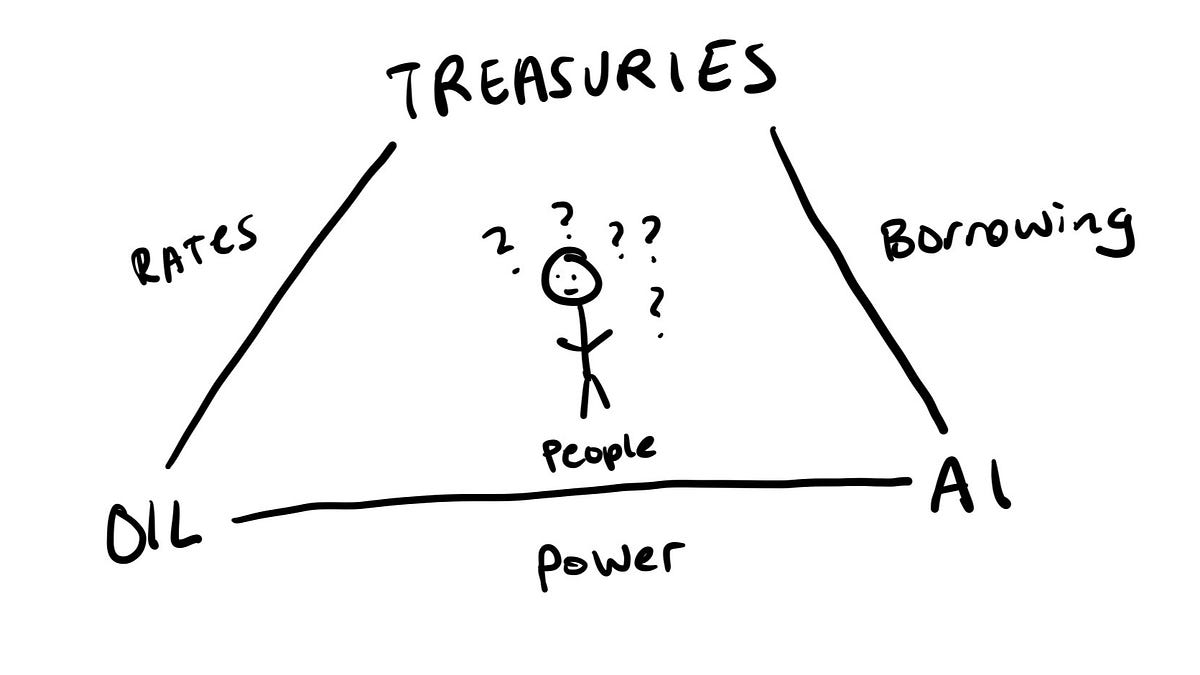
It’s everything, all at once. It’s oil, AI, and Treasuries, because they are feeding into each other. It’s a Triangle (a Bermuda Triangle as Coby Weiss puts it) - three points on a map.
Oil pushes up rates: the war with Iran has throttled oil shipping, diesel has spiked to record prices, and everything that rides on a truck or train or ship or plane costs more. That’s a big part of why the Fed has had to hike interest rates
The government happens to owe the size of the entire economy right now in debt, so when rates go up, so does their interest bill, the fastest-growing thing in the budget. The government covers that by selling more Treasuries, the thing that prices our economy at the same time the AI industry is borrowing unprecedented sums from the same pool of money.
Two giant borrowers, one pool of money, the sheer demand can push up long-term rates even more. And they shrug at any change in rates! The government borrows to pay bills. AI borrows to build, and that requires a ton of power.
AI needs energy, in a world where energy is really expensive. Data centers need a huge amount of power, and when the grid can’t deliver it, they burn it. Oracle is trucking natural gas to data centers. AI doesn’t really move the price of oil but it can’t turn on without it, which brings us back to Point 1.
So that’s the triangle. And who has to deal with it? People. People have to deal with the higher borrowing costs and the higher energy costs and the uncertainty about what AI will do to them. And no one wants to slow down because AI investment is a huge share of both the economy and the stock market, bolstering household wealth, so if the party stops, it reverberates across the entire economy.
It’s a form of shrugflation (can’t help a portmanteau) – usually, money gets expensive and people borrow less, right? Gas gets expensive, you drive less. That’s the whole thing. But right now, a war has made energy expensive and the Fed can’t do anything about that, because you can’t go to a Strait and say listen buddy I’m hiking rates over here. All you can do is make borrowing cost more.
And the two biggest borrowers in the economy hear that and just sort of … shrug? The government borrows at whatever rates are. The AI companies feel like they have to keep borrowing in order to survive, what Tracy Alloway calls the “existential imperative to borrow.”
What does this look like across the economy? Let’s start with oil.
At a finance conference a couple of months ago, the FT quoted a banker who said “Does anyone really care if the Strait of Hormuz is open?” perhaps a defining quote of this era. And to this bankers credit, no. The government seems to be only complicating the situation and AI doesn’t seem worried, at all. The only people who care are people.
I had the honor of moderating a panel on consumer sentiment at the Chicago Federal Reserve. The panel was extraordinarily brilliant and the room was full. One of the panelists talked about how consumers are getting “double squeezed” because they have to absorb both (1) high diesel prices through a higher cost of goods and (2) high gas prices to even go get those goods. The room nodded along.
And they nodded because people care. On October 9th, the University of Michigan’s consumer sentiment index came in at 46.3, the second-lowest reading in its history (the lowest was in May of this year). Its measure of how people feel about their current conditions is the lowest ever recorded1. People expect prices to rise 4.7% over the next year (not great for the Fed).
I’ve been inadvertently watching where all that diesel goes. A big portion of my current road trip has been driving. I drove from Albuquerque to Durango (and back), and from Oklahoma City to Tulsa. All three of these adventures happened between 10pm and 2am. So during those hours, it’s me and a bunch of truck drivers.
You can see the hidden machinery of the country so clearly. Trucks hauling other trucks, hauling cars, hauling horses, hauling food, hauling anything and everything. There are so many of them - on my 90 minute drive from OKC to Tulsa, which started at 12am, I saw about 100 trucks cruising along the interstate. All of them carrying the economy behind them. All of them are incredibly reliant on diesel.
High energy costs trace back to the war with Iran. Since the war started, shipping through the Strait of Hormuz (what a fifth of the world’s oil usually goes through) has been throttled.
Saudi Arabia had a side chute that lessened the blow, with a pipeline across the country into the Red Sea, but drones took that down too. For about two weeks, the main road and a detour were both closed.
The pipeline is running again, below capacity, and the Strait is running at 80% capacity, but only unrefined crude oil is getting through (and Iran is stepping up attacks on tankers).
Renting a supertanker to carry oil from the Persian Gulf to Asia now costs about $1.4 million a day according to Bloomberg. Pre-war, it was about $30,000.
A logistics guy summarized it beautifully for the WSJ – “chaos increases prices.” Our entire economy is truly an oil guzzling machine, as both gasoline and diesel come from oil, with things going all places all the time, across trucks and trains and tractors and ships.
If it gets more expensive to get things places, things are going to get more expensive!
Diesel hit a record $6.53 a gallon in September, up 77% in a year, according to the Wall Street Journal.
So governments are trying to free up fuel reserves. The G7 agreed to release 100 million barrels of diesel and crude from their reserves over four months. That’s only about a day of what the world uses, according to the New York Times. We use SO MUCH FUEL. And the thing about reserves is that they… tend to run out.
Expensive fuel makes everything more expensive, which creates inflationary pressures, which is the Federal Reserve’s problem. To combat this, the Fed raised rates on September 16th, for the first time since 2023. But the Fed can’t go march down to the Strait of Hormuz and broker a peace deal. They can’t direct ships through. All they really can do is make borrowing more expensive for everybody, so that way, people slow down, spend a little less, the economy therefore slows down, and hopefully, inflation slows down.
And we were recently reminded the importance of the Fed’s role in setting expectations like this! The Nobel memorial prize in economics went to Robert Hall and Michael Woodford for work showing that what households and businesses expect is a big part of what holds an economy steady. Shaping those expectations is a big part of setting policy.
Fed Chair Warsh has put aside forward guidance, one of the tools his predecessors used to steer those expectations. So we have an energy shock, people expecting prices to rise almost 5% over the next year, and a Fed Chair that is trying to pull back on some element of signaling where it’s going. Expectations matter. How people feel matters!
The expectations are already in action. Cleveland Fed President Beth Hammack spoke at NABE, a conference I was attending, and she mentioned that a retailer in her district told her that they’re planning to raise prices by more than their costs went up, because they figure more inflation is coming from somewhere – and that’s how inflation becomes self-fulfilling. So it’s the beginning of the loop in a way — what people expect to happen can be what happens, which is why it’s important to discuss people as a part of this triangle.
Oil prices and the 10-year Treasury yield are also moving more closely than at any time in 35 years, according to CBOE, which means that yields are driven heavily by whatever is going on with oil. Which is a problem for the one industry that needs to both (1) borrow a bunch of money and (2) use a bunch of energy.
SHOULD EVERY AI COMPANY AUTOMATICALLY GET $2 BILLION?
AI is a ghost of sorts, haunting most rooms, with people telling stories about it that sound like the scary ones that we tell over a campfire. It has made the future look bright for some, but certainly, not for all, at least not yet (if ever?)
But the price of the companies making an AI product keep getting bid up. Instinct, a personal AI assistant (these assistants are an agent, AI that has access to the computer) has an interesting product but they make $0. They have about 100,000 users or so. They, naturally, raised $1 billion on a $10 billion valuation (most of which they plan to spend on compute, the thing that powers the AI, which is in incr
正文由 探How 从来源站点 RSS 同步,内容未经改写;遇到排版缺失或需要图片、视频时请以原文为准。