Building a cheaper review loop for coding agents using Jev
When tests find a regression in agent-written code, the agent repairs it and the change needs another review.
以下正文同步自 Hacker News 最新,版权归原站所有,已转换为易读排版。
When tests find a regression in agent-written code, the agent repairs it and the change needs another review. Jev, TypeSafe’s hosted classifier, clears about a third of those re-reviews in my personal workflow, at a fraction of the cost of a general LLM review.
In Parallix, one agent family implements a change and another agent, using a different model, reviews it before I do. Human review and integration gates decide when the work is done. I don't expect the first agent to get it right first time; it usually needs a couple of feedback cycles.*
The work comes around again. Tests between handoffs, review by an agent from another model family, human review and integration gates can all return the work to the implementer.
Each re-review used to mean another general LLM review. That needs the requirements and codebase context, more than Jev can fit in 32k input tokens per question. Many re-reviews are easier:
did this repair fix the failed check without weakening it? And would it not be great if we can take decisions in those cases an order of magnitude faster and a couple of orders of magnitude cheaper?†
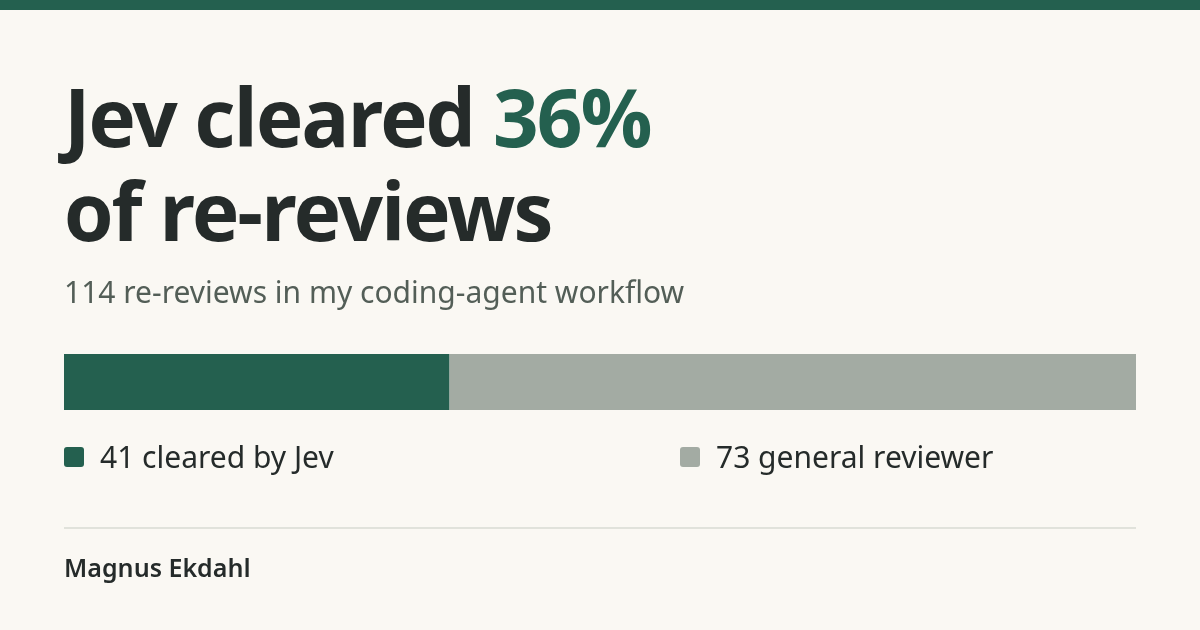
Jev cleared 41 of 114 re-reviews (36%)‡: 37 repairs to local integration gates and four general re-reviews. That leaves 73 for the general reviewer.
A typical integration-gate repair fixes one failed test or a performance regression.
Jev at the re-review. Approve proceeds to human review; abstain sends the patch to agent B; request changes returns it directly to the implementer. Local integration gates follow human approval; the dotted arrow continues to upstream CI integration.
Using Claude API prices as the baseline, that routing mix gives this projection:
About 29% less review work and 35% less API spend. For 800 re-reviews per month, the projection saves about 2.2 hours and $74, allowing for general-reviewer fallback, Jev’s evidence preparation and calls.
Production uses several general reviewers; the estimate assumes the avoided reviews would resemble the Claude sample.
Early experiments asked whether a repair addressed an integration failure. Jev kept leaving the decision to the general reviewer. Some requests also exceeded its token budget. Better packing got the requests through, but the decisions still weren’t useful.
The test run already answers whether the test passes after the fix. A reviewer has a different job. An agent can make a test pass by fixing a code or test regression, or by deleting or weakening a test. Both can produce a green exit status; only one preserves what the test was meant to establish.
Both tests pass. The repairs are different. The test run answers whether it passes; the reviewer asks whether the repair preserves what it was meant to establish. These are schematic examples.
That gave Jev a bounded job: judge whether the repair preserves the check and the behaviour already approved. The question names concrete ways to weaken a check, including skipping a test, loosening assertions or raising a CPU or time budget.
The classifier needs to know what was approved and what the repair changed. Its packet identifies the approved and repair revisions, supplies their relevant diff, names the failed check and states omissions. It excludes files changed only by other work landed on main and identifies changes brought in by a rebase. Rebase changes in the same file can still appear in the diff.
Filter files, not individual rebase hunks. A file changed only on main is left out. If the repair also changes that file, its diff can still contain changes from main. Filenames are schematic.
The local repair loop reruns its gates before re-review. A later rebase does not by itself require repeating every local test; upstream CI provides the usual integration validation. Jev’s approval leaves both stages in place.
The model version matters. I use Jev 1.13: on the same 43 approved historical repairs, it cleared 24 against Jev 1.14’s 12.
A request for changes gives Jev a specific question: did the repair fix what the reviewer asked for? Parallix sends the earlier findings, repair diff, relevant source and implementer’s response. Three questions run in parallel over that evidence, covering the requested fixes and related regressions introduced by the repair.
One clear was a one-line TypeScript correction. A test helper accepted the wrong callback return type; the repair changed it to the type the test runner requires.
A repair the classifier could check. Only the callback’s type changed; runtime behaviour and assertions stayed the same.
The panel can approve or send the patch back to the implementer. With uncertainty, conflicting votes or a failed call, the general reviewer takes over. This path cleared four re-reviews in the dataset.
Jev is a different model from general LLMs such as Claude and makes different decisions. It can make mistakes, but the difference I found in this sample was small.1 For example, in a local integration repair, the implementer added an admission property to a fixture that already had one. Jev cleared the change. The focused suite passed, but the separate TypeScript check later in the process rejected the duplicate key.
The repair introduced another problem. A follow-up review reproduced TS1117 on this revision. The ordinary local typecheck rejects it too. The example is simplified from the inspected patch.
The Jev tradeoffs
For me, the main cost is the attention tied up in review: waiting, checking progress and switching back. The estimate saves about two hours of review work per month at 800 re-reviews. How much human attention that recovers depends on when the workflow needs me, and on how quickly I switch to the next task instead of waiting for the re-review to finish. Reviews that run unattended offer less direct benefit.
Parallix keeps a human in the loop on purpose; I cannot assume a single agent pass finishes a mission. A defect Jev misses can reach my review or fail a later gate.
Cost matters too. Re-review API spend also falls by about 35%: $74 a month at API prices, before extra repairs and upkeep. That can matter when reviews compete for a fixed token budget. Human approval and the required gates stay in place in both options:
Both options retain human review, local integration gates and upstream CI. Cost and review work use the Claude Sonnet baseline and exclude extra repairs and upkeep. The monthly workload is illustrative: four weeks at 200 re-reviews, not a measured rate. The effect on human attention depends on the workflow and has not been measured.
1 The small difference in the sample is one confirmed repair defect Jev cleared among 114 re-reviews. The combined route requested fixes 18 times (15.8%); counting that missed defect gives 19 known cases a general reviewer would have returned (16.7%), a difference of 0.9 percentage points. Follow-up review covered selected cases, so this is the known difference rather than a complete count of misses. General reviewers requested changes in 252 of 786 historical re-reviews (32.1%), from 14 August through 21 October. The matrix applies the sample's 0.9-point difference to that baseline: ~31.2%, or about 256 versus 249 requests for fixes per 800 re-reviews. That projection holds the review mix fixed; the historical and current cohorts are not a matched comparison. Calculation details.
2 The 25 recovered Sonnet re-reviews averaged 33.84 seconds from process launch to exit, including tool calls. Apply that mean to 800 reviews without Jev, or 73/114 of them with Jev. Evidence preparation and classifier calls add about 31 minutes per month, leaving about 2.2 hours saved (29%). Untimed replay preparation uses the mean of four production panels. Shared gates, general-reviewer prompt preparation, final workflow bookkeeping, extra repairs and upkeep are excluded. Calculation details.
3 The Sonnet sample averaged $0.261 per re-review at API prices. Apply the same routing shares and add about $1.25 of classifier calls per 800 re-reviews, using recorded panel costs and historical integration-question costs. Estimated monthly saving: $73.84. Calculation details.
What I’d carry to another team is the bounded question: give Jev a repair it can judge, leave uncertain cases with the general reviewer, and keep human approval and the downstream gates. Count the misses as well as the reviews avoided; the extra repair cycles determine whether the saving survives.
Magnus Ekdahl builds Parallix, a workflow for coding agents with independent agent review, human approval and repository-owned checks.
Evidence reconciled on 21 October 2026. Aggregate data and calculation inputs · CSV. Raw sessions and case-review transcripts are retained privately; the case accounts above are selected source-checked summaries.
The live snapshot selects decided pull-request re-review rounds in the Parallix repository after round one, from the review-classifier update completed on 16 October at 04:39:57.259 UTC through 21 October 08:29:07.320 UTC. The recorded workflow contains 114 model-reviewed rounds across 41 missions: 37 classifier clears and 77 general-reviewer decisions. All 37 classifier decisions are integration-repair clears naming typesafe/jev-1.13-20260917. Twelve packets contain a recorded gate-rerun result; the other 25 state the workflow’s rerun guarantee. Neither form waives the required gates.
‡ Sometimes the infrastructure or tests are just flaky, and a test rerun clears the code without changes. Seven runs reused the old approval without a model review; those results were excluded from the 114 re-reviews. The four general re-review clears are replays with the original evidence and policy. ↩
The duplicate-key case is task-2785 round 4, inspected at revision 39b85d160e20b71e23ce0408f749f2834b792b5a. The original Qwen reviewer resumed its original session and reproduced TS1117. The reviewer-model-change case is task-2792 round 2; the original Sonnet 5.5 session approved. That comparison changes both model and history, so it does not isolate a causal model effect. The cases were selected for investigation, rather than sampled to estimate an error rate; the 37 live clears have not all received uniform independent adjudication.
I count a clear as wrong when the general reviewer finds an earlier obligation unfixed or a new problem inside the latest repair. A finding outside that repair is an acceptable pass. The general reviewer is the comparator, not ground truth; an unnecessary return adds repair work rather than letting a defect through.
I found a routing bug that left general re-review classification inactive for 42 of these rounds. I reran their original evidence with the existing questions, thresholds and pinned model: four approvals and 38 abstentions. Four control packets matched the recorded production hashes. Each approval agreed with the general reviewer at the same revision. These four rounds were already inside the 114, giving 37 integration-gate repair approvals plus four general re-review approvals. Jev requested no changes in this dataset; it has done so historically. The aggregate data retains the rerun cases, protocol and original workflow counts. The production routing fix is queued separately.
The three-question panel is not a majority vote. One approve vote with no reject can clear; one reject with no approve can return the repair. Conflicting votes, a failed call or no decisive vote leave the decision to the general reviewer. The v3 question can approve at a label score of 0.51; v1 needs 0.80. The v1 and original questions can reject at 0.89. Three of the four replay approvals scored 0.53–0.58; the fourth scored 0.71. These historically tuned scores are not calibrated probabilities of defect-free code. The exact questions and aggregation are in the question defini
正文由 探How 从来源站点 RSS 同步,内容未经改写;遇到排版缺失或需要图片、视频时请以原文为准。