We Have Built the Matrix. Now AI Is Learning to Control It
We Have Already Built the Matrix. Now AI Is Learning to Control It.
以下正文同步自 Hacker News 最新,版权归原站所有,已转换为易读排版。
Artificial Intelligence
Future
Society
Science
We Have Already Built the Matrix. Now AI Is Learning to Control It.
Michael Kraft (mAsTEr of WhenShouldSystemEnd :D)
49 min read·
Sep 22, 2026
--
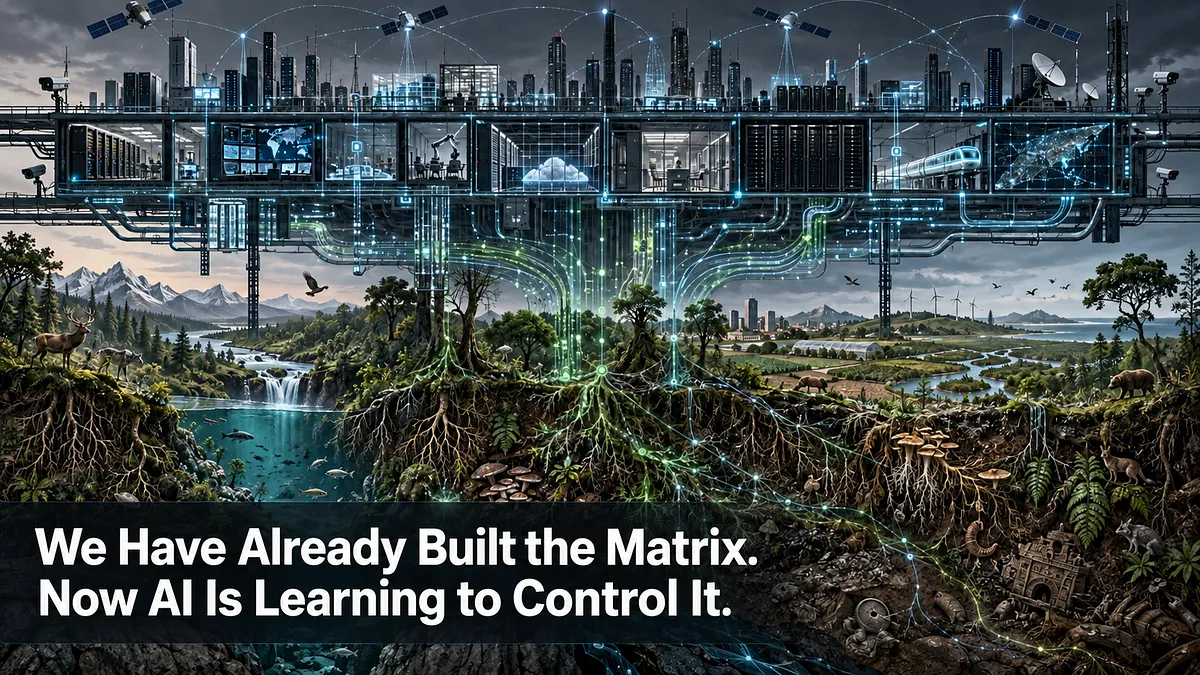
ai generated image
I am not an AI researcher, a military analyst, or a biologist. I have no internal laboratory files, secret blueprints, or classified documents. I am a software developer and a gamer.
This article did not begin with a leak. It began with the changelog of a game I had enjoyed playing.
An AI helped me find and compare public sources and structure this text. That makes the research faster, but not automatically true. AI can overlook sources, smooth over connections, and write with confidence where there should really be a question mark. That is why I link the evidence and distinguish as clearly as I can between documented facts, plausible connections, and speculation. I cannot see behind closed doors. Neither can the AI that helped me research this article.
Arena Breakout is not a crude backdrop where characters merely shoot at one another. Its engine models terrain, lines of sight, cover, weapons, impacts, sound, movement, injury, scarcity, and risk with a strong commitment to realism. Then there is the psychology of the players: wait or advance, secure the loot or keep fighting, follow a sound or treat it as a trap, hold on to a clear thought under pressure. Physics, tactics, and behavior interact so closely that the game world begins to resemble a small synthetic environment.
Then I read about the use and continued development of AI models for its opponents. I had not watched a bot do anything uncanny. There was no single scene I could recount. The text was enough, because in that moment I became aware of another role the player might occupy: perhaps I was not merely fighting a finished system. Perhaps my behavior was also providing material against which a system could be tested, adjusted, or trained.
That was the boundary for me. Or, more precisely, perhaps it had been crossed earlier and I had only just noticed. I no longer wanted to act voluntarily inside a realistic combat and decision environment without knowing whether my routes, mistakes, reactions, and tactical solutions served only the game or also influenced the development of its agents. So I stopped playing.
The strongest version of the claim — “Every match I play trains this specific model” — cannot be established from public evidence. But the uncertainty does not come from nowhere. The Arena Breakout privacy policy explicitly lists gameplay and combat data, elimination reports, and battle histories among the information it collects. At the same time, Tencent researchers described an agent deployed in an online game that combines a navigation mesh, rule-based shooting control, and deep reinforcement learning. Adapted rewards were intended to encourage human-like behavior and make tactical use of the terrain. The paper does not say that my gameplay or any other specific player histories were used as training data. It does show, however, that data collection and learning agents coexist inside the same synthetic environment. (Privacy Policy, Zhang et al.)
This creates several possible feedback loops that should not be conflated. A player can supply training data directly if their actions are used as demonstrations in a learning process. A player can improve a model indirectly if developers derive rewards, difficulty levels, or behavioral rules from telemetry. And even if no model learns during a match at all, the encounter can still serve as a large-scale field test: Where does the agent get stuck? Which tactics expose it? When does it appear human, unfair, or predictable? In all three cases, the player contributes to improving the system — but in technically different ways.
The question requires another distinction. First, a game can realistically model physical and tactical relationships without reproducing reality in full. Second, it can measure behavior as telemetry. Third, such data can contribute to the development of game agents; this is well established in games research, for example through imitation learning based on human movement and decision histories. Fourth, the transfer of specific Arena Breakout data into autonomous combat systems would be a separate claim. There is no public evidence for it. (Borovikov et al., Justesen et al.)
Even so, the potential scale is new. Across the world, millions of people in different games generate countless examples of navigation, target selection, teamwork, deception, risk tolerance, resource management, and reactions under time pressure. Such data can be extremely valuable for developing artificial agents: it shows not only which action succeeded, but which alternatives people chose in the same situation. What once had to be gathered expensively in small laboratory studies is now produced continuously as a side effect of play.
“A gold mine for autonomous combat systems” is therefore a plausible risk hypothesis, not a demonstrated data flow. There is a substantial transfer gap between a game and a real battlefield: different sensors, bodies, physics, opponents, legal rules, and, above all, real human consequences. Player data cannot simply be copied into a weapon. It may still be valuable as pre-training, a behavioral library, a basis for simulation comparisons, or a source of hypotheses. The militarily relevant raw material would be less the individual hit than the statistical diversity of human decisions.
The lack of transparency is therefore part of the problem. Players can usually see that data is being collected, but not which internal models, analyses, or later projects emerge from it. Consent to a privacy policy does not answer the ethical question of whether millions of people understand that their gameplay may contribute to refining increasingly autonomous agents.
The absence of a direct connection matters. A civilian game does not have to be part of a military program for its technical form to be socially significant. Games are controllable spaces in which the rules are clear enough for machines and the situations open enough for surprising behavior. They show how a world becomes legible to an agent: Which objects and actions exist? Which states count as danger? Which outcome counts as success? The transferability lies not in individual textures or weapon statistics, but in translating a complex environment into states, actions, and feedback.
One crucial remainder stays outside the model. A game character has no childhood, no family, and no fear of what happens after the server is switched off. Psychological pressure can be simulated and made visible in behavior without the simulation containing the human meaning of that pressure. An agent can learn that a wounded opponent is tactically easier to defeat. That does not mean it understands injury. This separation between functional performance and moral understanding must be preserved when similar optimization methods move into real contexts.
Later I encountered the same terms outside the game: agents, sensor fusion, tactical decision-making, reinforcement learning, digital twins, human-machine teaming. In documents from research and defense organizations, they sounded familiar. Except that, at some point, they were no longer moving an avatar.
As I wrote in “The Signal Is the System”, power does not begin only with the visible decision. It begins with the question of which signal a system perceives at all, how it translates that signal, and which next step other systems derive from it.
The obvious approach would be to search for the moment at which AI itself becomes a weapon. When does it recognize a target? When does it pursue it? When does it trigger a physical effect? Yet the longer we examine the architecture, the further forward the decisive boundary moves. A machine does not have to fire a shot itself to fundamentally change violence, surveillance, or control. It is enough for it to determine which signals become visible, which data belong together, which object receives priority, and which action appears reasonable to a human being.
AI is then no longer merely the weapon. AI is the system around it.
This does not mean that every AI is military or every form of automation dangerous. It means that we cannot look only at the final device. Perceiving, connecting, classifying, prioritizing, recommending, authorizing: these functions might once have been distributed across several people, departments, and periods of time. Today they can converge inside a software workflow. The final click may remain human. But by then, how much of the decision is still open?
The longer I searched for modern AI, the older the story became.
In May 1985, outside Denver, an eight-wheeled DARPA-funded research vehicle followed a prepared road by itself. The Autonomous Land Vehicle was slow, tightly constrained, and far removed from an operational autonomous combat system. Even so, military-funded machine perception had visibly left the laboratory. During the same period, SIMNET created early networked combat simulators. Another prototype, IRUS, connected a knowledge base and databases to a natural-language interface for a US Navy test system. Perception, simulation, and decision support were still separate components. But the components existed. (SPIE, Office of Technology Assessment, Computational Linguistics)
1985 was not the birth year of autonomous warfare. Retrospective origin myths like that make technical history smoother than it was. More interesting is the gradual convergence of functions that were once separate. A vehicle recognizes a road. Simulators connect people inside a shared artificial environment. A knowledge-based system organizes information about a military situation. Decades later, sensors, models, simulations, and actuators can become components of the same architecture.
As a developer, I think of distributed systems. A single microservice is rarely spectacular. Its significance comes from its connections: Who supplies its inputs? Which services trust its output? What happens when it produces an error? Which decision does that error trigger in a completely different part of the system?
The same is true of agents. Not every agent has to be exceptionally intelligent. The decisive factor may be the organization of many limited agents. With DICE, DARPA explicitly studies controlled emergence in multi-agent systems. CyPhER Forge connects a digital twin with an AI test agent. DISCORD is intended to combine live sensor data and high-resolution simulation in an “AI-native tactics engine.” Research is not deployment, and a program name is not evidence of a future capability. The direction is nevertheless visible: simulation is moving from a passive representation toward an environment in which systems can test, evaluate, and modify actions. (DARPA DICE, CyPhER Forge, DISCORD)
Perhaps the most important arms factory of the future will not be a building. Perhaps it will be a simulation.
That is a provocation, not a forecast about procurement volume. Simulations have legitimate purposes: training, safety testing, planning, and debugging. But they change the economics of experimentation. An agent can fail countless times inside an artificial environment, restart, and learn from feedback. Three questions then become more important than the number of attempts: Which goals were built in? Which reward counts as success? Which rare, long-term, or human consequences are absent from the model?
The public self-presentation of the new defense industry shows where this logic is heading. Anduril describes Lattice as a platform that connects sensors, autonomous systems, and so-called effectors into an extensible network. Helsing advertises mass-producible AI-supported combat drones and swarm capabilities. Through Replicator, the Pentagon sought to bring thousands of low-cost, attrita
正文由 探How 从来源站点 RSS 同步,内容未经改写;遇到排版缺失或需要图片、视频时请以原文为准。