The 39 pictures that changed the way we see men (for good and for bad)
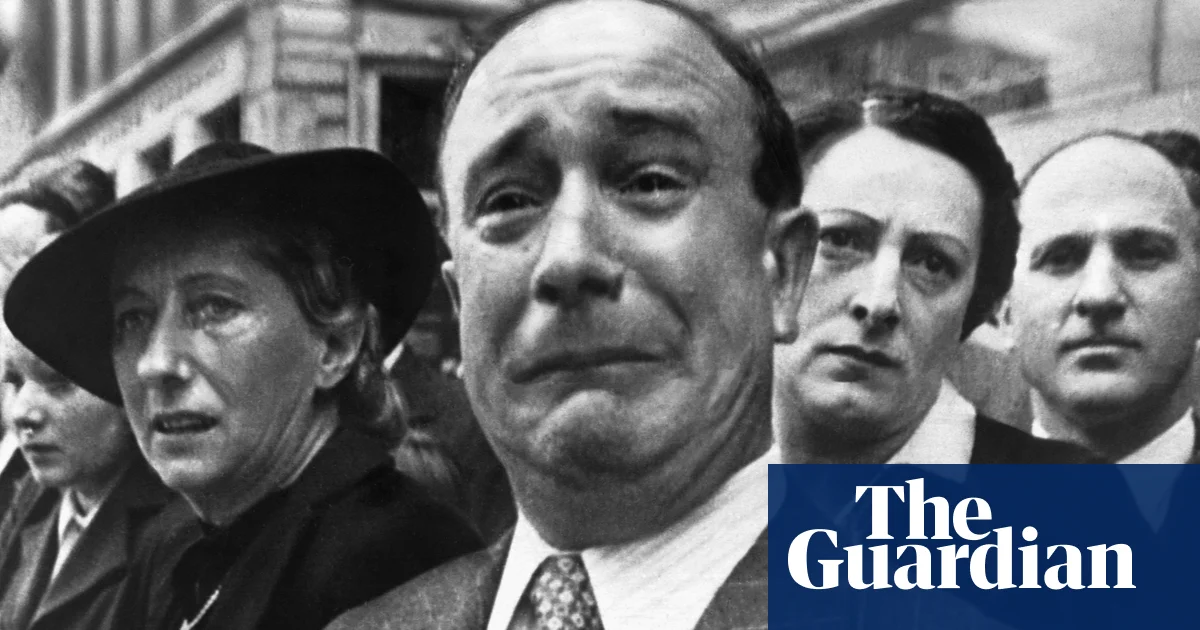
A Frenchman weeps as historic French battle flags are taken out of Marseille for safekeeping in 1941. Photograph: Historical/Corbis/Getty Images
以下正文同步自 Hacker News 最新,版权归原站所有,已转换为易读排版。
A Frenchman weeps as historic French battle flags are taken out of Marseille for safekeeping in 1941. Photograph: Historical/Corbis/Getty Images
From a body-building Arnie to a weeping Frenchman, these 39 groundbreaking images have upended assumptions about how men behave, dress and project power. Introduction by Luke Kennard
Prefer the Guardian on Google
I have an image of myself in 2011, pushing my newborn son in a big red buggy because he would only nap when in motion. As I traversed the streets of suburban Birmingham, I felt observed, glanced at, commented on in a manner that ranged from pity to reproach to disproportionate admiration. Daft that it should be a remarkable sight, I thought, but there we go. Probably I’d have felt less self-conscious if I’d followed David Bowie’s example and – as in one of the images showcased here – worn what looks like a dress.
On depictions of men and women in art history, John Berger famously stated that “men act, women appear”. Men were portrayed demonstrating their physical power and readiness for action; to assert their dominance. Just turning that gaze around and using the lens to capture masculinity feels subversive, maybe even a little undermining.
It is odd that a quarter of the way through the 21st century images of men crying – see the “weeping Frenchman” during the second world war and Paul Gascoigne’s tears during the 1990 World Cup – could still be seen as remarkable. Judith Butler describes masculinity as a phantasm, a haunting fiction of invulnerability and toughness that is all the more potent because it’s such a lie. We know this, but we’ve probably all had a part in enforcing it, knowingly or obliviously. Boys are still told they shouldn’t be sensitive, that it’s somehow shameful.
The 38 photographs here are proof that masculinity has strong connotations, histories and counter-histories; a lot of baggage. We stand in some relation to that baggage however we choose to express ourselves, and an image can either reinforce or challenge those associations.
Anyone with half a mind must feel a certain amount of pity for a man who feels the need to be depicted in his finery, or in a manner that expresses his prowess or authority – see Karen Knorr’s photographs satirising the privileged postures of men in gentlemen’s clubs – but we’re still surrounded by them, like it or not.
Despite the wonderful range here, it’s interesting how normatively hench many of the men depicted are, from Eugen Sandow, the father of bodybuilding, to Arnie to Hulk Hogan. There’s an absence of the body type enjoyed by roughly 80% of men: basically OK, a bit lumpy, sporadically hairy. We might run a 3k every couple of weeks and feel so pleased with ourselves that we down a bottle of wine and a box of cheese straws the same night.
It’s interesting how normatively hench many of the men depicted are. There’s an absence of the body type enjoyed by roughly 80% of men: basically OK, a bit lumpy, sporadically hairy
To judge from our media, one would think we were either waifs or muscle-men. Of course, the super-jacked male form is ubiquitous in film and television now, from Hollywood movies (where you expect it) to depressing ITV crime dramas (where you’d hope for a few more noodle arms and football-shaped tummies). Even the bang-average is barely represented; I feel like cheering when an even slightly flabby man takes his top off.
If there’s no body positivity movement for average men, that’s because men’s bodies are less likely to be scrutinised and judged. Certainly we don’t talk about body image much unless it’s in the context of the gym. It has only occurred to me in my 40s that I can marginally improve my appearance through exercise (I’m still not fully convinced and suspect I’m wearing myself out for no reason). We can say, “What do you bench?” but can’t say, “I’m feeling insecure about my jowls today.”
There’s a powerful defiance to the camp and the performative, of casually putting on a dress or a sarong as a straight man, already aware of the tedious reactions and thinking: “Yeah, and what of it?” There’s also a terrible self-consciousness to masculinity. I find the giant fake Warhammer-figurine shoulders of American football kits absolutely adorable. I’d feel the same about dictators on horseback if they weren’t dictators.
Depictions of queer masculinity offer an alternative here, from Leigh Bowery’s magnificently confrontational surrealist portraits to Rotimi Fani-Kayode’s beautiful, sculptural compositions of black queer men. Deliberately rougher round the edges, Sunil Gupta’s Exiles series depicts the underground (then illegal) culture of gay male life in India in the 80s: a furtive glance, a shy smile, the position of a cigarette, a palpable sense of risk.
So many current manifestations of masculinity feel beneath contempt, but maybe they’re not. Maybe we should loudly express our contempt for them and hopefully speed their decline. Every significant photograph that enters the collective unconsciousness shifts our reality a little – the power of an image to either bolster or subvert machismo is still profound.
View image in fullscreen
Photograph: © Robert Mapplethorpe Foundation. Used by permission.
“He made no effort to seem overpowering,” wrote a Gay Times correspondent of Arnold Schwarzenegger in 1978, “but, rather, radiated a mild – nay – sunny, disposition.” In the 1970s, Schwarzenegger turned body-building from a niche subculture into a national obsession. He combined an exaggeratedly masculine body with a sense that he was secure in himself. “He accepts the inevitable attention of gay men as a compliment,” concluded Gay Times.
Robert Mapplethorpe took this portrait of Schwarzenegger in 1976, a year before the release of Pumping Iron, the hit docudrama that led to his Hollywood stardom. Mapplethorpe, who was celebrated for his images of queer and S&M subcultures, was particularly fond of this photograph, using it for postcards and party invitations. “Hot Dirty Man,” went the text over Schwarzenegger’s torso on one invitation from 1979. “You are invited to … ” FB
View image in fullscreen
Photograph: John Kobal Foundation/Getty Images
“When Marlon Brando appeared on stage in a torn, sweaty T-shirt,” wrote Gore Vidal in 1985, “there was an earthquake.” Before Brando’s breakout performance in A Streetcar Named Desire in 1947, Hollywood leading men had been “nothing but a suit of clothes”, Vidal argued. Brando made it OK for a man to be a sex object.
Many of the actor’s performances eschewed the buttoned-up vision of masculinity in the films of the 1930s and 1940s. He was emotional, violent and physical. “I’d never seen anything as visceral,” wrote the critic Pauline Kael, remembering her first glimpse of Brando on stage in the late 1940s. FB
View image in fullscreen
Photograph: Sepia Times/Universal Images Group/Getty Images
“Great success here,” wrote Oscar Wilde of the American speaking tour on which this photograph was taken. “Nothing like it since Dickens, they tell me.” Though the 27-year-old had not yet written famous works such as The Importance of Being Earnest and The Picture of Dorian Gray, he was already a society sensation. His tightly controlled performance of a queer, urbane form of masculinity made him famous, but came with great risks. He was later imprisoned for gross indecency with men, and polite society turned on him – perhaps prefigured by newspaper digs at the time about the “effeminate” figure in this portrait. FB
View image in fullscreen
Photograph: Alamy
You may not recognise him now, but Sessue Hayakawa was one of Hollywood’s first heart-throbs. Born in Japan, he moved to the US in early adulthood and broke out as a major matinée idol with a star-making turn as the villainous lead in Cecil B DeMille’s The Cheat (1915). He was then one of LA’s highest-paid actors. One photographer recalled Hayakawa arriving at a premiere to a horde of female fans who “spread their fur coats at his feet” so he could avoid stepping in a puddle.
As an Asian leading man, Hayakawa had to put up with a lot of racialised typecasting, and anti-miscegenation laws meant his characters never got the girl; when anti-Japanese sentiment rose in the 1920s, his star faded. He did get a late-career comeback, however, with his Oscar-nominated role as the tyrannical Colonel Saito in 1957’s The Bridge on the River Kwai. GS
View image in fullscreen
Photograph: George Rodger/Magnum Photos
Nuba mountain communities in the Kordofan region of Sudan have faced violence from outsiders for centuries, from British colonial authorities to the Khartoum central government. Against this backdrop, a renowned tradition of wrestling tournaments has developed.
This image by Magnum co-founder George Rodger, of a wrestler hoisted on a supporter’s shoulders, brought global, and unwelcome, attention to the area. Former Nazi photographer Leni Riefenstahl produced controversial and exoticising work there. “When they found out what was going on, people felt exploited,” said Sudanese professor Guma Kunda Komey. FB
View image in fullscreen
Photograph: Donna Ferrato
It’s estimated that around one in four women worldwide have experienced physical or sexual violence by a male partner. Since the early 1980s, the photojournalist Donna Ferrato has dedicated her career to documenting the devastating impacts of these relationships.
This photo is from Ferrato’s 1991 book Living With the Enemy, which includes texts based on conversations with victims and perpetrators. Over the course of the project, she spent time in women’s shelters as well as riding in police cars and staying in people’s homes. Here, an eight-year-old boy, Diamond, shouts at his father as he is being arrested at their home in Minneapolis: “I hate you for hitting my mother.”
“I’d never seen a child stand up to his abusive father,” Ferrato later recalled. “That blew my mind. The mom hadn’t called the cops – the boy called the cops. He had just shown the police where his father had hidden the screwdriver.” GS
View image in fullscreen
Photograph: Buyenlarge/Getty Images
“The most masculine president in the American memory,” according to one recent biographer of Theodore “Teddy” Roosevelt. He is pictured here on horseback when he was a lieutenant colonel in an army unit known as the Rough Riders.
His carefully crafted butch image was, on closer inspection, a jumble of contradictions. Raised in extreme wealth, he was fond of being photographed in suspiciously pristine working-class clothing. And, plagued by physical infirmities since childhood, he was sensitive to any hint of weakness. FB
View image in fullscreen
Photograph: Karen Knorr
Karen Knorr’s languid photograph, part of a series of 26 images she took in gentlemen’s clubs in Mayfair, London, captures how comfortable certain men feel luxuriating in hereditary privilege – “an archetypal image of aristocratic power”, in Knorr’s words.
Each photograph is paired with a satirical text written by Knorr, who was inspired by parliamentary speeches and books about the British empire. “I wanted to make work that used irony and parody to explore attitudes prevalent amongst the English establishment in the 1980s,” she said. FB
View image in fullscreen
Photograph: RIA Novosti/Reuters
Russian president Vladimir Putin has a penchant for staging topless photo ops – always while partaking in a macho outdoor activity such as horse-riding or hunting. “It is easy to laugh at,” says Ruth Ben-Ghiat, author of a book on the political figure of the strongman from Mussolini (who also liked to pose shirtless) to the present. “But the use of masculinity as an authoritarian tool is deadly serious. Strongmen use their bodies to proclaim themselves the defenders of the nation, and yet they often pose as victims as well.” GS
View image in fullscreen
Photograph: The Life Picture Collection/Shutterstock
“A vital element has been added to th
正文由 探How 从来源站点 RSS 同步,内容未经改写;遇到排版缺失或需要图片、视频时请以原文为准。