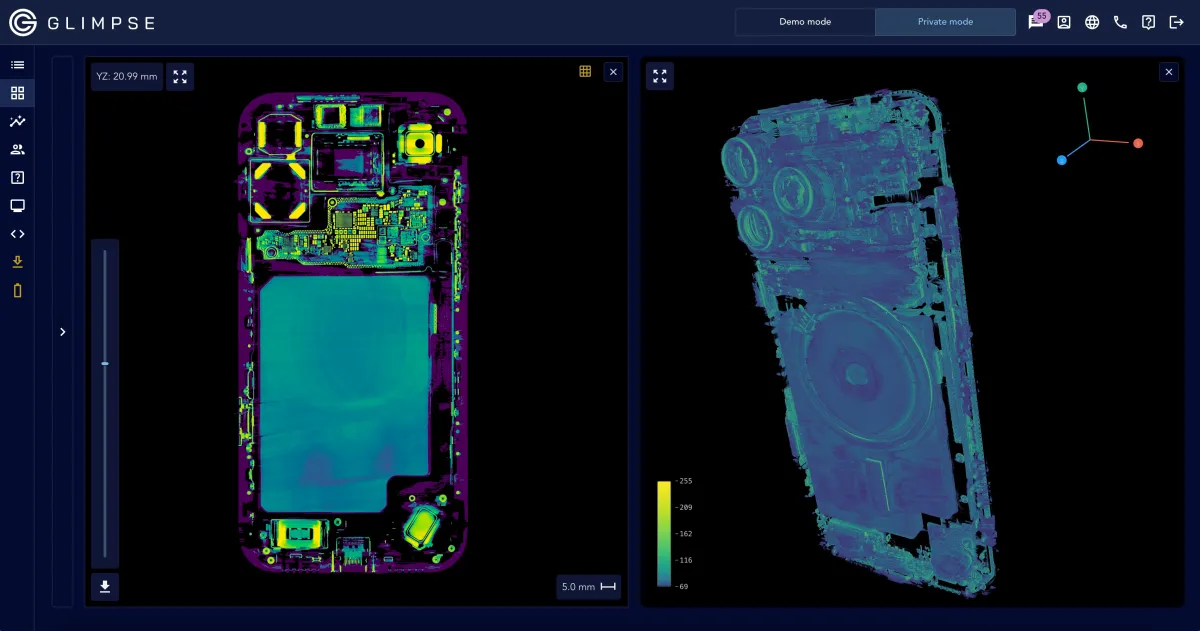
Glimpse wants to give hardware companies an X-ray view of every critical part
Called Explore, Glimpse's new image processing software lets hardware makers speed up quality control checks using CT scanners.
以下正文同步自 TechCrunch,版权归原站所有,已转换为易读排版。
Recalls are no joke. Take the one that sidelined every Chevy Bolt made between 2017 and 2022: A problem at an LG battery factory caused some parts inside the cells to be installed improperly, which ultimately cost LG $1.9 billion.
Pretty much every major manufacturer has to deal with recalls. In the EV space alone, Volkswagen, Stellantis, Hyundai, Toyota and others have all suffered through them.
“The majority of those major quality issues could have been caught with CT scanning. And the reason why they weren’t is because it’s way too slow to do any kind of statistical sampling,” Eric Moch, co-founder and CEO of Glimpse, told TechCrunch.
To help companies find more defects, Glimpse has developed a way for battery manufacturers to inspect cells 10 to 30 times faster by significantly boosting throughput on their existing CT scanners. Using Glimpse’s software, manufacturers could scan tens of thousands of cells per day, up from the current handful, Moch said. A customer “super scanner” that Glimpse is developing with partners could complete a scan in a second or two, he added.
Batteries aren’t the only parts to suffer from costly defects, of course, so Glimpse is launching a new product, the company exclusively told TechCrunch. Called Explore, the product will let customers in industries such as aerospace, automotive, electronics and medical devices use the startup’s image processing software to speed up quality control checks using CT scanners in their labs and development environments.
Glimpse currently has over 100 customers such as Anker, Lucid and the U.S. Navy, and currently generates revenue in the “mid seven-figure” range, Moch said. Customers include both buyers and sellers of batteries.
To wring more speed out of traditionally slow CT scanners, the startup has written its own image processing pipeline, which compresses scans and cleans them up. It’s built around deep learning algorithms, and much of the initial processing happens on edge computers deployed at a customer’s site. “It does all of the heavy lifting before sending the output to the cloud,” Moch said.
Altogether, the combination of quality improvements and compression make for clear images that load within seconds in a web browser, the company claims. “You don’t have to wait minutes or even sometimes hours for that data to load,” he said.
Alongside scanned images, Glimpse’s dashboard will also show customers part measurements they specify. In the case of batteries, it might measure the distance between layers in a battery cell. If they start deviating from the norm, Glimpse’s software will flag it and highlight it in the scanned images. “They can see with their own eyes the defects that they care about,” Moch said. The deep learning algorithms also take into account customer input, retraining themselves along the way.
Customers who don’t have their own CT scanners can ship parts to Glimpse, which will use its own CT scanner in the Boston area. The company said it is opening a second Scan On Demand center in the San Francisco Bay Area.
“We expect this scanning service to actually be a bigger market. You can spend a couple hundred bucks or a few thousand dollars on Glimpse, and you don’t have to buy a very expensive piece of equipment,” Moch said. “And one day, when it makes sense for you, you buy the scanner and then you run our software on top of it.”
When you purchase through links in our articles, we may earn a small commission. This doesn’t affect our editorial independence.
Tim De Chant
Senior Reporter, Climate
Tim De Chant is a senior climate reporter at TechCrunch. He has written for a wide range of publications, including Wired magazine, the Chicago Tribune, Ars Technica, The Wire China, and NOVA Next, where he was founding editor.
De Chant is also a lecturer in MIT’s Graduate Program in Science Writing, and he was awarded a Knight Science Journalism Fellowship at MIT in 2018, during which time he studied climate technologies and explored new business models for journalism. He received his PhD in environmental science, policy, and management from the University of California, Berkeley, and his BA degree in environmental studies, English, and biology from St. Olaf College.
You can contact or verify outreach from Tim by emailing tim.dechant@techcrunch.com.
October 13 – 15
San Francisco
Get 50% off a second pass
The Disrupt experience is meant to be shared. Get your pass and bring a colleague, partner, or peer at 50% off. Cover more ground by making connections, building momentum, and discovering what’s next in the startup ecosystem.
At 19, founder raises $11M for Ghost, maker of a $3,499 computer for personal AI
Dominic-Madori Davis
Federal judge calls Flock ‘indiscriminate mass surveillance’
Anthony Ha
Amazon responds to data center backlash, says it no longer uses NDAs
Anthony Ha
Google thinks SpaceX’s Starship has to launch 1,800 times before space data centers get off the ground
Tim Fernholz
World’s first enhanced geothermal power plant completed in just 23 months
Tim De Chant
Google releases Gemini 4 Argon, called its most powerful model yet
Lucas Ropek
The Pentagon taps Elon Musk and Palmer Luckey to help decide what the military should do next
Dominic-Madori Davis
正文由 探How 从来源站点 RSS 同步,内容未经改写;遇到排版缺失或需要图片、视频时请以原文为准。