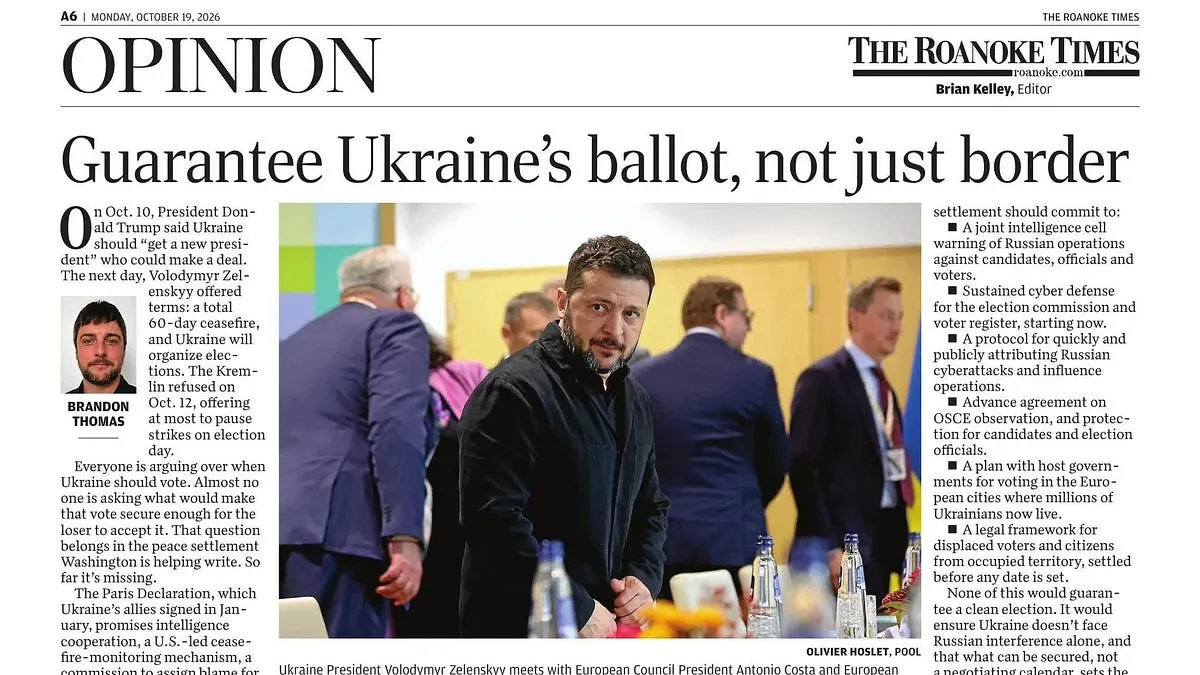
Guarantee Ukraine's Ballot, Not Just Its Border
On Oct. 10, President Trump said Ukraine should “get a new president” who could make a deal. The next day, Volodymyr Zelensky offered terms: a total 60-day ceasefire, and Ukraine will organize elections. The Kremlin ref…
以下正文同步自 Hacker News 最新,版权归原站所有,已转换为易读排版。
Brandon Thomas
Oct 21, 2026
Share
On Oct. 10, President Trump said Ukraine should “get a new president” who could make a deal. The next day, Volodymyr Zelensky offered terms: a total 60-day ceasefire, and Ukraine will organize elections. The Kremlin refused on Oct. 12, offering at most to pause strikes on election day.
Everyone is arguing over when Ukraine should vote. Almost no one is asking what would make that vote secure enough for the loser to accept it. That question belongs in the peace settlement Washington is helping write. So far it’s missing.
The Paris Declaration Ukraine’s allies signed in January promises intelligence cooperation, a U.S.-led ceasefire-monitoring mechanism, a commission to assign blame for violations, and a European-led force to rebuild Ukraine’s army and deter another invasion. It doesn’t mention elections. The peace drafts do, but only as an obligation. The 20-point draft Mr. Zelensky released in December says Ukraine must hold presidential elections as soon as possible after a deal is signed; a leaked American draft a month earlier set a 100-day deadline. The vote is something Ukraine owes, not something its partners will help defend.
That is a design flaw, and Ukraine’s history shows why. In 2004 the threat was to the candidate: Viktor Yushchenko, the pro-Western challenger, was poisoned with dioxin mid-campaign, and the general handling his security later said he had warned Yushchenko’s wife of that risk months earlier. In 2010 international observers broadly accepted Viktor Yanukovych’s victory as competitive. When he fled in 2014, his successor at the Security Service said the agency’s former chief, two deputies and two department heads had turned up in Russia. Moscow didn’t need to rig Ukraine’s elections. It needed the people elected, and the people they appointed, to be reachable.
The 2026 threat is different again. Ukraine banned its main pro-Russian parties in 2022, and four years of invasion have hardened public opinion. If Moscow can’t install a friendly government, it can still make whoever wins look unrepresentative, and the war has supplied the raw material.
A quarter of Ukrainians have experienced displacement, according to Opora, the country’s leading election monitor, and 29% live away from their registered address. About 5.2 million people have left since 2022, yet the voter register captures less than 1% of those moves abroad. In an Opora survey of Ukrainians in Poland, Germany and the Czech Republic, 74% plan to vote but only 16% are registered with a consulate. Add soldiers at the front, millions under occupation and polling stations destroyed by shelling.
Each gap is a ready-made grievance. Permit voting under Russian control, and Kyiv can’t verify the ballots. Exclude those voters, and Moscow calls the election incomplete. Let millions abroad struggle to vote, and Russian disinformation will tell them they were shut out on purpose. In February 2025, Opora and some 400 civic groups warned that Russia would use cyberattacks, bribery and disinformation against any vote, and the Central Election Commission wants six months of preparation after martial law ends, before the 90-day campaign the law requires.
If Washington wants this election, it shares responsibility for making it defensible. The settlement should commit to:
• A joint intelligence cell warning of Russian operations against candidates, officials and voters.
• Sustained cyber defense for the election commission and voter register, starting now.
• A protocol for quickly and publicly attributing Russian cyberattacks and influence operations.
• Advance agreement on OSCE observation, and protection for candidates and election officials.
• A plan with host governments for voting in the European cities where millions of Ukrainians now live.
• A legal framework for displaced voters and citizens from occupied territory, settled before any date is set.
None of this would guarantee a clean election. It would ensure Ukraine doesn’t face Russian interference alone, and that what can be secured, not a negotiating calendar, sets the timetable.
A peace secured at great cost would rest on whoever wins. If the result is credible, the settlement has a government strong enough to defend it. If it isn’t, Moscow will have found a cheaper way to undo what its army could not.
Russia has spent four years failing to decide by force who governs Ukraine. Washington shouldn’t help create an election whose weaknesses give Moscow another way to try. If the U.S. insists that Ukraine vote as part of a peace settlement, securing that vote should be part of the settlement too.
正文由 探How 从来源站点 RSS 同步,内容未经改写;遇到排版缺失或需要图片、视频时请以原文为准。