Why Is Netflix Laying People Off When Business Is So Good?
Why Is Netflix Laying People Off When Business Is So Good?
以下正文同步自 Hacker News 最新,版权归原站所有,已转换为易读排版。
Translate
Why Is Netflix Laying People Off When Business Is So Good?
Robert Rosenberg
Oct 19, 2026
2
1
Share
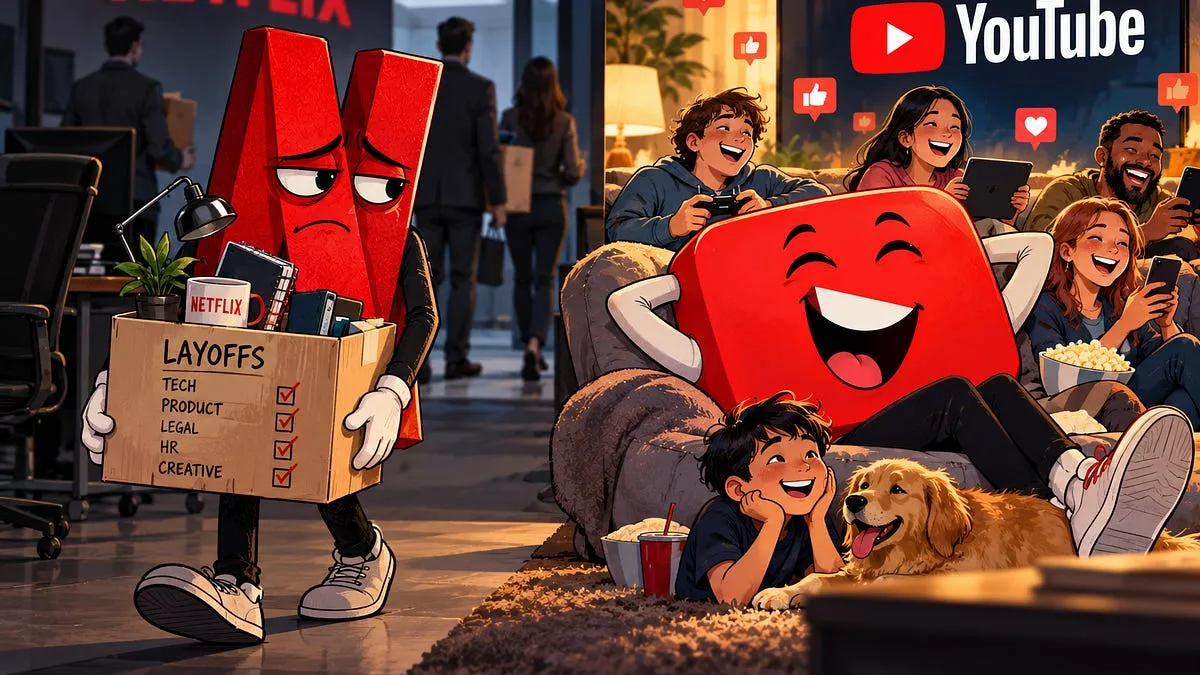
Netflix has spent nearly two decades teaching Hollywood how to run a streaming business. It rewrote television’s distribution rules, turned binge-watching into a lifestyle and built the most successful paid streaming service on the planet. So why is a company making billions in profit laying off roughly 1,000 people?
Because success does not exempt a company from the laws of economics. And because Netflix is discovering that buying more programming does not necessarily buy more of the one thing every entertainment company wants: our time.
A Very Profitable Company With a Very Expensive Problem
But layoffs at a profitable company are not necessarily a contradiction. Management may be trying to protect margins, redirect resources, remove overlapping functions, simplify decision-making or adjust to slower growth. Automation may also change staffing needs, although Netflix has not established how much, if any, of this particular reduction is attributable to AI. The immediate question is not whether Netflix can afford its employees. It is whether its current organization and spending habits are delivering enough incremental value.
That question becomes harder to dodge when content spending is approaching $20 billion this year, up roughly 11%, while reported viewing hours grew only about 2% in the first half of 2026. Those figures cover different periods and are not a precise return-on-investment calculation. Still, when the grocery bill rises much faster than the family’s appetite, someone eventually checks what is in the shopping cart.
The challenge is particularly acute as signature hits such as Stranger Things and Squid Game conclude and Netflix searches for their successors. It can spend heavily on an ambitious new series, promote it globally and still discover that audiences are indifferent. Even a returning show is not guaranteed an encore: according to figures reported by the Los Angeles Times, the second season of Avatar: The Last Airbender drew 59% fewer views in its debut period than the first. That single comparison is not a verdict on the slate, but it illustrates the risk of paying upfront for attention that may never arrive.
YouTube Has More Viewing Time. It Also Has a Different Business.
The comparison that seems to haunt Netflix is YouTube. Nielsen reported that YouTube accounted for 14.2% of U.S. television viewing in July, compared with Netflix’s 7.8%. That is television-set viewing share, not total time spent on either service across every device. Nevertheless, it is an eye-catching scoreboard, especially for a company accustomed to winning.
But the two services are playing different games. YouTube largely lets creators finance, produce and upload their own programming, then shares in advertising and other revenue. Its recommendation system can amplify a video after viewers demonstrate that they like it. YouTube has investments in creator incentives, infrastructure, moderation, partnerships and some acquired or licensed content, so “free” is not quite the right word. But it generally does not have to greenlight and bankroll each prospective hit before the public gets a vote.
Netflix does. It commissions, licenses, curates and markets a deliberately selected library, often committing millions before a single viewer can tell it whether a series is worth watching. YouTube can sift through an ocean of uploads to discover what floats. Netflix has to choose which boats to build.
The usage patterns differ too. YouTube is an all-day utility: tutorials at breakfast, clips between meetings, music in the background, podcasts during chores and rabbit holes whenever someone has five minutes to kill. Netflix is more often a deliberate entertainment choice, especially for evenings and weekends, when viewers settle in for a movie or a series. There is overlap, and both habits are changing, but expecting the same viewing-hours profile from these services ignores what customers hire them to do.
So yes, Netflix should study YouTube’s dominance. It should not conclude that its future depends on becoming a slightly more expensive YouTube.
Experiment, But Don’t Forget What People Are Paying For
But there is a difference between extending a successful brand and changing its DNA. Netflix’s great strength is still a curated collection of films and shows people are willing to pay to watch. It does not need to win every spare minute of every consumer’s day. It needs to make the time people choose to spend with Netflix feel worthwhile.
Two Fixes That Don’t Require Reinventing Netflix
First, stop making loyal audiences wait an eternity for the next season. Long gaps are sometimes unavoidable, particularly for effects-heavy shows, complicated productions and talent schedules. But when a returning series disappears for two or three years, even enthusiastic viewers can lose the thread, the habit and the emotional connection. Netflix should put more emphasis on production continuity and realistic release planning before committing to another season. Keeping momentum may be more efficient than paying to rebuild it.
Second, reconsider the reflex to release every episode at once. Binge drops are part of Netflix’s identity and should remain an option. They work beautifully for certain shows and viewers. But a weekly or staggered rollout gives a promising series time to generate conversation, press coverage, recommendations and anticipation. A show that might dominate one weekend could instead become part of the culture for two months. Netflix already uses different release strategies in some circumstances; it could make those choices more deliberately, based on the programming rather than an inherited rule.
Neither adjustment requires a new business model or another expensive initiative. Both aim to get more value out of shows Netflix is already paying for. And both recognize that audiences do not always need more titles. Sometimes they need a better reason to return to the titles they love.
The arrival of veteran programming executive Peter Rice, replacing Bela Bajaria, is significant, but it should not become the entire explanation for a company-wide restructuring. Rice brings experience with talent, franchises and large entertainment operations. He may bring more discipline to greenlighting, scheduling and franchise development. Yet no executive can guarantee the next breakout hit, and Netflix’s challenges reach well beyond the content chief’s office.
The more consequential signal will be how Netflix allocates its next dollar: to another speculative tentpole, a faster return for an established favorite, a new kind of viewing experience or a less glamorous improvement in the core service.
Netflix’s October 20 earnings call should help clarify whether content spending will keep rising, whether production volume will change and how management intends to measure returns from sports, games and other experiments. Investors should also ask whether the layoffs are primarily about cost control, organizational design or a more fundamental reassessment of how Netflix grows. Until Netflix explains its rationale, those are questions, not settled facts.
Netflix does not have to apologize for being profitable, and it does not have to imitate YouTube to justify its existence. YouTube wins enormous amounts of casual, creator-driven attention with an economic model Netflix cannot simply copy. Netflix wins by making selected entertainment compelling enough that people will pay for it month after month.
The layoffs may be a sign that Netflix wants to spend more carefully rather than spend less ambitiously. The real test is whether it can turn that discipline into better shows, smarter release schedules and more lasting relationships with viewers.
Netflix has already won the subscription-streaming revolution. Now it needs to resist the temptation to fight YouTube’s war instead of winning its own.
正文由 探How 从来源站点 RSS 同步,内容未经改写;遇到排版缺失或需要图片、视频时请以原文为准。