Chinese authorities blocked Canada's Tiananmen Square tribute
The audio version of this article is generated by AI-based technology. Mispronunciations can occur. We are working with our partners to continually review and improve the results.
以下正文同步自 Hacker News 最新,版权归原站所有,已转换为易读排版。
Listen to this article
Estimated 5 minutes
The audio version of this article is generated by AI-based technology. Mispronunciations can occur. We are working with our partners to continually review and improve the results.
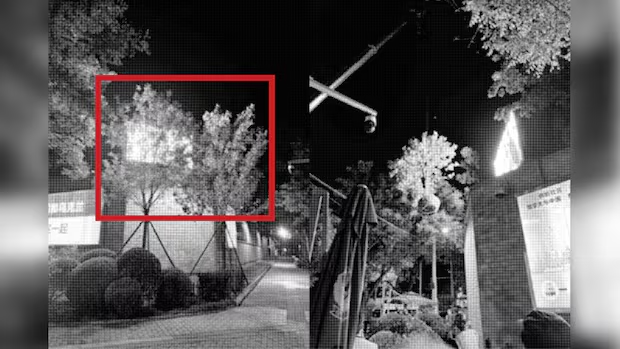
Two trees block an LED display in front of the Canadian Embassy in Beijing, in a photo CBC News obtained through an access to information request. An embassy staffer writes the trees were planted by local authorities days before Canada intended to display the image of a candle to commemorate the Tiananmen Square massacre. (Global Affairs Canada)
Social Sharing
Chinese authorities blocked attempts by the Canadian Embassy to visually commemorate the 1989 Tiananmen Square massacre for the last two years, CBC News has learned.
The second incident came just months after Prime Minister Mark Carney's trade trip to Beijing, where he touted improved relations with Chinese President Xi Jinping.
"Late Saturday evening local authorities, working into the early hours of Sunday, planted two large, mature trees in an attempt to block the embassy's LED screen," noted an email by Diana Tan, a staffer at the Canadian Embassy in Beijing, obtained by CBC News through an access to information request.
The message was dated June 1, three days before the Canadian diplomatic mission intended to display an image of a candle to mark the Tiananmen Square massacre's 37th anniversary.
"The trees were planted on municipal property, approximately 0.5-1 metre from the embassy wall," Tan noted.
Another document released as part of the access to information package notes that in 2025, "the Chinese government sent a crane to suspend a large rectangular barrier in front of the screen of the embassy so that passersby could not see the candle."
A boom lift partially blocks the view of a screen depicting a lit candle at the Canadian Embassy on the Tiananmen Square massacre anniversary last year. (Ng Han Guan/The Associated Press)
China remains sensitive to remarks about the Tiananmen Square massacre, when tanks and soldiers cracked down on unarmed protesters seeking political reform, transparency and freedom of the press. Background information in the documents note the death toll estimates range from several hundred to several thousand.
The documents obtained by CBC News, largely redacted, suggest 2024 was the first time the Canadian Embassy in Beijing displayed the image of the candle on its LED screen. Though the unredacted portions make no mention of the image getting blocked that year, they do state the projection "led to security officials contacting the embassy."
"The projector image of a candle in Beijing is an important tool for public communications used for the last two years to ensure some level of local visibility since social media posts in China will likely face some kind of censorship," the documents note.
The documents also reveal Global Affairs initially intended to publish a two-paragraph statement on the social media platform X this year to commemorate the event.
In an email sent June 1, hours after the one from embassy staff sharing the news of the planted trees, senior communications adviser Meghan O'Brien sought clearance for the post's publication. The first paragraph of the draft post is redacted.
The response from Mike Williams, who is identified in the emails as deputy director for the Greater China Political and Coordination Division, reads: "Modified single tweet, rather than 2 short tweets. Also revised message to commemorative tone focused on victims/families."
The post Global Affairs wound up publishing in full on X reads: "Today, Canadians honour the memory of all who lost their lives, were injured or went missing during the Tiananmen Square crackdown on June 4, 1989. Canada stands with the survivors and the families and loved ones who continue to demand accountability."
That post raised eyebrows online, many noting the use of the word crackdown instead of massacre. Former Alberta premier and federal Conservative defence minister Jason Kenney called it a "deliberate misuse of language to minimize the massacre."
Conservative MP Andrew Lawton wrote "stop letting [Liberal MP] Michael Ma write your tweets."
Canada faces fresh scrutiny, calls to do more to prevent Canadian corporate abuses abroad
Statements on X, one of many U.S. social media platforms blocked in China, have gone further in previous years.
In 2025, the department named China, calling on the country "to uphold its human rights obligations under international law."
In 2024, Mélanie Joly, then minister of foreign affairs, wrote: "Canada calls on China to uphold its human rights obligations under international law and we will continue to speak for those who cannot speak freely and stand with those who stand for human dignity."
The documents also note that China did not censor a Canadian Embassy post on Chinese social media platform Weibo in 2025, saying it was the first time Beijing did not do so. Redacted portions of the documents show Canadian officials prepared alternative statements to be posted on Weibo in case the initial one was taken down this year.
The Canadian government has never publicly spoken about either attempts at blocking the LED screen, nor provided an explanation about the wording of the social media post published on X this year.
CBC News has reached out to Global Affairs, the Prime Minister's Office and the Chinese Embassy in Canada for comment.
Prime Minister Mark Carney met with Chinese President Xi Jinping in Beijing at the start of the year. (Sean Kilpatrick/The Canadian Press)
Carney is expected to return to China this month to attend the Asia-Pacific Economic Cooperation (APEC) summit.
He has met with Chinese President Xi Jinping twice so far in his capacity as prime minister. The two first attempted to reset relations during a one-on-one in South Korea in November 2025, on the margins of last year's APEC summit, before Carney's visit to Beijing in January.
Ties between Canada and China were fraught under Carney's predecessor Justin Trudeau, with Canada arresting Chinese tech executive Meng Wanzhou in December 2018 as she faced fraud charges in the U.S.
Days later, the Chinese government imprisoned Canadians Michael Spavor and Michael Kovrig for alleged espionage — eventually releasing them in 2021.
The public inquiry into foreign election interference also found China to be one of the chief state actors attempting to intervene in Canadian elections in 2019 and 2021.
Raffy Boudjikanian is a senior reporter with the CBC's Parliamentary Bureau in Ottawa. He has also worked in Edmonton, Calgary and Montreal for the public broadcaster.
正文由 探How 从来源站点 RSS 同步,内容未经改写;遇到排版缺失或需要图片、视频时请以原文为准。