Meet Feather, the startup building the ‘Android of robotics’ for developers
Feather is betting on a customizable, $30,000 platform built for software developers.
以下正文同步自 TechCrunch,版权归原站所有,已转换为易读排版。
If there is one thing robotics founders and investors agree on, it’s that the “ChatGPT moment” where a general-purpose robot can seamlessly adapt to any environment has not arrived. Opinions vary on whether the breakthrough is just around the corner or a decade away.
Feather Robotics, a humanoid startup founded last year, is developing a robot for either timeline. Unlike Tesla or Figure, which are tackling the lofty mission of building both the body and a foundational ‘brain’ that isn’t yet widely deployed, Feather provides the hardware and software toolkit for developers to tackle real-world tasks now.
“You can’t buy a Tesla robot today and develop on top of it,” Feather co-founder Hoa Mai told TechCrunch. “We realized that this is not how most companies became successful. Hardware players like Nvidia or Apple started with a product that worked and was deployable, and then they added complexity over time.”
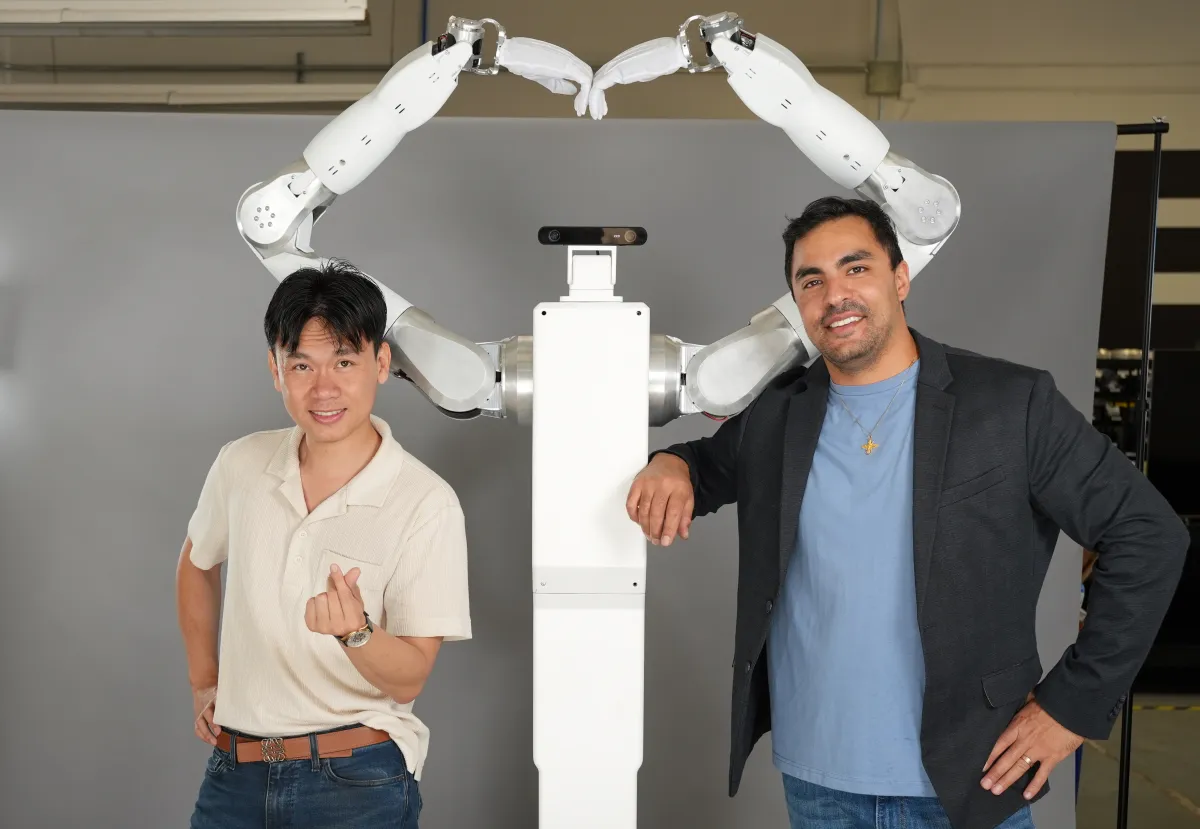
In 2025, after selling his previous humanoid startup to 1X, Mai (pictured left) teamed up with Parsa Bakhtiari (pictured right), a former Tesla Model 3 engineer who at one point reported directly to Elon Musk, to build what the duo hopes will become the Android of robotics.
That vision was attractive to Gradient Ventures, which backed Feather at its inception, leading the startup’s previously announced $7.6 million pre-seed round.
Since then, Feather has rolled out a modular robotic system that allows developers to customize the hardware for different use cases, such as adjusting arm lengths. The startup has already begun selling to customers, surpassing $1 million in revenue.
Although Feather is not disclosing its customers, it said that its robots are working as cooks in restaurants in Japan and cleaning up science labs. On the software side, the hardware can run models from any leading robotics AI provider, including Generalist, Skild, or Physical Intelligence.
“We’ve been selling small quantities of these robots, and now that we resolved like almost all the issues over the last year of field testing, we’re getting ready for a big product launch,” Mai said.
According to Darian Shirazi, General Partner at Gradient, Feather doesn’t have direct competitors in the US. He breaks down the current hardware robotics landscape into three categories: startups like Sunday building domestic household robots, heavyweights like Figure and Tesla aiming for general-purpose machines, and Feather, which, he believes, is the only U.S. startup developing a modular humanoid platform.
Mai admits that Feather took a page from Chinese robotics companies like Unitree. But with new foreign-made models restricted from entering the U.S. market, Feather is now uniquely positioned as a homegrown option of its kind.
Feather’s other advantage is its price. The robot costs $30,000, which is about half the price Unitree’s H2 Edu.
Shirazi believes the market size at that price could be very large. “You would hire a laborer for $50,000 to $60,000 a year, you’d have to train [them]. They’d have to have HR. They’d have to have all these different support mechanisms,” he said. “You can now buy a Feather robot to do that.”
Feather is also operating extremely efficiently, having spent only a fraction of its pre-seed funding, according to Shirazi.
The startup’s big bet, of course, is that the value in robotics will come from an ecosystem developed around the hardware.
“If we think about the market size today for physical AI companies, it’s very small,” Mai said. “But if you think about how many physical AI application companies will probably exist in five years, we expect it to be in the thousands.”
Feather hopes to be the platform that powers all of them.
When you purchase through links in our articles, we may earn a small commission. This doesn’t affect our editorial independence.
Marina Temkin
Reporter, Venture
Marina Temkin is a venture capital and startups reporter at TechCrunch. Prior to joining TechCrunch, she wrote about VC for PitchBook and Venture Capital Journal. Earlier in her career, Marina was a financial analyst and earned a CFA charterholder designation.
You can contact or verify outreach from Marina by emailing marina.temkin@techcrunch.com or via encrypted message at +1 347-683-3909 on Signal.
October 13 – 15
San Francisco
Your next big connection is at Disrupt.
Connect with 10,000+ founders, VCs, operators, and tech leaders. Explore tomorrow’s breakthroughs, hear what’s shaping tech today, and save up to $200 by Sept. 25 at 11:59 p.m. PT.
Anthropic says its biology lab has already found something big
Julie Bort
PitPro’s first tire-changing robot goes live in Canada
Sean O'Kane
Anthropic releases Opus 5.5 with lower prices and Fable-level performance
Russell Brandom
Meta’s Muse is outpacing ChatGPT’s early mobile launch
Sarah Perez
Tilly Norwood’s press tour is going about as well as you’d expect for an AI
Amanda Silberling
Anthropic is operating a lab that conducts biology experiments
Julie Bort
A new kind of AI model from a ChatGPT inventor is thrilling developers
Tim Fernholz
正文由 探How 从来源站点 RSS 同步,内容未经改写;遇到排版缺失或需要图片、视频时请以原文为准。