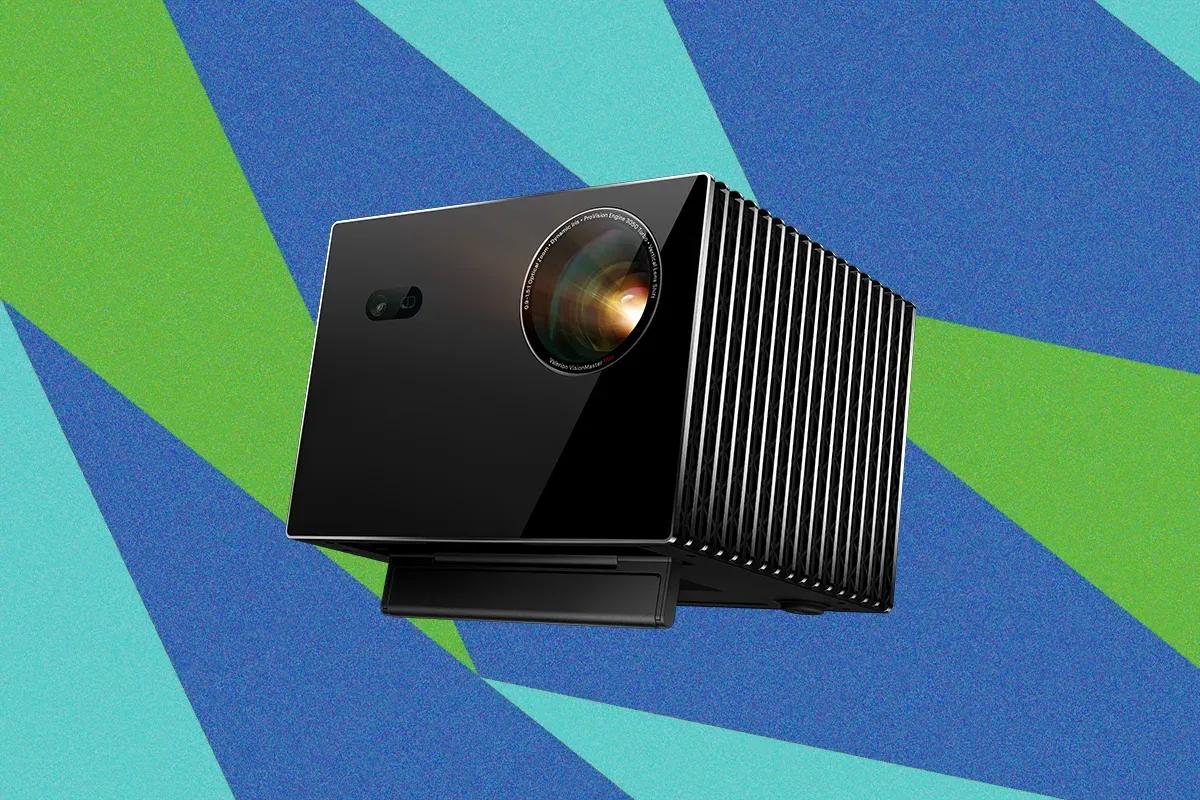
Valerion VisionMaster Max 4K Projector Review: Looks Great, Sounds OK
The Valerion VisionMaster Max 4K Projector delivers superb blacks, great brightness, and more adjustment capabilities than many users need.
以下正文同步自 Wired,版权归原站所有,已转换为易读排版。
WIRED
Classy premium design. Sensational image quality, brightness, and black levels. Google TV makes for a simple setup. Great remote. Superb connectivity and compatibility.
TIRED
Given the competition, it’s too expensive for an all-in-one projector. Audio performance does not match the picture quality. Too much projector for casual use.
Valerion’s VisionMaster Kickstarter campaign raised more than $8 million in 2024, making it the most-funded campaign on the platform that year. After spending the past few weeks with the flagship VisionMaster Max, I’m confident there are plenty of satisfied backers.
At $3,999, it costs far more than excellent point-and-play rivals, such as the Nebula X1 (9/10 WIRED Recommends), but considerably less than native 4K home-theater projectors from brands like Sony and JVC. That leaves the Max straddling two very different camps.
Its compact design, built-in Google TV, and automated setup suggest the classification of a premium lifestyle projector, while optical zoom, vertical lens shift, a mechanical iris, and sophisticated black-level processing point toward something far more capable. It’s easy to use and almost too pretty to ceiling-mount, but arguably too sophisticated to spend its life propped up on a side table. So the question remains: Who is the VisionMaster Max actually for?
It’s clever tech, though not fully unique, with the XGIMI Horizon range and Nebula X1 offering similar optical-image manipulation. Even so, the VisionMaster Max offers considerably more control than most point-and-play designs. Praise is also due for the remote, which looks and feels great. Many brands scrimp on details like accessories, but Valerion maintains its premium feel throughout.
While I watched during the day, the colors appeared a bit washed out in this environment, but much less so than I expected. Once I watched in the dark, however, I enjoyed punchy high-dynamic-range (HDR) highlights, excellent detail, and smooth motion.
In terms of color, the Max has 110 percent Rec.2020 coverage, meaning the lasers can reproduce an exceptionally wide range of colors, far exceeding the needs for ultra-high-definition (UHD) and HDR video. In my living room, colors looked rich without becoming cartoonish, while the combination of brightness, detail, and contrast gave movies cinematic quality.
Black levels with most home projectors are good, but not brilliant. Here, however, the proprietary six-stage iris self-adjusts the aperture from scene to scene, closing for darker images to deepen blacks, and opening up when a scene calls for more brightness. Enhanced Black Level (EBL) works alongside the iris, electronically reducing laser output in darker scenes, adjusting the image curve to maintain details. Together, these features dramatically reduce the charcoal-gray blacks common with this type of projector. I was astonished by the depth and shadow detail it produced without losing brighter details. Even the film The Dark Knight, with its muted color grading, looked good.
Though I didn't put the VisionMaster Max through its paces for video-game testing (I’m not much of a gamer, unless you count Mario Kart battles on the Nintendo Switch), the projector's specifications are nonetheless impressive. It supports refresh rates up to 240 Hz at 1080p, with claimed input lag as low as 4 milliseconds (ms); for 4K, 60-Hz gaming, that input lag is rated at 15 ms. Two HDMI 2.1 inputs and auto low-latency mode further strengthen its gaming credentials, although it lacks a variable refresh rate (VRR) to dynamically smooth out delays.
Less impressive than its picture is its sound: The VisionMaster Max has two 12-watt speakers, and audio is clean, detailed, with effects neatly separated from dialog. But it still suffers from its box form factor. To be fair, with the exception of Anker’s removable satellite speaker designs like the Nebula X1, audio fails to keep up with image quality in many lifestyle projectors. I'd contend that at this price, an all-in-one projector should provide audio that matches the pixel-perfect picture. The Max’s speakers are fine, but push it beyond level 25 of 100, and it just sounds loud.
Thankfully, since the projector supports both DTS and Dolby Atmos, you can connect it to a decent 5.1/7.1 home theater audio system. You can also wirelessly link to a Bluetooth speaker, which makes for a clean living-room setup, although latency can be an issue. For reliable synchronization and true surround sound, HDMI eARC remains the better audio option.
While not necessarily casual, the Max is great and likely best suited for the viewer who wants to enjoy its capabilities. Its weight, extensive picture controls, and exceptional brightness encourage a proper screen, external sound, and careful setup, where its superb black levels and cinematic image can be fully exploited.
The brand seems to agree, as it's strongly encouraging customers to go all-in with its baffling array of deals. At the time of publication, you can opt to bundle the $3,999 Max with a choice of screens and four stands—including a tripod and ceiling mount—without paying any additional fee.
It may be overkill for occasional big-screen streaming, but as a compact projector at the heart of a home theater, I highly recommend it.
正文由 探How 从来源站点 RSS 同步,内容未经改写;遇到排版缺失或需要图片、视频时请以原文为准。