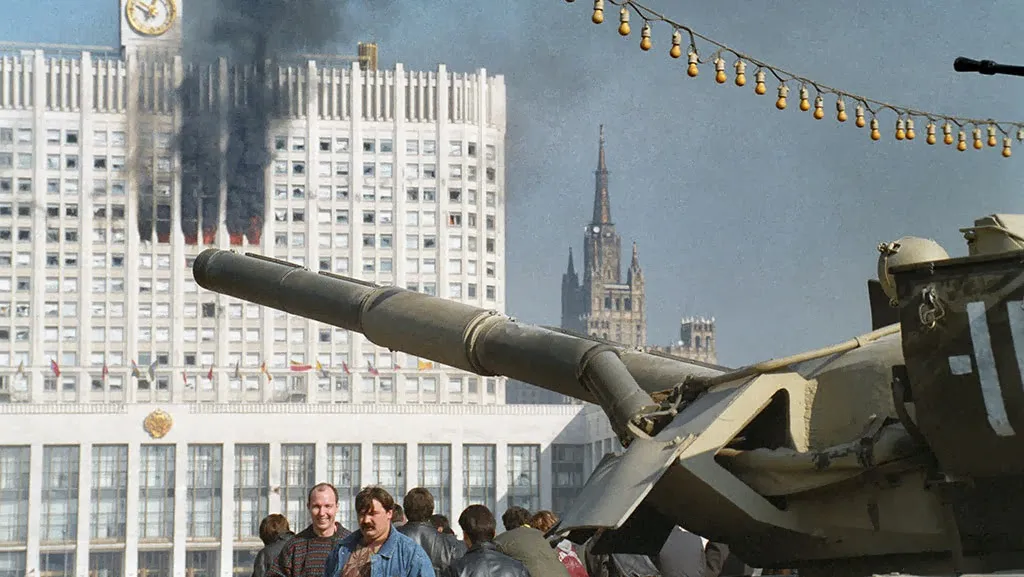
If You're So Smart, Then Why Are You So Poor? Russia's 1990s Revisited
“We never tried to wake our children up on weekends: the more they sleep, the less they eat.”
以下正文同步自 Hacker News 最新,版权归原站所有,已转换为易读排版。
“We never tried to wake our children up on weekends: the more they sleep, the less they eat.”
Recently, the Russian-speaking segment of the Internet got flooded with personal photographs from the 1990s. I first took note of them on my own Facebook feed. Some appeared expectedly funny—imagine the hairstyles!—others were nostalgic. Yet what seemed like a spontaneous flashmob turned out to be a planned event. In fact, this social-networking experiment was organized by the Yeltsin Foundation in conjunction with one opposition publication. It targeted the under-40 demographic, but especially those born in the late 1980s-early 1990s, who were too young to remember some of the horrors of that decade. Thus, the purpose of this pseudo-spontaneous photo-sharing was to reshape the memory of a nation about the early years following Soviet collapse. This memory has been overwhelmingly negative: looting the country’s natural resources by the select few, mob violence in the streets, daily hunger, institutional collapse, and national humiliation, just to name a few aspects.
And now, a new Yeltsin Center that includes a museum and an archive is being launched in Yekaterinburg, Russia on November 25 by the same non-government organization. Its declared purpose is the seemingly benign preservation and analysis of the social and political events in the 1990s. This upcoming opening has been accompanied by a substantial and professional social-media campaign and consequent protests.
Some of the protesters pointed out that its location in Siberia and the recent slew of visits by foreign diplomats are not coincidental, and are meant to generate social unrest and “Siberian separatism.” The latter does not actually exist on any meaningful scale, though certain Western media sources hyping it in order to serve their respective countries’ geopolitical interests certainly wish this were true. In any case, these protesters are wary of the so-called color revolutions gone wrong, and many Russians, in general, view the Center’s purpose as one of rewriting history. Whereas what happens with the Yeltsin Center remains to be seen, the photo-sharing exercise in soft power turned out to be a failure.
After all, in addition to photographs, thousands of people, including the target demographic itself, disseminated personal commentary that was less than favorable. Some of it is worth translating and appears below. I have taken these reader statements from the Facebook page of a well-known Russian journalist, Dmitrii Steshin, who writes for Komsomolskaia Pravda.
There are many interpretations of the USSR’s dissolution—from Western malevolence to a people’s utopian desire for the ideologically Liberal values of democracy and freedom, personal and economic. The truth is somewhere in between: the combination of Western pressure, failure to transform a giant ossified bureaucratic organism in dire need thereof, and the country’s own elites betraying national interests are some of the most important factors to consider.
Time, July 15, 1996 issue highlights Western engineering of a fraudulent election.
After 1991, nothing was the same. Some saw this brave new world as an opportunity, but most were lost. Social guarantees, toward which many worked and contributed all their life, disappeared. Many institutions simply collapsed: well-educated and extensively-trained scientists and engineers were out in the streets, if not literally, then making too little to provide basic necessities.
Protest signs read: “A hungry physicist is a SHAME for Russia” and “Give scientists the salaries that they are OWED.”
Factories and entire factory towns stopped operating. The military was demoralized: unilateral pullback from abroad with no written guarantees from NATO. (Look where that got us today.) Russia turned into one big open-air market with what some euphemistically described as “small business.”
Luzhniki Stadium-area of Moscow as a giant open-air market, 1997. This and most other photographs below are from an exhibition called Boris Yeltsin and His Time (Boris Eltsin i Ego Vremiia) by the Moscow House of Photography.
In truth, the more entrepreneurial residents traveled abroad to purchase clothing and other kinds of products to resell them at a markup domestically. “Export / import” turned into a joke about Eastern Europeans everywhere.
Hostages leave a Budenovsk hospital captured by a group of terrorists in 1995, the result of which was 129 dead and 415 wounded.
Thanks to the newly-opened borders, Russia was introduced to a whole new world.
Budenovsk hospital at the time of the terrorist attack, 1995.
The country’s so-called leader made a fool out of himself seemingly on schedule, whether through drunken public appearances or prancing around with that iconic sign of global capitalism, McDonald’s logo, following in the footsteps of the previous leader, who opted for Pizza Hut commercials.
Democracy was about Coke or Pepsi, after all.
Yeltsin at a McDonald’s opening, early 1990s.
Oligarchs Berezovsky and Abramovich, 2000.
Turf wars left people gunned down in the street in broad daylight. The eXiled made fun of it all.
This was the period that gave birth to one lasting expression, “If you’re so smart, then why are you so poor?”—a criticism directed towards those, who were lost in this surreal new world of wild capitalism.
It wasn’t all bad, of course. Literature and historic writing was now free of rigid ideological constraints, though initially its pendulum swung too far in the opposite direction. Perhaps, understandably. And, they were back. Churches. Hundreds of them.
One of the smaller crosses being attached to the reconstructed Church of Christ the Savior, Moscow, 1995.
Most important was Yeltsin’s legacy of leaving Putin in power. The latter systematically “undid” the damage of the 1990s. Imperfectly. Incompletely. But his leadership provided the country with the kind of reasonable stability domestically and sovereignty internationally that his people forgot could be possible. So next time you smirk about Putin’s impressive ratings, remember the 1990s.
Misconceptions about this decade persist. A particularly pesky one is that the USSR’s collapse had been nearly bloodless. This, of course, is grossly inaccurate, and its affects are still being felt today: the Ukrainian conflict is the prime example. Transnistria, Nagorno-Karabakh, Abkhazia, South Ossetia, Tajikistan, Chechnya… Prior to the war in Donbass, estimates of those who died in military conflicts in the former USSR range from 100,000 to 600,000.
Rally in support of Georgian President Gamsakhurdia, Tbilisi, 1992.
The rest of the statistics for the 1990s show a demoralized people. Overall death rates rose from 10 per thousand in 1989 to 16 in 1994, which is considered unprecedented in peace time. Among causes of death from external reasons, suicide was at the top of the list, up to a quarter of all cases for men. Its rates, specifically, drastically increased: 41.8 per 100,000 population in 1994.
Moscow, 1995. Bus-stop ad reads: “The world is changing.”
Abortions skyrocketed. Violent crime grew twofold by the early 1990s, and between 1992 and 1997, 169 thousand people were murdered. Emigration increased dramatically. People fled war and unemployment. Russia alone accepted 11 million asylum seekers between 1989 and 2002. Most of them came from the former USSR. Some commentators have suggested that the numbers of those, who died in this decade due to political and social turbulence as well as war, rivals those lost in Stalin’s 1930s.
But I’ll leave statistical calculations to professionals. In some ways, memories of those, who lived through it all, speak loudly enough.
Most comments that I’ve translated from Dmitrii Steshin’s page could be organized into three categories: food, salaries, and the spirit.
First payday without parents: a pack of kasha, vegetable oil, a pack of sugar, tea, and shampoo. Dieting! 🙂
I remember one particular day from the 1990s: in the morning, really early, we went on a walk to the park with our dogs. We never tried to wake our children up on weekends: the more they sleep, the less they eat. Anyhow, we found several mushrooms in the park and returned home happy, since we had pearl barley at home and could make soup!
In my town, all the pigeons were killed [and eaten]. People searched for food dumpster-diving. Shock therapy.
I gave birth to my son in December of 1993. That particular winter was quite cold, and our apartment building barely had any heat. When we returned home from the hospital, it was 10 C (50 F—Ed.) degrees inside, so we lived in a small room without turning off our portable heater for days.
I also remember that it was even difficult to buy soap: the stores were empty. My daddy, who was always very organized, came home one day feeling extremely pleased with himself, dragging a three-liter jar with brown stinky goo. The latter turned out to be liquid soap. We used that horrifying substance for bathing for a long time.
This is difficult to read, brings me to tears! It’s scary to remember that to this day I’m afraid to be left alone with an empty fridge, as if I grew up in besieged Leningrad (during World War II—Ed.). To this day, I feel acute shame because I had thoughts about stealing groceries. And, yes, we had to eat food covered with mould.
My friend fainted from hunger making kasha for her two little children.
They also did not pay us in money, but in light bulbs, for instance. Then we had to sell the light bulbs in order to buy something to eat. Or barter.
I was happy back then because I was in love. I also had a bag of flour and a bag of potatoes.
I remember that my mom bought me a Mars chocolate bar for my birthday. Then there were no more sweets for a long time, because we ran out of money. How many died back then just like that? We can’t say anything good about anyone from that particular government. If they were still alive, we should’ve put them to the back of the wall.
We ate macaroni. For breakfast, lunch, and dinner.
I don’t want to remember those years. I only recall that I came up with the following motto: “We will survive despite everything!” I grasped the fact that we have begun to live better when we got the ability to buy fruit for our children on a regular basis. I’m not talking about limes or avocados, but simply apples, pears, and oranges.
I was a college student at the beginning of the 1990s. I remember that one winter I kept having dreams about apples. 🙂 Evidently, I lacked vitamins terribly, because apples were a huge luxury for me.
I took my little five-year-old child (I had no one to babysit) and traveled to the nearby town (this was embarrassing to do in my own town) and sold worn children’s clothing, which my daughter outgrew. If I were lucky, then I used the money I earned to buy food. Then there was barter…
For me, the worst thing about the 1990s was not hunger (it wasn’t that bad, by the way), but rather, the constant, tedious, and continuous sense of humiliation. Today, I would call this national humiliation, but back then…you turn on the television and see drunken Yeltsin, the first Chechen war, and the nationalists in the former Soviet republics…In the streets, there was a mixture of wild poverty and, at the same time, similarly wild tackiness. Discos, tents with booze. Maybe it wasn’t this bad in reality, but this is precisely how I remember it. I can’t even look at my photos from the 1990s: I can’t believe this is how we dressed and styled our hair!!!
The clothing factory made a deal with the nearby macaroni factory to buy macaroni in bulk, which they then sold to us at five times the market price. It was either about taking the macaroni then or waiting for the money to appear. Macaroni for a year and a half.
Food stamps, kasha, and macaroni with onions and carrots. What I really craved was milk products and meat. And money in the millions [du
正文由 探How 从来源站点 RSS 同步,内容未经改写;遇到排版缺失或需要图片、视频时请以原文为准。