The October inflection point for vibe game development
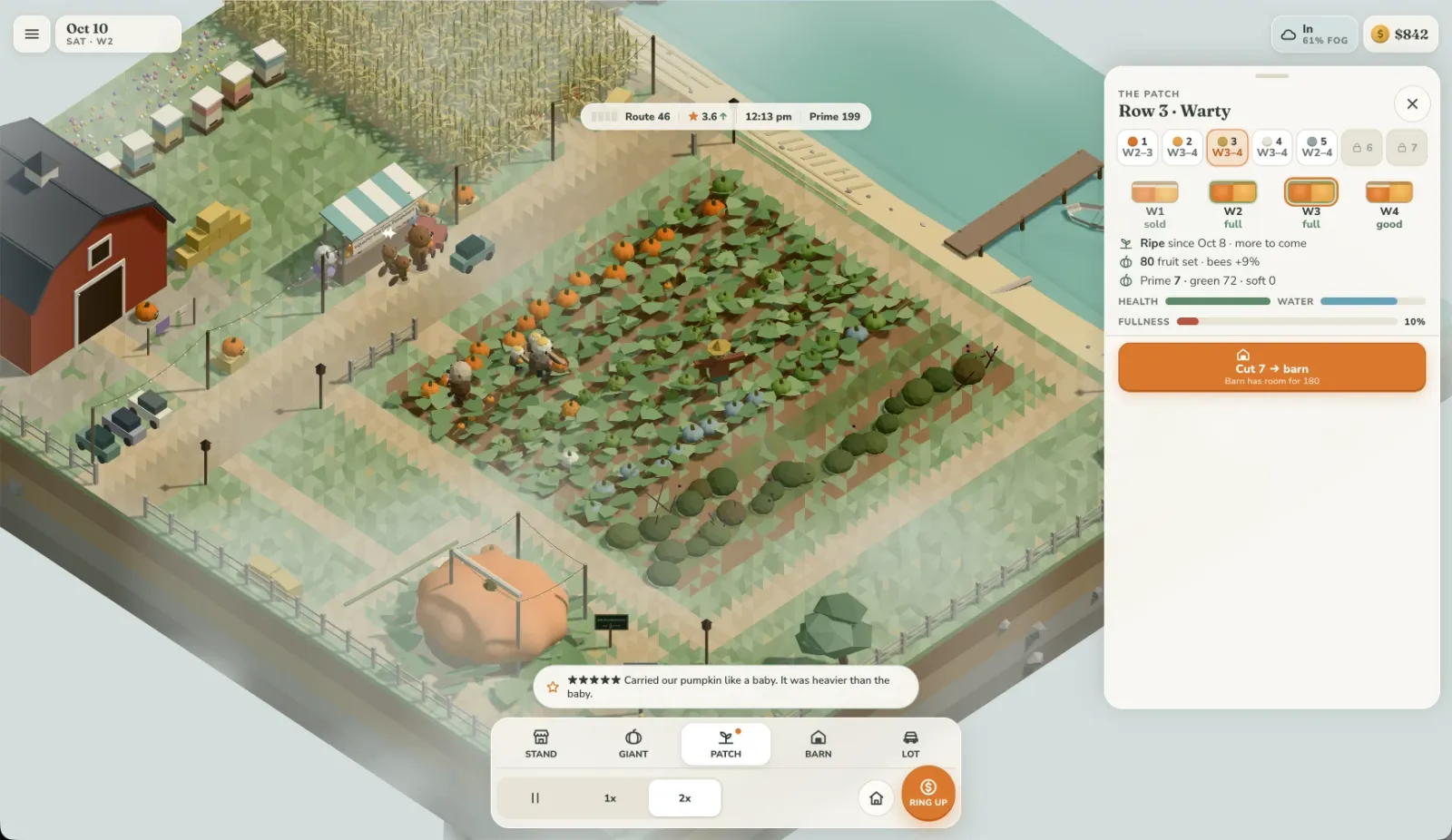
You can play the latest version here. I’m not convinced by the game mechanics yet—it’s actually quite complicated: you have to decide when to plant pumpkins such that they will become ripe at the weekends in October wit…
以下正文同步自 Hacker News 最新,版权归原站所有,已转换为易读排版。
You can play the latest version here. I’m not convinced by the game mechanics yet—it’s actually quite complicated: you have to decide when to plant pumpkins such that they will become ripe at the weekends in October with the most visitors.
Here’s the initial brainstorming session, which resulted in this spec file. Then I had Opus 5.5 Ultracode burn millions of tokens and nearly two days building it.
I told Claude to “surprise and delight the user frequently” and the result is so many little details and easter eggs. There are mischievous raccoons, an elephant seal that runs the weigh-off, harbor seals that roll their pumpkins back into the ocean, a wandering goat, and superstitions about growing giant pumpkins that sometimes come true.
This isn’t my best game yet—it’s not as fun to play as Battle Drones—but it represents the kind of game I want more of: weird, fun, uniquely personal—something that wouldn’t have been built in the before-times.
If you are offended by AI-generated art, AI-generated music, AI-generated writing, and AI-generated code, I have bad news for you: vibe coded games combine all of those at once.
The wider games community already has an aversion to AI-generated assets in games. This has been a growing issue over the past few years as tools like Midjourney have enabled developers to generate assets for their projects. This IGN story covering complaints about slop in Valve’s Steam Next Fest is a good recent example.
We now have games where everything—code, assets, dialog, and even the game design itself—can be outsourced to the models. And the results don’t suck!
Building a computer game used to be one of the most challenging projects in all of software development, combining a diverse range of skills and requiring intense focus and effort over many months or even years. And now here I am spitting out a playable multiplayer RTS by prompting on my phone!
I expect that, as we’ve already seen with programming, this will result in a split. Some players will refuse to have anything to do with games that were built in this way. Others may embrace this as opening up game development to a much wider audience. I lean in that direction!
I certainly won’t be entering any of my vibe coded games in traditional game jams or competitions—I don’t feel like I’ve earned that right. We’ll likely see new avenues emerge for vibe game developers to compare their projects.
The thing I find both exciting and shameful about this is that I have got interesting results from so little creative input. The projects I’ve described here are loosely ordered by how much effort I’ve put into them. Not a single project represents more than four hours of my work (plus many more hours of Claude Code churning away by itself).
Now imagine what could be achieved by anyone who takes this seriously, invests significant creative time, applies better taste in game design, and then playtests and iterates on the result until it’s as good as they can make it.
I want to see games that wouldn’t have existed without these new tools.
Building games in this way is so much fun. It’s the perfect application for vibe coding because it’s so low stakes: how much damage can you cause with a bug in a personal vibe coded game project?
(OK, you can do some damage... my attempt at audio-based multiplayer gave my wife Natalie a nasty headache!)
All of my games so far have been HTML and JavaScript using static hosting (generally GitHub Pages or Cloudflare Pages). Modern browsers—including mobile browsers—are incredibly capable. Frontier models already know libraries like three.js and Phaser. I’m finding these mobile web games to be indistinguishable from the native experience, at least for the kinds of games I’m trying to build.
I suggest starting with a prompt like this:
Build a mobile-friendly three.js game where...
This works on both chatgpt.com and claude.ai—you don’t even need to fire up a full coding agent. As one last example, here’s “Build a mobile-friendly three.js game where a mouse has to hide from a cat” by Claude Opus 5.5 Extra and by GPT-6 Extra High.
Switch to Codex or Claude Code once your project passes the proof-of-concept phase.
And if the game isn’t fun enough, add this:
正文由 探How 从来源站点 RSS 同步,内容未经改写;遇到排版缺失或需要图片、视频时请以原文为准。