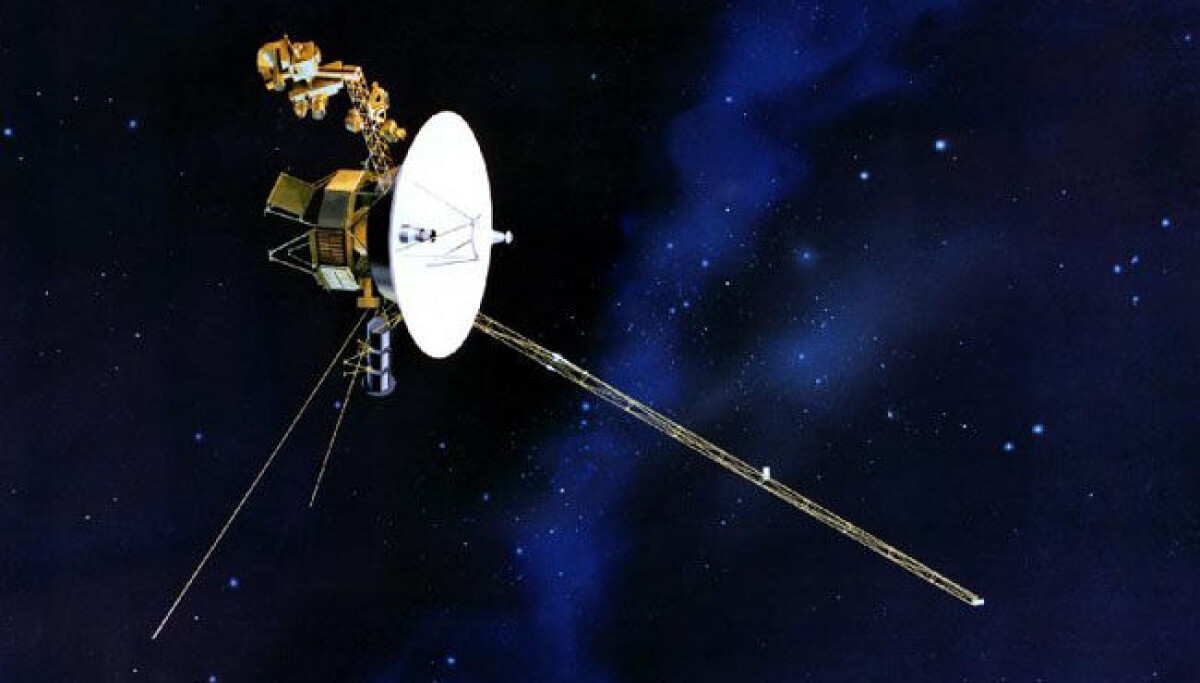
Dr Garry Hunt talks to us about the astonishing Voyager probes
Voyager imaging team member joins The Reg's Kettle podcast to talk about his role in the mission as probe approaches light day's distance from Earth
以下正文同步自 Hacker News 最新,版权归原站所有,已转换为易读排版。
Voyager imaging team member joins The Reg's Kettle podcast to talk about his role in the mission as probe approaches light day's distance from Earth
It's been nearly half a century since the Voyager probes launched from Earth on a mission to explore the outer solar system, and they're still running.
You're probably familiar with some of Voyager's iconic images, like the Pale Blue Dot and and its portraits of the outer planets.
Those photos and observations wouldn't have been possible without Voyager's imaging team, eight members of which were selected from scientists from around the world. The UK's sole representative, Dr. Garry Hunt, joins us on this episode of The Kettle to discuss his role in the Voyager program, the future of the mission, and the state of science in the UK, US, and beyond.
The Voyager Imaging Team (back row: Garry E Hunt, Carl Sagan, Toby Owen, Merton Davies. Front Row: Ed Danielson, Brad Smith, Allan Cook III, Verner Suomi, Larry Soderblom)
A lightly edited transcript is included below:
Hi everyone, and welcome to another episode of The Register’s Kettle Podcast. I'm your host, Brandon Vigliarolo, and we have a very special episode for you this week. We're gonna step away from the doom and gloom of AI and the silliness of Silicon Valley to talk about something and to someone of considerably more historic importance. The Voyager space missions will mark fifty years of exploring the solar system and beyond next year. With us to talk about this is Reg Reporter Richard Speed and our very special guest, British astrophysicist Dr. Gary Hunt who was a member of the original Voyager imaging team.
Thank you so much, Dr. Hunt, for coming on. And I'm gonna turn this over to Richard today, since you two have such a history together working on stories for The Reg, and I'm excited to hear about what he's going to pick your brain about. So Richard, take it away.
Well Dr. Hunt, we've spoken a lot about the Voyager project over the years, but for anyone who's not aware of it, I wonder if you could summarize the mission, which is, I know, a big ask, and also what your role in it is and was.
Well indeed, it's a unique mission in the sense that every 176 years the major planets Jupiter, Saturn, Uranus, Neptune, line up virtually in a straight line. And we wanted to explore the outer planets 'cause we've never been there before. I'm talking in the 1970s, late 1960s, '70s. So this is an unknown world. We thought that the major planets were keys to understanding the origin of the solar system, indeed the origin of life, so sending space missions there was a priority.
But it needed to be done in a very economical way. With the planets lined up, that meant we could get there in the quickest way, requiring less fuel, and it would be the best way of going about it. So the opportunity came and NASA funded a mission to send two spacecraft at this unique time, which was in the mid '70s, 1977, to the major planets.
NASA sent out an invitation to tender. They selected the ten instruments. Imaging had as an instrument in concept had been suggested, but they wanted a team of real scientists, not astronomers, not basic astronomers. They understood this is a chance to do real detailed science, real physics, real chemistry, the whole understanding of what went on. So they were looking for an interdisciplinary group of people. They selected eight people from invitations and I gather there were about nearly a thousand people proposed and of those eight I was chosen.
So I decided I suddenly found myself in this incredible position. I'm there to represent atmospheric physics. I want to understand the physics, the meteorology of the major planets. So here is an opportunity to explore the outer planets to learn about why we wanted to go to Jupiter, Saturn, Uranus, and Neptune. However, funding was tight. The president at the time was Nixon, and we only had funding as far as Jupiter and Saturn. So we were treading new territory. At the time the mission was sort of decided, we had not been through the asteroid belt. So the first question was: would the spacecraft even get that far? And of course the pioneers had just been launched at the beginning of the '70s and they managed to get through and raised a lot of questions. So I was part of the imaging team, this amazing set of what I will call prima donnas, because we all were. They were from Carl Sagan to Vern Suomi, who was a meteorologist, to Brad Smith, a whole collection of people. And we had to design the imaging system, the cameras, and be part of the organization that developed the choice of trajectories and all the other facets of this mission.
In other words, we had to understand the risks as well as the potential rewards that came from it. So it was a big responsibility. And to put the whole thing in real context, I learnt in December '72 from NASA that I'd been selected. We had our first mission meetings in February of '73, and we had until the summer of 1977 to get the spacecraft launched. And the window for launching was ten days. So this was really a big precision job. So large responsibility and had many opportunities, not only to do the science, but the work that I was doing when I took the data back to the UK was to actually serve as a trigger for planetary research within the UK. So this really was a major major part of a new world, new understanding. And as we have learned over the years, we have made history and just about all the observations we've made.
Okay, great, thank you. So, I mean, as you said, it's been coming out for half a century, 50 years since the spacecraft were launched on their mission and they've been, as you say, Jupiter, Saturn, Uranus, Neptune, and so on. I was just wondering, why do you think they've lasted for so long? Because it's just incredible, really if you think about it.
Well, firstly I will put my hand up and say that the engineers of JPL are exceptional. We've had a few hitches and they've overcome it. First of all, we also said we want a spacecraft. It's going to unknown territories. We don't know how long it's going to last. Reliability was the key. So it was built around the mariners, which have been the bedrock of the earlier missions to around Mars and flying by Venus. So that was the first thing.
And so many of the aspects of it were built from equipment from the mid-sixties. So the issue is even more exciting to think that here we are 50 years after launch flying a spacecraft with equipment which was already 10 years old by the time we got it there. So this really is an example of reliability, which is the bottleneck. And of course, the other aspect of it we built in redundancy as well. So we knew that, if things went wrong, we had to find a way of easily overcoming it. As it's drifting away at the speed of thirty thousand miles an hour, you can't just sort of go out and repair it. You've got to be able to do things while the spacecraft is in motion. So there's a certain amount of redundancy, built in reliability, incredibly good careful planning, absolutely brilliant engineers who to this day are doing the most incredible things.
Well, yes, I have to say, I agree, having spoken to the current Voyager team, they are a bunch of very impressive individuals. And they seem to keep eking out more and more life from the spacecraft. I know it's powered by RTGs, which will eventually expire and there won't be enough power to keep it going. But it seems they'll be able to continue well into the 2030s, maybe even beyond. I mean, what do you think is going to end the mission because I mean it must be coming up. Do you think it'll be a hardware failure? We have had some spacecraft failures over the years or do you think it's going to be more prosaic? Perhaps it'll be just a lack of funding.
Well, if you go back to our elementary school physics, we know that as it moves away the signal strength disappears like one over the square of the distance, so it's getting pretty weak. It's incredibly weak. The brilliance of the deep space network, Goldstone, Madrid, Canberra, that's key. Furthermore the power on board and we have our own nuclear power plant on board, which is decaying plutonium, which is the key aspect of the spacecraft. That's getting less and less. We're losing several watts per year. There will come a time when the signal is literally so weak we can't pick it up. So that is one thing that we predicted about 2035. Could it become out of touch before then? Well, that's then politics versus science and engineering.
And yes, it costs money to keep this thing running, but the way in which science budgets are being hacked at every moment, we are worried that once we pass our our big date of fifty years next summer, that perhaps that the politicians will say: You've had your time, enough is enough.
I really hope that's not the case. Personally I hope that there's some development in deep space monitoring over the next few years that would enable us to keep picking it up beyond that. Or do you think it's simply a matter of distance and background noise that it would be unreachable?
The signal is incredibly weak. and there'd be insufficient power in the spacecraft to actually power it. They've got to have some form of heating. It's pretty cold out there. or virtually everything has been turned off. They've just done a major activity with the onboard power system. They literally have done everything they can. We reckon to 2035 we will still be able – that'll be about the time it'll be too weak for anything on Earth to be able to pick it up. So that literally is the time we were anticipating the end would come, if we can keep the politicians out of the way.
Well, absolutely and I mean I I think as we spoke recently it's approaching a one light day to kind of get a feeling of how far away these things are now where it takes an entire day to send a command to spacecraft a light day for the command to come back.
Well, I think the issue is it's one light day in distance. Now if I'm sending you a message, suppose I'm speaking to you and you're on Voyager. I start talking to you now, it's 24 hours before you get my message, then it's 24 hours before we send it back again. Can you imagine operating like that? This is a very significant factor. This is the furthest anything it has ever got that we've been able to record. Voyager 2 will not get there until about 2030, I think it is. Because it's on a different path. But these are immense distances. So it's never happened before. It actually occurs, if you want UK time, on the 18th of November at 10.06 in the morning [0206 Pacific Time, 0506 EST]. So look at your watch when that time comes up and say, that's where Voyager 1 is.
I must admit, speaking to the JPL team, and again, we work in technology, the thought of the fact you would send a command to the spacecraft, you won't even know if it's worked until the following day or a day or so later, at which point it could have done something awful to the spacecraft and it's too late to fix it. I just can't get my head around that kind of risk analysis and risk assessment, which you must do.
Well, we've we've had that situation occur because you probably remember several months ago, they wasn't replying to signals and they discovered that the dish was actually pointing slightly away so it could not be picked up in Goldstone, but managed to find a way of turning it around so it could actually recommunicate. But there was another problem. All the codes for the very, very poor computer which actually has less power in it than I have in my Apple Watch I'm wearing. They were written in assembler code. Well those people who go back to the early days of computing, that is one of the very basic codes. There was nobody in JPL who had that experience. Somebody had retired and was willing to come back and find them. Everything was written down on pieces of paper. So it was a whole new bal
正文由 探How 从来源站点 RSS 同步,内容未经改写;遇到排版缺失或需要图片、视频时请以原文为准。