Lobbying Is Corruption
How Inspired Entertainment reduced integration development from 8 weeks to 1 week
以下正文同步自 Hacker News,版权归原站所有,已转换为易读排版。
How Inspired Entertainment reduced integration development from 8 weeks to 1 week
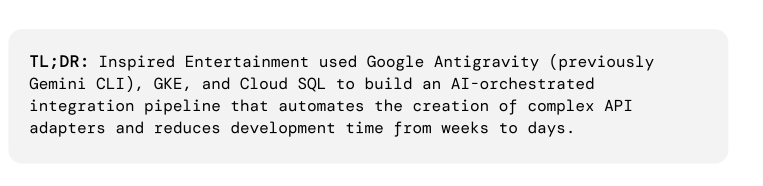
Inspired Ent - TLDR763×186 15.8 KB
A special thank you to Simon Twigg, CTO of Inspired Entertainment, and Trace Wax, Head of AI Engineering at Barefoot Coders, for partnering to bring this incredible story to life!"
At Inspired Entertainment, our core technology is processing the secure financial transactions that power the global online betting industry. Our centralized platform, the Remote Gaming Server (RGS), handles real-time wallet operations across multiple strictly regulated jurisdictions, supported by 11 data centers and over 200 deployments worldwide.
Growth in this space requires continuously integrating our platform with major betting operators like DraftKings, Entain, and the Flutter Group. The challenge is that every operator maintains entirely custom, proprietary APIs for their wallet transactions—requiring complex integrations just to handle standard operations like authenticating users, checking balances, and processing debits and credits.
The bottleneck: Even if all major betting companies use JSON over HTTP, the data structures and protocols are highly customized and proprietary. Historically, to connect our server to a new operator, we had to manually interpret the API doc, map it to our RGS API, and build a custom “adapter”—a Java Spring Boot translation microservice. This required a standard scrum team of five and took 6 to 8 weeks, consuming roughly 40 dev days and 12 QA days per integration just on boilerplate code.
The impact: This manual bottleneck artificially capped our business at completing about 12 integrations per year, which limited revenue growth. Furthermore, our highly skilled developers were stuck doing repetitive, “rinse and repeat” translation work instead of building core platform features.
Instead of continuing to manually map API documentation to Java code, we partnered with Google Cloud and the Barefoot Coders to build an AI-orchestrated integration pipeline. We utilized Gemini CLI to ingest operator wallet APIs and automate the creation of the Java Spring Boot integration modules. Now, a process that took weeks of manual coding is orchestrated by a single developer in days.
Our infrastructure relies heavily on Google Cloud to handle the strict regulatory and performance demands of real-money gaming.
Google Antigravity CLI (previously Gemini CLI): The core automation engine. It ingests complex, proprietary API documentation alongside our internal markdown guidelines and outputs the adapter module code. We also use it to review pull requests and modernize legacy systems.
Google Kubernetes Engine (GKE): We use GKE to handle the core RGS and the newly generated Java Spring Boot microservice adapters are deployed and managed as containerized services within GKE.
Cloud SQL & Cloud Storage: We use Cloud SQL to manage self-hosted transactional state, and Cloud Storage buckets to host game assets.
Cloudflare & Cloud Armor: We leverage Cloudflare for our CDN and Cloud Armor to provide critical security filtering and WAF layers to protect our gaming payloads at the edge.
Bitbucket + Gemini: We placed Gemini directly in the middle of our CI/CD pipeline as an automated code reviewer on pull requests.
Our new adapter workflow completely bypasses the manual mapping phase. The developer feeds the API documentation (PDFs/Markdown) and specific prompts directly into the Gemini CLI. The AI acts as the primary author, mapping the proprietary JSON payloads to Inspired’s normalized RGS endpoints.
正文由 探How 从来源站点 RSS 同步,内容未经改写;遇到排版缺失或需要图片、视频时请以原文为准。