Show HN: Lcc – compact Claude Code sessions without summarizing them
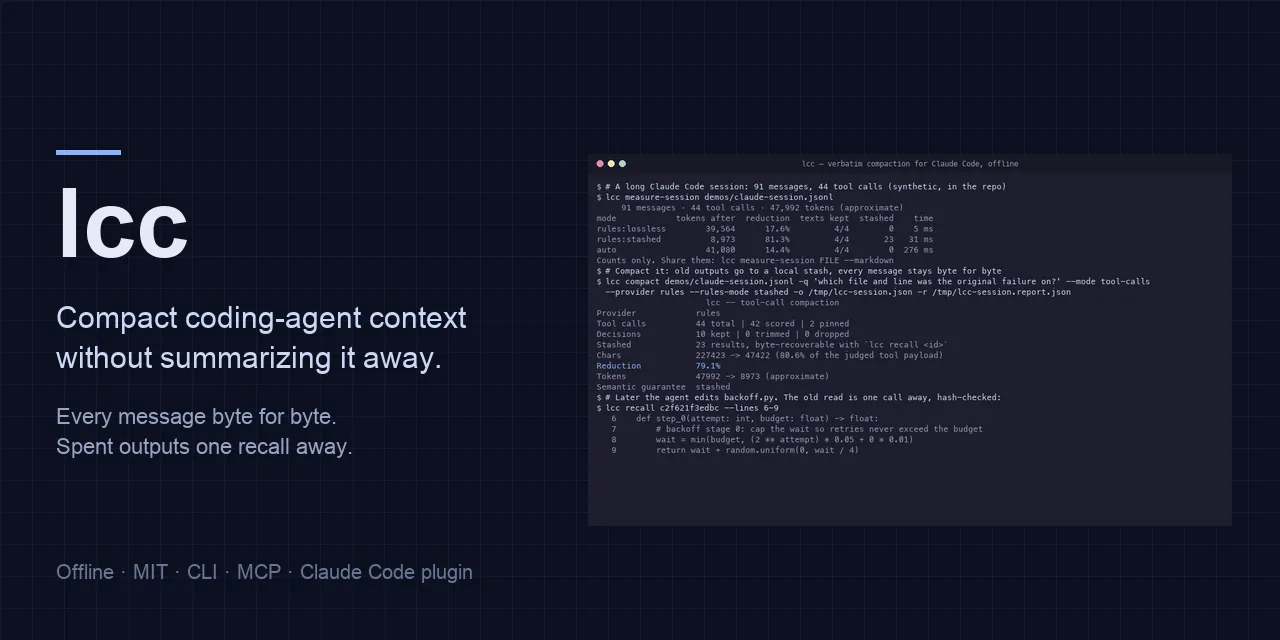
Compact coding-agent context without summarizing it away.
以下正文同步自 Hacker News 最新,版权归原站所有,已转换为易读排版。
Compact coding-agent context without summarizing it away.
lcc cuts what the model does not need, keeps everything else byte for byte, and writes a receipt.
Claude Code's /compact replaces your session with a summary written by a model. Summaries drop the exact error, path or line the agent needs two turns later. lcc does the opposite: old tool outputs leave the context but stay one recall away, and every user and assistant message is kept as it was.
Measured with lcc measure-session (PyPI 1.2.0, offline, exact o200k_base token count; re-run 2026-10-23). On main, whose stash note now states lines and size, the same session gives 28,983 (−49.2%). That session is one of the best cases. Across all 299 of my long sessions (100+ messages each, 36.3 M tokens) the median cut was 21.8% (middle half 15% to 31%, best 65%), with 0 messages lost (python benchmarks/research/long_sessions.py, 2026-10-23, main). These are all my sessions: run it on yours and post the result.
In a pre-registered test on 172 real requests (evidence), an agent answering from the stashed context plus recall did as well as with the full context on file recall (+0.006, 95% CI −0.023 to +0.034) with 36.6% fewer tokens. It called recall for 90% of the questions about removed content. A /compact-style summary of the same sessions got 73% of exact values right (our reimplementation of /compact, written by Opus); full and verbatim context got 98%.
pip install "local-context-compiler[tiktoken]" # the CLI is lcc
lcc measure-session "$(ls -t ~/.claude/projects//.jsonl | head -1)" # your latest session
The second line reads your most recent Claude Code session, runs every mode offline and prints counts only. Nothing is changed and nothing leaves the machine.
Claude Code plugin (replaces the /compact summary). Function hooks are early access, so this needs Claude Code 2.1.274+ and the flag below:
export CLAUDE_CODE_ENABLE_FUNCTION_HOOKS=1 claude plugin marketplace add lucasmartins-ai/lcc claude plugin install lcc@lcc --config provider=rules --config rulesMode=stashed
Allow mcp__plugin_lcc_lcc__recall so the agent can get removed outputs back. When a pass fails or removes too little, the plugin hands over to the built-in summary and says so in a toast. Details: Claude Code guide.
MCP (Claude Code, Cursor, Claude Desktop, any stdio client):
{"mcpServers": {"lcc": {"command": "lcc", "args": ["mcp"]}}}
Tools: compact, compact_transcript, recall, inspect, prepare, explain, intake (MCP guide).
lcc compact ~/.claude/projects/<project>/<session>.jsonl -q "finish the parser fix"
--mode tool-calls --provider rules --rules-mode stashed -o compacted.json -r report.json
lcc recall <id> # a removed output, hash-checked
lcc compact notes.md -q "what is wrong with the booking flow?"
--provider mechanical -o compacted.md -r report.json
lcc explain report.json --source notes.md # why each block was kept or dropped
Send us your numbers
lcc measure-session ~/.claude/projects/<project>/<session>.jsonl --markdown
Codex CLI rollouts are auto-detected from their session_meta record:
lcc measure-session /path/to/rollout.jsonl --markdown
or a whole project directory: per-mode median and p90 reduction over its sessions
lcc measure-session ~/.claude/projects/<project>/ --markdown
It runs every mode on one of your sessions, offline, and prints counts only: messages, tool calls, tokens before and after, messages kept, time. No text, path or tool output. For exact counts, install the tiktoken extra and cache its tokenizer once (lcc itself never downloads): python -c "import tiktoken; tiktoken.get_encoding('o200k_base')". Otherwise the report says approximate and why. Paste it in Discussions → Results. Add --input-map to see where the session's billed input goes instead: cache reads and writes, and the share taken by tool results, tool-call inputs, injected instructions and the fixed system prompt and tool schemas (counts only, from the usage records in the file). Already compacting with lcc? lcc share-stats turns your local reports into the same kind of counts-only summary (SHARE_STATS.md), or use the results issue form. Every number from someone other than me makes the claims above less mine and more true.
Verbatim. Kept spans are byte-identical to the source. Nothing is summarized or rewritten.
Recoverable. stashed moves removed outputs to a local content-addressed store (~/.cache/lcc/stash); recall re-hashes on read. The placeholder, [removed: 120 lines, 4.3 KB · lcc recall <id>], states lines and size, not tokens, so it is identical on every machine.
Auditable. Every pass writes a JSON report; lcc explain gives the reason for every drop.
Local. The default judges run on your CPU in plain Python. No API key, no network.
Providers
Provider Runs When it is used Report says
specialist-v3 local, CPU default (auto) whenever transcript blocks are present: the Claude Code hook, compact_transcript, --mode tool-calls semantic_guarantee: none (a rank, not a judgment)
mechanical local, CPU --provider mechanical; plain text under auto (a configured TypeSafe key does not change that unless LCC_AUTO_REMOTE=1) semantic_guarantee: none
rules (lossless, recoverable, stashed) local, no model provider: rules for transcripts lossless: only provable duplicates removed; recoverable: also outputs that can be re-read; stashed (recommended): removed outputs stay byte-recoverable through recall
jev remote (TypeSafe API) opt-in: --provider jev / provider: jev, needs TYPESAFE_API_KEY semantic judgment or explicit degradation
laya local model deprecated; runs only when named named model and fallback state
specialist-v3 details and limits: SPECIALIST.md. Rules modes: TOOL_CALLS.md. Jev is an optional path you name explicitly (--provider jev); it sends the objective and context blocks to the TypeSafe API, and LCC_DISABLE_NETWORK=1 disables it. auto never picks it on its own: having a key is not consent to send context off-machine, so plain text under auto stays on mechanical unless you set LCC_AUTO_REMOTE=1. compact writes a relevance-compaction-1.2 report; check provider_used and degraded before trusting the output.
Real sessions (held-out, INFERIDO). In plain words: when a ranker has to drop part of a session, how often does it keep what the agent actually used next? 1.0 would be always. A one-shot final test on 193 items from 36 of the maintainer's sessions that started after the training cutoff. Retention AUC over drop budgets of 0–60% of candidate tokens:
The labels are next-action evidence from one maintainer's Claude Code sessions, which favours v3's training target. The sessions are private; only aggregates are published (SPECIALIST.md).
Synthetic, reproducible (python benchmarks/run_judge_bench.py, about 20 s, no network). Nine hand-written edge cases: supersession, contradiction, config change, exception rule, pt/en mixed, prompt injection in a tool output, large git diff, old root cause, re-read.
These cases are lexically easy, so the lexical baselines do well; v3 misses the Portuguese case. Timings are from macOS arm64 under heavy machine load. Method, every arm and the limits: BENCHMARKS.md. Rules modes on real sessions: REAL_SESSION_BENCHMARKS.md.
Reduction depends on how much of a context is noise. Below a 25% gain, the report marks the pass as not worth it, and the Claude Code plugin keeps the built-in summary.
It does not check that a model will answer correctly. A structural PASS is not an answer quality result.
No RAG, embeddings or vector store.
Protection rules and bounded restoration reduce, but do not rule out, lost evidence; see the safety model.
specialist-v3 was trained on Claude Code transcripts. Other agents and plain documents are out of distribution; plain text uses mechanical unless you opt in to Jev.
Docs
Topic Link
Five-minute tour of the CLI QUICKSTART.md
Claude Code plugin CLAUDE_CODE.md
MCP server MCP.md
Tool-call compaction and rules modes TOOL_CALLS.md
Aider chat history as input AIDER.md
The local ranker SPECIALIST.md
Benchmarks BENCHMARKS.md, REAL_SESSION_BENCHMARKS.md, benchmarks/
Python API (lcc.msi.compile) msi-api.md
Architecture and decisions architecture.md, ADR 0010, ADR index
Opt-in and deprecated providers JEV.md, LAYA.md
Research archive paper.md, results-master.md, TRANSCRIPT_AB.md
Privacy PRIVACY_POLICY.md
Development
Python 3.11+.
python -m pip install -e '.[dev,tiktoken]' pytest -q && ruff check . && mypy npm test # Node API and hook tests python benchmarks/run_judge_bench.py --check --out /tmp/judge-bench
The PyPI package named lcc is unrelated; this one is local-context-compiler. Contributing: CONTRIBUTING.md. Security: SECURITY.md. Changes: CHANGELOG.md.
MIT. The optional Laya integration carries Apache-2.0 attribution in NOTICE. Maintained by LookADev.
正文由 探How 从来源站点 RSS 同步,内容未经改写;遇到排版缺失或需要图片、视频时请以原文为准。