Lighthouses, War and a Puffling
On Open Doors day, the enigmatic and fascinating Isle of May reveals its history and its stories.
以下正文同步自 Hacker News 最新,版权归原站所有,已转换为易读排版。
On Open Doors day, the enigmatic and fascinating Isle of May reveals its history and its stories.
Sometimes the island is a dark mass of brooding mystery. Sometimes it’s a pearl on the horizon, its cliffs gleaming with the droppings from its 200,000 odd sea birds.
Sometimes water and light bends perspective. The island lunges towards the East Neuk coastline, all clear detail, dramatic cliff and white foghorns. Other times it seems to shrink to the horizon, half-obscured by mist and fog. The view of the island is never the same – a constant shifting of light, cloud, water, sun, rock and yes, the reflection of bird shit.
At night, its lighthouse rakes the Firth of Forth and North Sea every 15 seconds. On the mainline, on a dark winter’s night the winds howl through the old smuggling wynds and drives the waves at the harbour sea walls. Unperturbed, the lighthouse skims its steady winking beacon like it has done so for so many nights down the years.
The Isle of May from the shoreline is Mrs C’s favorite view in the world after St Pauls looming up at the end of Fleet Street in London. The family joke is that we can wrap her up in a bath chair, leave her with her view, and pick her up at the end of the holiday. She loves the sense that the human presence is marginalised – the island is nature’s realm, where nature gets on with its business.
The island can look like a wild mystery, a drift into a gothic imagination where it inhabits territory similar to the film, The Lighthouse. A place of isolation where the now silent foghorns relentlessly bellow. The Lighthouse explores repressed sexuality, alcohol abuse and a descent into madness. Its main characters are trapped in the purgatory of endless storms and gulls screaming omens of disaster. Mermaids and supernatural creatures taunt the tortured human interlopers. It doesn’t end well. Sometimes, the Isle of May really does look like the kind of place where a deranged, barely alive Robert Pattinson lies nude on the rocks, writhing in agony as gulls peck at his exposed organs.
And yet, the island in many ways, is just not that isolated or mysterious – its waters are too fertile for fishing, its location is too strategic and key to human interest. Furthermore, the Forth has always been busy with shipping. But it’s also an area of hidden rocks, reefs, sandbanks, sudden fogs or haar, and malignant storms. Shipwrecks and loss of life were common along this stretch of coast.
NatureScot staff and bird enthusiasts stay on the island during the season. Come November, they leave the island for winter. But the island receives a lot of visitors. During the season, it’s a popular day trip from Anstruther. For an island only a mile long and and half a mile long, it packs in a lot of life and history. And on one day in the year, the island fully opens its doors to reveal its history.
First there are the pilgrims and saints. The island had one of the earliest Christian churches in Scotland. The current chapel on the site is dedicated to Saint Adrian of May (sometimes known as Ethernan). He died in AD 875 when marauding Vikings slaughtered the entire population of the monastery. The island was abandoned until the 12th century when David I of Scotland obtained the church again, and the Benedicte community was established. One of the tasks of the monks was to pray for the souls of the Kings of Scots.
The island, with its relics of St Adrian, became a popular destination for pilgrims and royal visitors. The shrine could help a woman become pregnant. It could also provide cures; the bones of pilgrims buried on the island showed that most had been seriously ill. The weather-beaten remains of St. Adrian’s medieval chapel and a 12th-century Benedictine priory are still there on the island.
Unsurprisingly, with its strategic location, the Isle of May has been an island of war. During World War II, the navy maintained a control centre on the island to detect U-boats and enemy surface vessels trying to enter the Forth
The island also lent its name to the Battle of May in 1918.The name is misleading, a classic example of British gallows humour for a terrible event when the Royal Navy attacked itself. A sequence of accidental collisions between Royal Navy warships occurred over little more than an hour which saw two submarines sunk with heavy loss of life, another four damaged along with a light cruiser.
Judging by the old black and white photos, the island was frequently visited during war. There were prayers and services amongst the ruins of St Adrian’s chapel. There were 7-a-side football matches between armed forces and trawler crews. Wuffy, a beloved naval dog, who drowned was buried with a wooden headstone.
Lighthouses are remarkable. They are a symbol of our common humanity, rising out of dramatic crashing waves, a coming together to save lives for people we may never meet. As a nation, we may have less connection with the sea than previous generations, but it’s still in our bones. It’s why, along with the Shipping Forecast, harbour walls and old-fashioned trawlers, lighthouses evoke nostalgia and longing. They are a repository for folklore, our history, often macabre stories and feats of engineering.
They are also, of course, about bleak human isolation set amongst the relentless power of the seas. It’s easy to be romantic about something when you don’t have to actually do the job. On the sea towers, the lighthouses that emerge straight out of the sea, the keeper couldn’t even go for a walk.
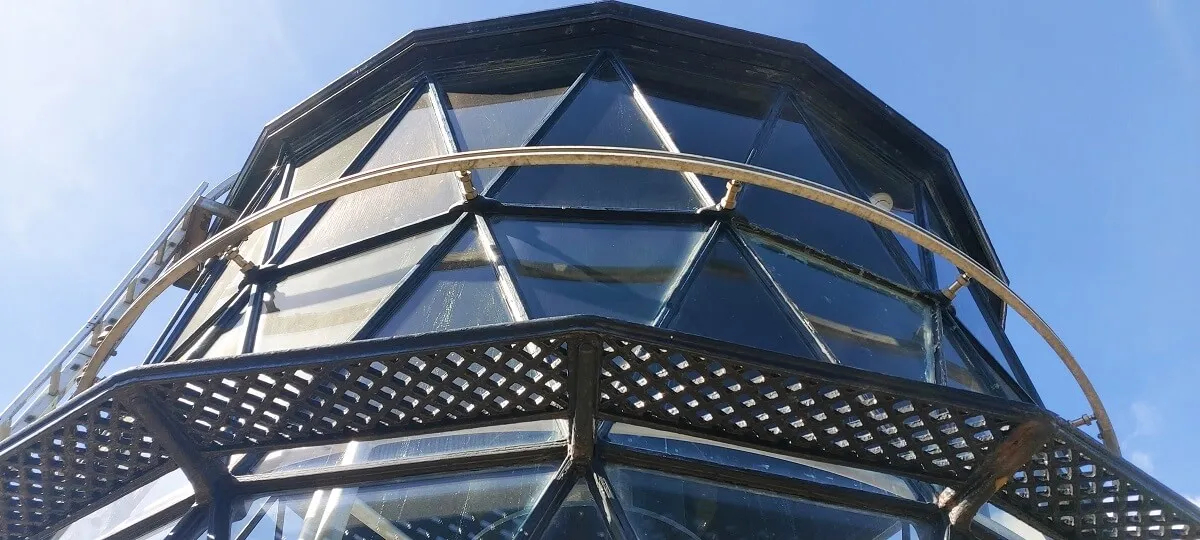
Life on the lighthouse of the Isle of May seemed to be relatively social and civilised. Robert Stevenson’s lighthouse, built in 1816, is an airy beautiful building, a feat, at the time, of modern lighthouse architecture. There were facilities so that lighthouse keepers could bring their families, there was fishing in a small loch and a stream of visitors and deliveries. Mrs Bruce, the mother of the last family to leave the island in 1972 recalled that “it was never lonely living on the Isle – the bird watchers would come over and stay in the bothy.”
Nonetheless, there was tragedy with Scotland’s oldest lighthouse, the remains of which can still be visited. It was a coal-fired beacon that was established in 1635. In 1791, a light keepers family was suffocated by fumes from the coal ash piled up around the tower. The only survivor of six children was their eleven-month-old daughter Lucy, who was discovered alive three days later. The small boy who rescued Lucy later went on to marry her.
During the 17th and 18th century, the island’s now vanished village housed 15 fishermen and their families. Many were also smugglers who took advantage of the caves and narrow inlets on the island. Then there were those using the island to hide from the pressgangs of the Royal Navy. You could see how the nightly, secret work of smuggling might create folklore. There were sightings of unearthly lights. A keeper’s daughter was attacked by kelpies in the 18th century.
The Devil himself hurls a rock from the Isle of May towards Crail, a fishing village on the mainland, in protest at the building of a new church. The Devil also whipped up a storm in which Alexander Cunningham, the builder of the original lighthouse beacon, died. The Devil’s work had consequences. Some old women were later blamed for this and burnt as witches. Fife was one of the worst areas in Scotland for witch-burning during the 16th and 18th centuries.
The island is home to one of the largest puffin colonies in the UK. When they are 30 days old, pufflings are abandoned by their puffin parents to survive or die. The pufflings must use the cover of darkness to escape predatory gulls, walk into the sea and get away as far as possible before daylight. Scout didn’t escape. He was found wandering around, a lost little puffling. He was reared by NatureScot staff and fed with bits of fish. On our boat back to the mainland, he was to be released at sea.
A bemused, wriggling Scout was pulled out of a sack and introduced to everyone on the boat. Then, a mile or so from the island, past the seals gathering for breeding season, the boat came to a stop, rolling and pitching with the swell. It was Scout’s big moment.
He was unceremoniously dumped onto the sea, no other way to do it. There was a moment of jeopardy when a gull flew overhead, its threatening screech triggered gasps from the onlookers, willing Scout on. Scout floated in a moment of confusion, the first time in his life he was not on land. …and then all the instincts kicked-in and he dived. He appeared again, dived and then was finally lost amongst the roll of the waves. How did he know what to do? No-one had shown him anything. It was a special, remarkable moment to witness.
The puffin’s comical appearance and iconic way they carry sand eels is perfect for the merch but they are astonishing birds, hard as nails. Scout won’t see land for three years. He’ll ride the waves and bear the freezing storms. A hardcore seafarer leading a solitary life across the vast cold Northern seas. He can hold his breath for over a minute and dive two hundred feet down.
He’ll return to the Isle of May after a few years to find a mate. They mate for life but once they’ve raised a chick, they separate for another winter alone. When they both return to the same cliff patch, they’ll identify each other through the stripes of their bills.
Puffins are of course in decline because of us, and because we can’t live in balance with this extraordinary world of which the Isle of May is but one small yet vivid, teeming island. Maybe Scout – rescued, nurtured and given another chance by kind humans, is out there drifting and wintering on the oceans. Maybe he represents hope for his kith and kin, hope for all of us.
Or maybe he’s already been eaten by a gull. That’s nature for you, ruthless and lacking in sentiment.
正文由 探How 从来源站点 RSS 同步,内容未经改写;遇到排版缺失或需要图片、视频时请以原文为准。