Lykyn Review: A Mushroom Garden Worth Showing Off
Dramatic lighting and fog make this countertop fruiting chamber a conversation starter. The mushrooms are pretty good too.
以下正文同步自 Wired,版权归原站所有,已转换为易读排版。
WIRED
Stylish and effective way to grow your own mushrooms. Quiet. Needs little to no maintenance. Works for even difficult varieties like shiitake.
TIRED
Fruiting block not included. Mushroom show is brief, with unattractive downtime between harvests. Sliding door and misting mechanism can be finicky.
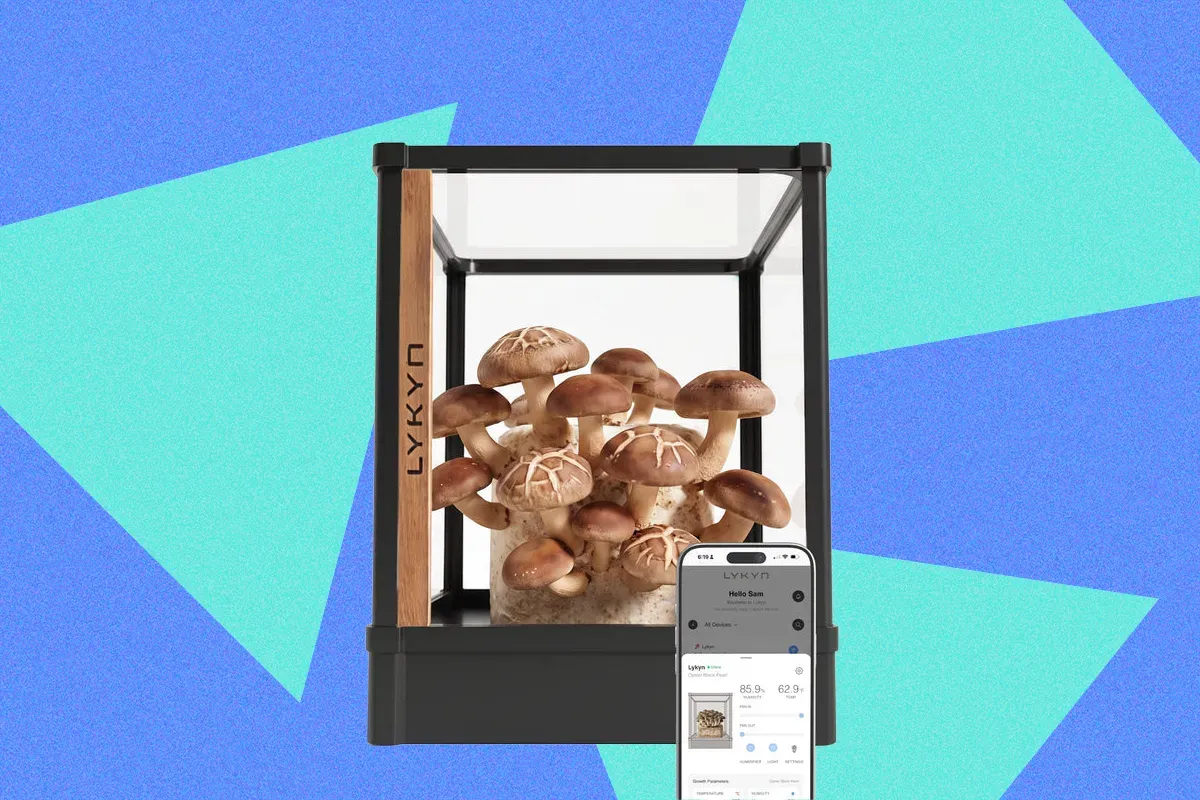
If your online algorithm detects your having even the slightest interest in growing mushrooms, you will, at some point, probably see an ad for the Lykyn. It looks like something out of a science fiction movie—a clear box with theatrical lighting, fog, and a giant mushroom displayed like an otherworldly specimen.
After trying the Lykyn myself for a month, I can confirm that it really does look like that in real life, and as someone who has tried many different mushroom-growing methods, I was impressed by how well the Lykyn worked as a legitimate fruiting chamber. The thing you’ll have to decide for yourself is whether it’s worth $300 to showcase a process that lasts only a week or two.
The 13 x 13 x 15-inch unit, available in white or black plastic, arrives mostly disassembled—you will need to peel the protective film off both sides of each acrylic panel, slide them into plastic tracks on the base, add the corner posts, and fill the unit with distilled water. One panel doubles as a sliding door, and installing it was fiddly on my unit; I had to open and close it a few times to loosen it, and even now it still takes two hands to wrench it open. The Lykyn must be connected to 2.5-GHz Wi-Fi and a power source with its 5-volt USB-C cable (there is no provided brick), and the light—a little LED pad that sits on top—plugs into the base.
The only troubleshooting I had to do was with the ultrasonic humidifier, which emits an occasional cloud of fog (and is audible, but no louder than a typical humidifier), with extra humidity being pulled out by a fan. Despite my following directions, the mister produced no mist, and I kept getting notifications from the Lykyn app that the unit was out of water, despite the reservoir being visibly full. I eventually had to push the preinstalled wick farther down into its slot and “prime” the membrane on top with a little bit of water. (I later verified the Lykyn app’s humidity reading against my own hygrometer; the readings were similar within a couple of percentage points.) Other than refilling the water reservoir, the Lykyn needs no maintenance.
The Lykyn is a “smart” fruiting chamber, which means the humidity, airflow, and light schedules are controlled by settings for your specific species in the easy-to-use Lykyn app. There are also options to control these variables manually. (Note also that though the app shows the temperature, the Lykyn is not able to heat or cool.) While you can use any brand of fruiting block in the Lykyn up to 6 pounds, I tested my unit with the brand’s own 5-pound shiitake and pink oyster blocks, which came separately—no fruiting block is included with your Lykyn purchase. There are also no instructions on or with the blocks themselves, so be sure to check online for how yours needs to be prepared—some, like the shiitake, need to be taken totally out of their packaging, while others simply need an X cut into the side of the bag.
Having the block in versus out of the bag had a dramatic effect on the overall aesthetic of the Lykyn, which sat front and center in my dining room during the test. The bare shiitake block looked like a moon rock or quirky scientific specimen under the colorful lighting (which is customizable, but the default indicates the mushroom's “emotions," from green for “happy and thriving” to red for “stressed and worried”), while the black-bagged oyster mushroom block looked like … well, a black plastic bag. With the precisely controlled lighting and humidity, both mushroom blocks fruited within several days, compared with several weeks with other methods I’ve tried. This is especially impressive for shiitake, which are notoriously fussy in their requirements.
“The mycelium-to-fruit turn is one of the more visually alive things that can happen in a home,” he said. “Something that earns a spot on the kitchen counter, not a place to hide in a closet.”
Lykyn says most blocks should have two to three flushes, but only my shiitake block has had a second flush so far, and it was about three weeks after the first (and less voluminous), which meant most of the time I was displaying what looked like a moldy compressed-sawdust brick. Still, I love the Lykyn and absolutely plan to kit it out with a new fruiting block next time we have people over—a centerpiece you can eventually sauté is hard to resist.
正文由 探How 从来源站点 RSS 同步,内容未经改写;遇到排版缺失或需要图片、视频时请以原文为准。