Kimi continues to challenge the frontier with K3.1 Pro
PLUS: Let AI sign in without sharing your passwords
以下正文同步自 The Rundown AI,版权归原站所有,已转换为易读排版。
PLUS: Let AI sign in without sharing your passwords
Good morning, AI enthusiasts, and welcome to our 10,866 new readers. The frontier leaders keep warning that China’s open models are closing in. For the past year, Moonshot’s Kimi has been the fastest one on the frontier’s tail.
The company’s new K3.1 Pro now trails only Anthropic’s and Meta’s top models in independent rankings, and the free weights coming soon would make it the strongest open model yet. Scores like these are usually the bat signal for Anthropic’s and OpenAI’s next industry-moving releases.
Kimi continues to challenge the frontier with K3.1 Pro
Let AI sign in without sharing your passwords
Canva’s first in-house image model climbs the ranks
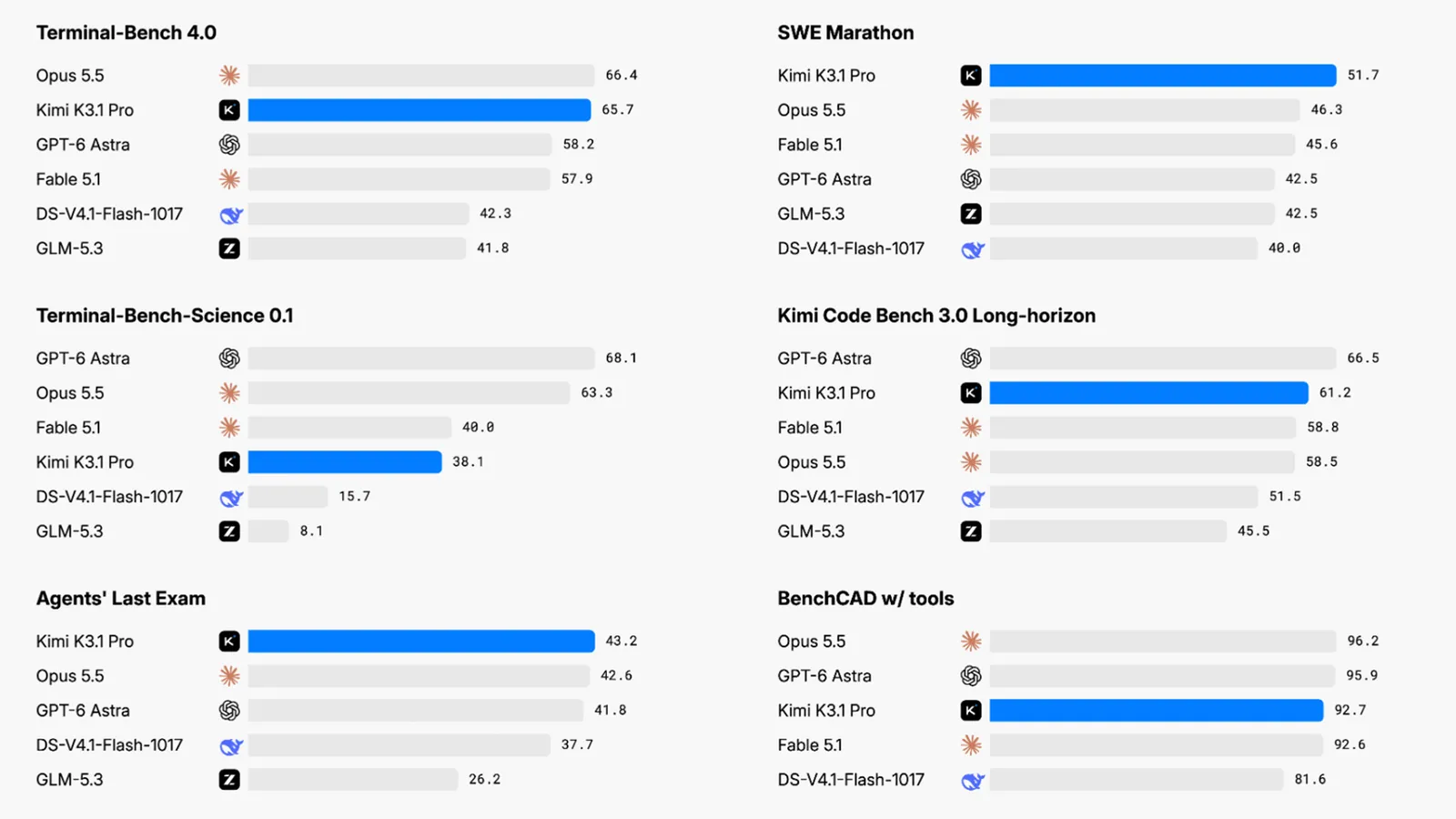
The Rundown: Chinese AI lab Moonshot just introduced Kimi K3.1 Pro, an upgrade to its July K3 model that it says is “matching the strongest proprietary models” on key benchmarks, with free-to-download weights set to come by Nov. 4.
Artificial Analysis placed it No. 4 overall on its Intelligence Index, beating OpenAI’s GPT-6 Astra and trailing only Anthropic’s 5.5 duo and Meta’s Muse Wonder.
In Moonshot’s tests, K3.1 Pro tops Opus 5.5 on hours-long coding projects, expert academic questions, document-heavy research, and real-world job tasks.
At $2 in/$10 out per million tokens, K3.1 Pro is priced like Sonnet 5.5, a fifth of Astra’s rate, but consumes tokens at a higher rate than its frontier rivals.
AA also ranks it the best openly available cyber-defense model, scoring 64% with no safety refusals, trailing just a GPT-6 variant available only to vetted defenders.
Why it matters: U.S. labs have kept their best hacking models locked down, but a Chinese model now sits just behind OAI’s gated cyber model. Dario Amodei gave defenders 6-12 months in May before Chinese models catch up, and K3.1 Pro is already near the top on defense — with open models’ attack skills also likely not far behind.
The Rundown: Megavendors still control enterprise software today, but for how long? With AI reshaping how apps are built and licensed, this Gartner webinar shows how to use SaaS renewals for flexibility, cut hidden API costs, and govern AI outcomes.
The Rundown: The Rundown Roundtable is a weekly feature where we poll members of The Rundown staff about how we use AI in our work and daily lives.
Jonah, Head of AI Education: My wife and I used ChatGPT to bring our vision for a new master bedroom to life instead of hiring a designer.
We started by sketching the basic layout, which ChatGPT rendered into a floor plan. We identified the wood, the type of cut we wanted, and the finishes. Then we had a detailed conversation about what we wanted the room to look like from each side.
For smaller details, we scanned Google Images and Pinterest for inspiration pictures and designs we liked. We used ChatGPT Voice for back-and-forth conversations and final tweaks, re-rendering the images as our ideas developed.
We took the final images to our contractor to help him understand the higher-level vision we wanted to achieve.
Jennifer, Tech & Robotics Writer: We’re narrowing down high school options for my daughter, who wants to focus on art. I’m using Astra to find public schools in our area and beyond with strong art programs and understand how they compare.
Astra can research school rankings and academic results, review art courses and facilities, and bring admissions requirements, portfolio expectations, fees, and commute times into one clear comparison. It can also suggest preparation classes—such as drawing, painting, digital art, or portfolio workshops—based on what each school expects.
From there, it’s helping me build a shortlist, organize open days and application deadlines, and prepare questions for school visits. We can work through the options together and find a school she’s excited about.
The Rundown: In this guide, you will use 1Password to approve an AI assistant’s login without pasting a password into chat. You’ll deny one request, test a small reading task, and check that access ends when you’re done.
Check whether your agent has the official 1Password connection. Muse and Grok Bot are rolling it out, while Claude has a separate Mac setup
Choose a test account with no private data or saved payment details. Save its login in 1Password and sign out in the browser the agent will use
Give the agent a page to read and rule out edits, messages, and purchases. Check the site and saved login in the 1Password request, then deny the request
Start again and approve the correct test login. Check that the agent reads the right page without changing anything or asking for a password in chat
Stop the task, sign out of the website, and remove the 1Password connection. Check the browser as well as the connection settings
Pro tip: Removing a password connection may leave a website signed in. Check both before you finish.
The Rundown: Have an ad that’s performing well? Or an ad format that inspires you? OpenArt’s Ad Remake makes it easy to create your own versions with your product, branding, and style — giving you more ads to test without starting from scratch.
Keep the hook, pacing, and structure that work
Swap in your product, characters, and language without reshooting
Adapt ads to 9:16, 16:9, 1:1, and 4:5 formats
The Rundown: Canva just launched Craft, the company’s first in-house AI image model, debuting at No. 4 on DesignArena’s crowdsourced leaderboard behind only three OpenAI models.
Craft was trained on millions of designer-made templates like menus, slides, and posters from the company’s own library.
The model plans each layout before drawing it with a two-step architecture, so images convert easily into editable designs via a Magic Layers feature.
Craft’s 1340 score on the DesignArena beats the top models from Microsoft, Google, and xAI, while also landing No. 1 overall in portrait and nature categories.
Craft is live for all Canva platform users and via public API, with MCP access for external assistants and agents also on the way.
Why it matters: Canva has an endless supply of training data, and Craft’s strong results show how powerful that can be for building an in-house model. While legacy competitors have been reeling amid the AI boom, Canva’s integrations and now its own AI model put near frontier-level image capabilities in front of 250M+ users on its own terms.
▸ Bridget built a gym log that updates itself every Friday
Today’s workflow comes from reader Bridget Overson:
“Every Friday at 10 a.m. ET, a scheduled Claude agent refreshes a living 'Hevy Workout Log' document with that week's strength-training data, body measurements, and a progress photo. The automation runs fully unattended, with no human in the loop after the owner sets it up.
The agent pulls information from three independent systems: the Hevy fitness-tracking API, a Google Drive photo folder, and the living document. It reconciles those sources against a date range, determines what's new versus already recorded, and writes structured, formatted updates in the correct places. This requires more judgment than a simple script or webhook.
Claude Docs, through a Claude Artifact, is the living document: it has one tab for each weekday and a Weekly Summary tab. There is no custom backend, database, or glue code. Because the workflow runs on a schedule without anyone watching, its specification requires a notification every time, including when nothing changed.”
See the workflow on our Community Workflow Hub →
What have you fixed or built with AI lately? Share your workflow, and you could be featured right here in The Rundown.
📶 Kimi K3.1 Pro - Moonshot’s powerful AI, with open-weights coming soon
🎨 Canva Craft - Canva’s first in-house image model, trained on design templates
⚙️ Duet - Anthropic’s Claude Opus 5.5-powered personal agent app
🧋 Boba - humans&’s AI assistant that lives in your texts or group chats
Microsoft’s Frontier Accelerate for Marketplace delivers hands-on expert support & $30K in Azure credits. Explore Premium & check eligibility now.*
Jack Dorsey’s Block unveiled Dessa, a realistic voice AI trained on audio recordings of people chatting without any text, and small enough to run on a high-end MacBook.
Anthropic lost two of Claude Code’s most visible builders ahead of its IPO, with desktop app creator Anthony Morris and Thariq Shihipar announcing their exits on X.
OpenAI’s AI hacking teams uncovered unknown security holes and sandbox breakouts in its training setup, after a model’s Sept. escape forced an 11-day pause on frontier training.
Anthropic’s deputy security chief Jason Clinton told security defenders to brace for 18 rough months and that things are going to get “a lot worse before they get better.”
Today’s AI tool guide: Let AI sign in without sharing your passwords
RSVP to next workshop on Oct. 28: Get consultant-grade deep research back
Rowan, Zach, Shubham, Jennifer, and Nate — the humans behind The Rundown
正文由 探How 从来源站点 RSS 同步,内容未经改写;遇到排版缺失或需要图片、视频时请以原文为准。