Artificial intelligence is capitalism's final destination
Artificial intelligence is capitalism’s final destination
以下正文同步自 Hacker News,版权归原站所有,已转换为易读排版。
Artificial intelligence is capitalism’s final destination
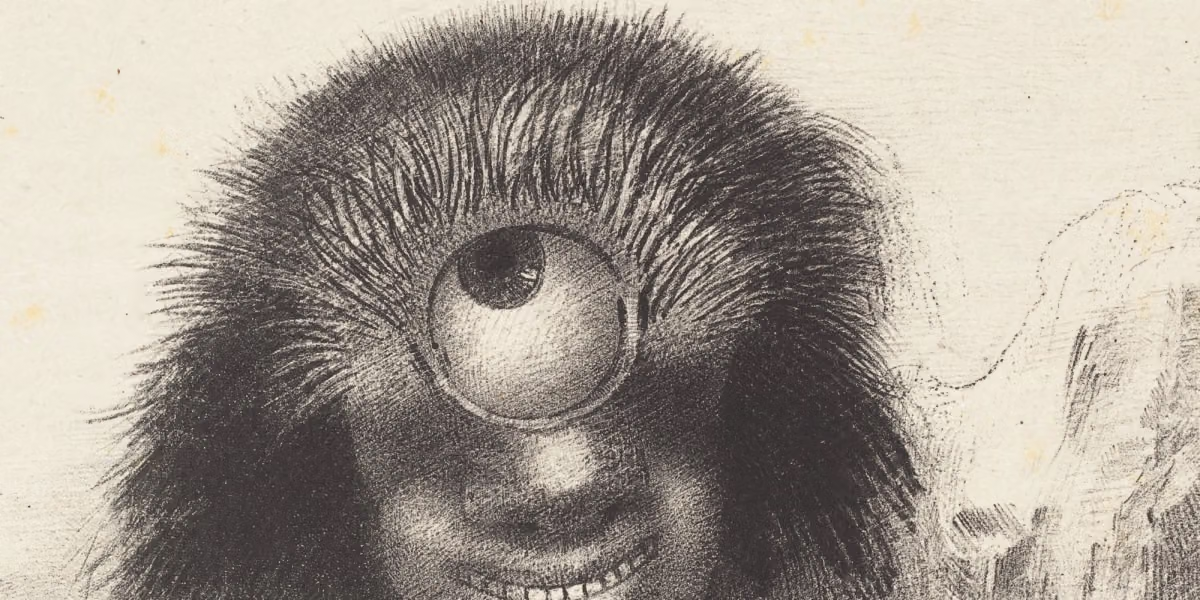
Odilon Redon: The deformed polyp floated on the shores, a sort of smiling and hideous Cyclops (1883) / National Gallery of Art
The auguries are raining down hard. Think or Sink. Comply or Die. Look Up or be Left Out. And so, with these not-so-gentle threats, it has come to pass that the Age of AI – Actual Idiocy, Actual Super Idiocy, Recursive Snowballing-Idiocy – is upon us. Heck, I’ve already used two dashes in this opening paragraph. That, as they say, is a tell. So, perhaps I haven’t written this essay at all. You’d have to use an AI app to check if it’s actually AI, and whether I’m really, or not really, or only partially me. You can no longer use your instincts. You have to use the App. Now that AI owns the em dash, what will future generations make of Emily Dickinson and her love of them? Has she been fed to the machine, too? Will they love her less? Are we being gradually locked out of language? Does it matter anymore?
For reasons that have more to do with a writer’s ego than with faith, I have always been enthralled by the first verse of The Gospel According to St John: “In the beginning was the Word, and the Word was with God, and the Word was God.” I believe this to be true. I believe that disrupting and vitiating the fundamental relationship between humans and language will undermine all semblance of social coherence.
AI has crashed into the world of literature, leaving writers, publishers, literary agents, readers, critics, teachers and students feeling the ground give way under their feet. Professors must now look at student assignments with distrust. Publishers have to evaluate new writers like detectives inspecting a potential crime scene. It’s hard to describe what this does to reading or learning. The joy and challenge of intellectual engagement has been replaced by something closed, mordant and mechanical. A taxidermists’ Shangri-La in which everything that was once alive has been skinned and stuffed, and regards you unblinkingly, with a meaningful glint in its bright, spurious eyes. It’s like looking at someone and wondering if it’s really who you think it is. Or looking in the mirror and seeing your likeness, but knowing it isn’t really you.
In time, we may forfeit that knowledge, too. Then we will no longer know who we are, or even if we are.
And when this happens to a whole society, a whole species, when we can no longer rely on instincts that have been learned over centuries, passed down from generation to generation, when we can no longer trust our hearts, our eyes or our ears, when we can no longer tell truth from falsehood or the virtual from the real, when time collapses and the past, present and future run into each other, when a million languages and cultures are pureed into glop, when an ancient social compact – whatever its limitations and flaws – is smashed beyond recognition, are we setting ourselves up for mass psychosis?
This line of thinking may open me to accusations of having fallen prey to the inevitable moral panic that ensues when we’re faced with something new and incomprehensible – the same panic that preceded the Industrial Revolution or the coming of the computer. The question is: is that all it is? Are we just living through an uncomfortable moment of transition in the evolution of human “progress”? Or is this indeed a catastrophic rupture?
Perhaps we should listen to the people who are building this glorious new technology. Last month, a young employee at Anthropic, Jacob Coxon, quit his job, saying that his conscience would not allow him to work on a project that could potentially annihilate the human race. The picture he painted of his workplace was more or less the Manhattan Project on steroids. But as we know, this time around the scientists are motivated in large part by profit and a race to “get there first”. What followed Coxon’s resignation was bewildering. The CEOs of the biggest AI companies fell over each other in their rush to discuss, disagree or concur with the whistleblower who had exposed them. Our screens blew up with videos of those billionaire oligarchs informing us in sombre, sepulchral tones that there was a fair chance that the Machine God they are in the process of consecrating could bring about the end of human civilisation.
Having established their suzerainty over our species, they reassured us that they were doing their best to mitigate the risk. They made a plea for government regulation. Their cry for help hinted at some sort of pathology. There was something a little kinky about it – a sort of Tie Me Up! Tie Me Down! vibe. Is it that, or is it just the inherent nature of capitalism? Helplessness in the face of untethered greed?
The oligarchs do seem to believe in their extinction narrative – at least enough to have built themselves bunkers at the far ends of the Earth stocked with water, food and ammunition. But extinction is not what they are selling the rest of us. (Donald Trump and tech libertarians openly call it a hoax.) Progress, glory and the good of mankind are the marrow of their sales pitch. One of them, Peter Thiel of Palantir, has even gone so far as to call critics and those calling for regulation the “Anti-Christ” who are courting the devil – by default conferring divinity on his company and its aspirations. (Yes, the same person who, when asked whether he believed that the human race should survive, famously replied “Ummm….” and went on to stutter and mumble.)
The crackle and pop eventually settled along faultlines that are familiar to tech insiders – doomers, accelerationists, skeptics. But when other voices speak up about the real, calamitous ongoing damage being done by the AI industry, they are deliberately ignored and shut out.
Interestingly, the oligarchs seem to be a lot more comfortable with Jacob Coxon than they are with some other whistleblowers. They did not rally in defence of Meredith Whittaker, now president of the Signal Foundation, who resigned from Google in 2019 after she called out its contract to build machine vision technology for US drones. Seven years later, that synthesis between the AI industry and the weapons industry is on display for all of us to see. (Cf. The US double-tap attack on a girls’ school in Minab, southern Iran, in February, in which 156 people including 120 schoolchildren were killed. No apologies were offered, because no one did it. Machine-planned murders come guilt-free. This is also true of Lavender, Gospel and Where’s Daddy?, the AI systems behind Israel’s assassination campaign against Hamas militants in Gaza, in which, according to human rights reports, the basic target unit for the locating and tracking systems was the family home.)
There was no outbreak of oligarch support when Timnit Gebru, one of the very few black women in a senior technical role in Silicon Valley, was fired from Google in 2020 for refusing to take down a research paper she had co-authored. The paper exposed the environmental costs of training large language models (LLMs) – including Google’s – and showed how they magnified and reproduced white supremacy and misogyny from the data sets they had swallowed whole. She warned that these pathologies would only be amplified as the models were scaled up and became harder to audit. Her findings were buttressed by another researcher, Abeba Birhane, who co-authored a paper called “On Hate Scaling Laws for Data-Swamps”.
Why would Whittaker and Gebru and their very specific indictments worry the oligarchs more than the prophets of all-out extinction like the AI scientist-turned-critic Geoffrey Hinton, or Jacob Coxon? Perhaps because, like a big fireworks display, Hinton and Coxon’s warnings add frisson to the atmospherics. They end up augmenting the oligarchs’ power play, which, when their companies go public, as they are set to do soon, will serve them very well indeed. Their valuations will depend on how sophisticated – and, in the case of AI weapons systems, how lethal – their models are.
Who are these billionaires who claim to hold the power of life and death over humanity? They give the impression that they have already disaffiliated themselves from the human race, and from this planet we call home. Are they satyrs? Half-human, half-machine? Let’s call them Cyclopes – “pees”, plural. Those giant, one-eyed, cave-dwelling shepherds from Greek and Roman mythology. (In the twenty-first century, their caves are opulent and their sheep are humans.)
Think of them as a single entity. A mutation. Cyclopes has a single head and a single pale, unblinking eye set into its forehead, way to the right of centre, which casts its jaundiced gaze on ordinary humans and sees only what miners see in a mineral-rich forest, or what dam builders see in mighty, flowing rivers. A resource to be extracted, accumulated and put on the market. Fuck the forest. Fuck the river. Fuck the human.
But unlike the silent, blundering cyclops we saw on our cinema screens recently, Cyclopes branches at the neck into several squabbling bodies that give the impression they don’t get along, but, when it comes to the End Times – or, more precisely, End Times Fascism, to borrow the title of Naomi Klein and Astra Taylor’s magnificent new book – they clearly do.
Cyclopes’ extinction orgy appeared to many industry watchers as a set piece staged to persuade an increasingly angry, agitated public how central, important, irreducible and un-roll-backable AI companies are to the US economy, and to the security and future of its people.
Asking to be regulated is an attempt to graft the industry onto the state, to shut out every last chink of daylight between the government and these corporations. The oligarchs’ hope is that this regulatory embrace will give them the blank cheque they so badly need. Because the scale of money, land, water and energy that they require can only be provided by the government. Not to put too fine a point on it, what they really want is government permission to self-regulate. Legitimacy without ceding control.
This sort of delicate manoeuvre needs to be performed like a kabuki play. It needs a villain, a bogey man, to scare an increasingly restless public, and any incoming governments who may not be as malleable as the Trump regime.
To protect the US from the threat of a rising China, Cyclopes offers the US government an array of lethal autonomous weapons systems that other countries cannot dream of, as well as the fantasy of lab-grown viruses and bioweapons thus far unknown to science. To contain and align restive populations domestically, it offers the US and other friendly governments surveillance and facial-recognition systems that promise to make Israel’s Pegasus spyware look like a toy. In return, it demands unimpeded capital flows, and the promise of as much land, water and energy as it needs to service its giant data centres and supercomputers.
Translated into direct speech, it goes something like this: we’ll market ourselves as the cutting edge of human enlightenment, and the manager and disburser of human knowledge sans frontières. But in truth, we’ll be map-shaped. We’ll fuse ourselves to our nation, its economy, its intelligence grid and its security apparatus until you won’t be able to tell us apart from yourself. Except for our bank balances. In exchange, you can pretend to regulate us until we achieve our mission to colonise the moon and outer space. No frontiers, no fears. Then we’ll kick away the ladder that you so kindly lent us. We won’t even need to replace you. You simply won’t exist. We will run your people, your cities, your communications, your finance systems, your courts, your army and your police. If not us, it’ll be China that runs you.
These pleas by the major US-based AI corporations for government regulation also serve to foreclose competition by smaller players, so that when international treaties on AI are signed (as they must be),
正文由 探How 从来源站点 RSS 同步,内容未经改写;遇到排版缺失或需要图片、视频时请以原文为准。