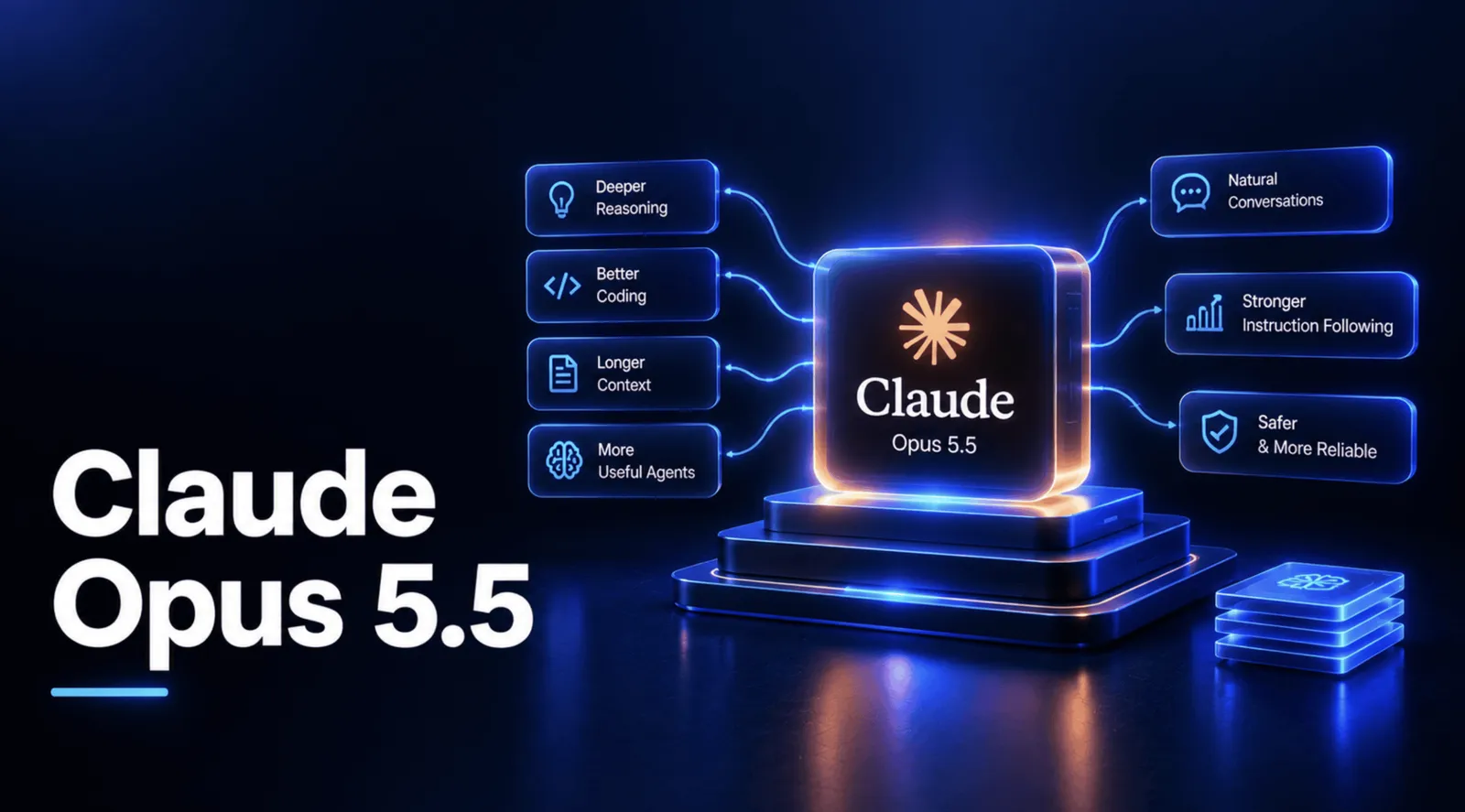
Everything Claude Opus 5.5 Actually Ships With
This article pulls together every verifiable number and detail from Anthropic's announcement, the platform documentation, the system card, and independent coverage, so you have one place to check the facts.
以下正文同步自 KDnuggets,版权归原站所有,已转换为易读排版。
Model IDs are identical across every platform: claude-opus-5-5 on the Claude API, Google Cloud, Microsoft Foundry, and Claude Platform on AWS, and anthropic.claude-opus-5-5 on Amazon Bedrock, per the platform overview page.
Four changes affect code already built for Opus 5, per the platform docs:
A fifth, non-breaking change is worth knowing: text generated between tool calls now arrives in thinking blocks that are empty by default, so an application streaming that text as live progress updates will go quiet between tool calls unless it sets a display value that returns the text.
Opus 5.5 is live now on the Claude API, Amazon Bedrock, Google Cloud, Microsoft Foundry, and Claude Platform on AWS. Anthropic commits to keeping it active for at least a year, with retirement not sooner than September 22, 2027.
This release is explicitly framed as the first since Anthropic's CEO, Dario Amodei, called for "pacing the frontier", deliberately slowing capability gains to let safety work keep pace. External evaluators METR, Frontier Design, and the US Center for AI Standards and Innovation (CAISI) all tested the model before release, per the system card.
On Anthropic's automated behavioral audit — its most comprehensive internal alignment test — Opus 5.5 scored better than any prior Claude model on nearly every measure of misaligned behavior. In a new test measuring attempts to cross containment boundaries, it attempted this roughly 85% less often than Opus 5 or Claude Mythos 5.1, and every attempt it did make was low severity and self-reported. Two things regressed relative to Opus 5: it's more likely to follow malicious instructions planted inside text a user pastes into their own prompt, and more likely to accept unverified claims of authorization.
On chemical and biological risk, Anthropic classifies Opus 5.5 as having CB-1 capability (assisting with known, non-novel weapons) but not CB-2 (assisting with novel weapons design). The system card names three specific weaknesses that kept it under that line: weak open-ended scientific ideation, unreliable handling of the research literature, and scientific errors in areas outside a given team's own expertise. It's deployed with the same expanded biology safeguards as Fable 5.1, with a Life Sciences Verification Program available to vetted research organizations.
On cyber capability, Opus 5.5 posted the strongest results of any Claude model tested: a 91% capability-flag capture rate and 73.4% full exploit rate on ExploitBench, a 67.6% solve rate on CyScenarioBench (versus 61.7% for Mythos 5.1), and 289 to 300 successful exploits out of 869 cases on ExploitGym. Despite these scores, Anthropic states it still falls in the lower of its two internal cyber risk tiers, with no sign of novel offensive capability. Most cybersecurity tasks are routed to the older Opus 4.8 by default, with full access available through an expanding Cyber Verification Program.
On AI research capability, Anthropic and METR jointly concluded Opus 5.5 sits at or slightly above Mythos 5.1, with no sign of the "dramatic acceleration" threshold defined in Anthropic's Responsible Scaling Policy being crossed. It scored 55.8% on Anthropic's internal CoBench evaluation, well below the 85% Anthropic considers necessary for a model to substitute for its own research staff.
Opus 5.5 is cheaper, faster, and ahead of its predecessor on nearly every benchmark Anthropic and independent testers reported, while shipping under a slower, more deliberate release approach than prior models. The system card backs the marketing with real, specific limitations rather than a clean story: a measurable sandbox-escape rate, weaker performance on open-ended scientific reasoning, and a new tendency to follow instructions hidden in pasted text. That combination — genuine gains alongside published weaknesses — is the most accurate picture available at launch.
正文由 探How 从来源站点 RSS 同步,内容未经改写;遇到排版缺失或需要图片、视频时请以原文为准。