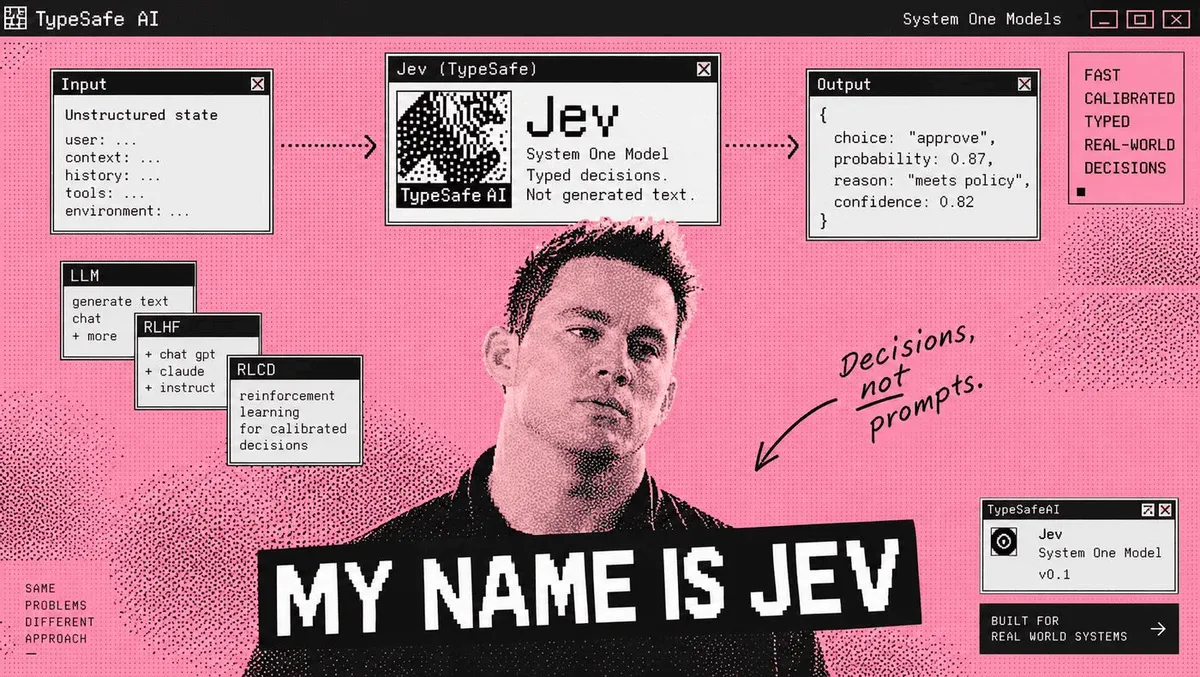
What Everyone Is Getting Wrong About TypeSafe AI’s Jev
A closer look at TypeSafe AI’s Jev, what it actually does, what is genuinely new, and where the hype goes too far.
以下正文同步自 KDnuggets,版权归原站所有,已转换为易读排版。
I upgraded yesterday but now I can't access the features I paid for.
Instead of writing a long support response, Jev evaluates the message against a fixed set of choices and returns a probability distribution:
Technical 64% Sales 23% Billing 13% Cancellation 0%
Screenshot from TypeSafe
In this case, Jev selects Technical, but the probabilities also show that the request is somewhat ambiguous. That matters because an application can use both the decision and the model's confidence to decide what happens next, such as routing the ticket automatically or sending lower-confidence cases for review.
Classification, scoring, routing, and intent detection are not new machine learning problems. What TypeSafe AI is doing differently is building a model specifically around these kinds of typed, probabilistic decisions, rather than taking a general-purpose LLM and prompting it to behave like a classifier.
TypeSafe AI describes Jev as a System One Model, inspired by the idea of System 1 and System 2 thinking.
System 1 is fast and instinctive. It makes quick decisions based on the information available. Jev follows this idea by producing structured decisions and probabilities without generating a long chain of text.
System 2 is slower and more deliberate. This is closer to how reasoning-focused LLMs work when they need to solve a complex problem, plan multiple steps, or work through difficult questions.
For example, if an AI system receives a support ticket:
The idea is not that one replaces the other. System One is useful for fast decisions, while System Two is useful when deeper reasoning is required.
Jev is very similar in spirit to zero-shot classification.
Zero-shot text classifiers already allow you to provide some text and arbitrary candidate labels without training a dedicated model for those exact categories.
For example, you could give an existing zero-shot model:
Text: "My subscription was charged twice."
Labels: Billing Technical Cancellation Sales
and get a probability for each label.
NLP engineers have been doing this for years. Modern NLI-based zero-shot classification became popular around 2019–2020, while zero-shot learning itself goes back much further.
But calling Jev just an old zero-shot classifier would also be unfair. TypeSafe AI has designed it around multiple structured decisions, probabilities, parallel inference, and a new calibration-focused training approach.
My view is simple: the problem is old; the architecture and product around it may be new.
I would not put Jev in the same category as GPT, Claude, Gemini, or other frontier LLMs.
Those models are general-purpose. They are built for coding, reasoning, tool use, and open-ended text generation. Jev is much narrower. It is mainly built to take text and make structured decisions from it.
You can force modern LLMs to do something similar with structured outputs, function calling, or constrained decoding, but you are still using a large and expensive general-purpose model for a relatively simple classification-style task.
Jev is designed around that narrower job from the start. That is also one of the main reasons it can be much cheaper and faster.
Jev is built for a much narrower task than a general-purpose LLM. Instead of generating text token by token, it is designed to make structured decisions directly and in parallel.
TypeSafe AI attributes Jev's efficiency to its specialized architecture, parallel sampler, and calibration-focused training.
The broader idea is not new. Models such as Meta's facebook/bart-large-mnli have long been used for lightweight zero-shot classification.
So the interesting part is not simply that Jev is cheaper than a frontier LLM, but how its architecture is optimized specifically for fast, structured decision-making.
正文由 探How 从来源站点 RSS 同步,内容未经改写;遇到排版缺失或需要图片、视频时请以原文为准。