ML Engineer, AI Engineer, or LLM Engineer: Which Role Actually Builds What in 2026?
Same job postings, different titles. Here's what each role actually builds.
以下正文同步自 KDnuggets,版权归原站所有,已转换为易读排版。
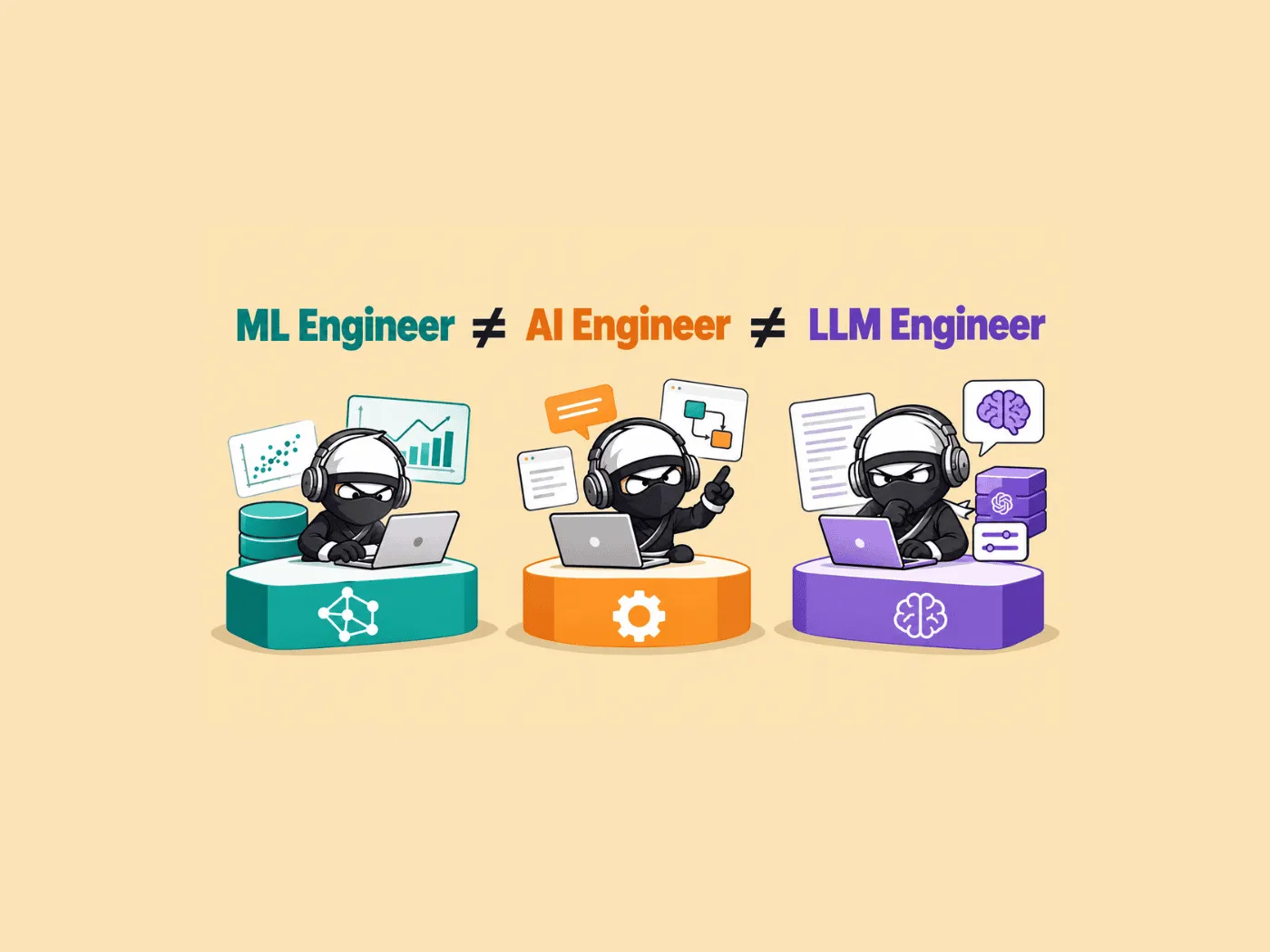
A machine learning engineer builds and trains a model from data. A data scientist explores that data and prototypes an approach; the machine learning engineer takes the validated approach and turns it into something that runs reliably in production, at scale, on new data it hasn't seen before.
An AI Engineer starts one step later. The model already exists, usually a large model someone else trained and exposed through an API. The AI Engineer's job is to connect that model to a real product: a support tool, an internal search feature, an agent that completes a multi-step task.
An LLM Engineer is a narrower version of the AI Engineer role, focused on one category of AI rather than AI broadly (computer vision and recommendation systems are AI too, just not language models). The added responsibility is fine-tuning: adjusting a pretrained model's own weights for a specific use case.
Here's what the daily work behind each of those three definitions actually looks like.
A machine learning engineer's core loop looks the same across most companies: collect and clean data, choose an algorithm, train it, validate it against metrics like RMSE or a confusion matrix, deploy it, then monitor and retrain it as new data arrives.
The tools are Python, PyTorch or TensorFlow, scikit-learn, and a feature store like Amazon SageMaker or Databricks. The output is usually something specific: a recommendation system, a fraud detection model, a demand forecast, a fraud score attached to every transaction.
Most of the actual time goes into data, not algorithms. Bad grain, leaked labels, or a poorly designed feature window will break a model long before the choice of algorithm does. Our own breakdown of what a machine learning engineer does goes into this in more detail, including why the role sits closer to applied data science and software engineering than to pure research.
An AI Engineer's day splits roughly like this: a large chunk on prompt design, retrieval, and connecting to a language model; a smaller chunk on evaluation and monitoring for hallucinations or quality drops; some standard backend work, APIs and databases; and the rest on prototyping and writing things down for other teams.
The tools are Python or TypeScript, LangChain, LangGraph, or LlamaIndex for orchestration, and a vector database for retrieval like Pinecone or Qdrant. Nobody here is training a model from scratch. It's a common misunderstanding between expectation and reality in the field: people take the job expecting to train models, then end up spending most of their time fixing data pipelines and rewriting prompts.
That's the honest version of the job. The work starts after a model is trained and validated, and it ends when that model reliably serves real users instead of one impressive demo.
An LLM Engineer does most of what an AI Engineer does, plus one thing most AI Engineers don't touch: fine-tuning. Using techniques like LoRA or QLoRA, they adjust a pretrained model's weights on a domain-specific dataset, usually because a general-purpose model doesn't perform well enough on a narrow, specialized task.
Good LLM Engineers spend more effort ruling out fine-tuning than doing it. Better retrieval, a longer prompt, or a different base model often solves the same problem for less money and no ongoing maintenance burden. They try those first and reach for fine-tuning only after ruling out everything else.
正文由 探How 从来源站点 RSS 同步,内容未经改写;遇到排版缺失或需要图片、视频时请以原文为准。